Showing posts with label random. Show all posts

Wednesday, May 1, 2024

On the Waterfront: Random Encounter Tables for High Seas

The Flashing Blades maritime supplement High Seas introduces six additional character backgrounds - colonial versions of the Rogue, Gentleman, and Soldier plus three new backgrounds, Marine, Sailor, and Pirate - as well as numerous new ranks, such as Gunner's Mate, Sailmaster, Ship's Pilot, or First Mate. HS also includes an encounter table for encounters at sea, aimed primarily at the waters on either side of the Atlantic Ocean; I took it upon myself awhile back to create a table specific to the Mediterranean Sea.

While High Seas covers encounters at sea, there are no new tables to add encounters ashore incorporating the introduced backgrounds, so I took that on myself to remedy.

Encounter Tables


Roll (d20) Encounter on a Quay
1 1D6 Sailors
2 1D6 Smugglers
3 A Merchant Captain (a possible Patron)
4 1D6 Merchants
5 A Wealthy Ship Owner (a possible Patron)
6 1D6 Dockworkers
7 1D6 Fishermen
8 A Wealthy Merchant (a possible Patron)
9 1D6 Marines
10 A Knight-Captain and 2 Chevaliers
11 An Investor and 1D6 Clerks (a possible Patron)
12 A Food Seller and her handcart
13 A Cartographer
14 A Warship Officer (a possible Patron)
15 1D6 Sailors
16 1D6 Boatmen
17 A Ship Chandler
18 1D6 City Guards
19 A Magistrate an 1D6 Lawyers
20 1D6 Pirates

Roll (d20) Encounter in a Port Tavern
1 A Barmaid
2 1-3 Merchant Officers carousing
3 1-3 Dockworkers
4 1-3 Sailors
5 A Wealthy Merchant Captain (a possible Patron)
6 1-3 Gamblers
7 A Knight-Captain and 2 Chevaliers (a possible Patron)
8 A Disguised Nobleman (a possible Patron)
9 A Pickpocket
10 A Master Gambler
11 A Master Gambler who cheats
12 A Rowdy (brawler)
13 1-3 Rowdies (brawlers)
14 1D6 Rowdies (brawlers)
15 1-3 Marines
16 A Warship Officer (a possible Patron)
17 A Drunk
18 A Ship Owner (a possible Patron)
19 The Tavernkeeper or Manager (a possible Patron)
20 A Smuggler (a possible Patron)

Notes -
  • "A Knight-Captain and 2 Chevaliers" may represent knights of one of the military orders active against the Barbary corsairs or the Sallee Rovers, such as the Holy Order of Saint John of Jerusalem - the Knights of St, John, based on Malta - or the Order of San Stefano, based in Tuscany.
  • Hopefully most of the occupations are self-explanatory, but here're a couple of notes just in case: "Boatmen" are the boatswain (or bo's'n) and oarsmen of what High Seas calls a jolly boat; "Ship Chandler" is a merchant who specializes in supplies for ships, everything from ropes and sailcloth to pitch and varnish.
  • These tables, like the ones in the Flashing Blades core rules, provide the opportunity to flex the referee's creativity; frex, consider that a "Rowdy" or a "Drunk" could be a sailor, a pirate, a dockworker, a smuggler, a marine, a boatman, a rake, a plantation owner, a rogue, and on and on.

I know to a lot of gamers these and the Flashing Blades encounter tables on which they're based are thin to the point of emaciated, but I love how much they leave to interpretation and personalization. It's rare for me to find a commercial product that I can plug'n'play, so inspiration is much more important to me, particularly given the way I like to use the FB encounter tables.

Monday, September 16, 2013

Lazy Monday Link Dump

Rough night last night, and I'm wiped tonight. Going a night without sleep wasn't a problem when I was younger; now, I'm wrecked the next day.

Nate at d20 Pirates has a simple set of system-free rules for handling dehydration and starvation - being marooned on a desert island gets nastier, more brutal, and much, much shorter.

DHBoggs at Hidden in Shadows explores the similarities between D&D magic and the magic found in Shakespeare. I really enjoyed this post.

Eric Treasure at The Dragon's Flagon has a great post on the diverse interpretation of reaction rolls - another great random tool.

And last, at Bayuca, the blog I want RBE to be when it grows up, is a (p)review of A Field in England, a combination historical thriller and psychodelic movie set during the English Civil War. Any further explanation would be wasted - just click the link and check out the trailer.

Thursday, September 12, 2013

Dividends

Random tables, at their best, inspire, and creating random tables is a way of banking inspiration for a rainy day.

Last weekend one of my non-player characters, the vicomte de Bouvard, hosted a fencing exhibition with the adventurers as his guests. A series of mock duels, with blunted swords and padded doublets, ensued, culminating in a match between Riordan O'Neill, recently appointed fencing master to the King's Musketeers, and Lieutenant Ponceau, fencing master to a company of musketeers in the Picardy Regiment.

I knew the duel between Riordan and Ponceau would be epic; one of the features of the dueling rules in Flashing Blades is that it's very difficult for a pair of master fencers to actually hit one another, and with the constraints of the 'exhibition' - no brawling, no dirty tricks - basically it would come down to fumbles and perhaps fatigue.

But in creating Ponceau, I figured out another tactic, taken from the second entry from annoying habits of duelists random table. Ponceau was given a high Endurance score and the Carousing skill, granting him a considerable capacity for drink. When the duel opened, Ponceau immediately called for a glass of wine for both men, tossing the empty glasses into a nearby fountain. And did so again after a touch by Riordan. And after a particularly elegant exchange of attacks and parries.

In short order, Riordan, the better fencer, was drunk and his advantage reduced. With each subsequent round of toasts, he struggled simply to stay awake and on his feet, eventually winning the contest despite his besotted state and adding to his burgeoning reputation as the best swordsman in France.

The simple act of writing stuff down pays dividends.

Monday, September 9, 2013

Random Encounters Coda: Order from Chaos

Alexander Macris, lead designer of Adventure Conqueror King System and co-founder of The Escapist magazine, published an article on the art of abductive reasoning in running a roleplaying game.
The foremost philosopher of abduction, Charles Sanders Peirce, summarized abduction as follows:

The surprising fact, C, is observed;
But if A were true, C would be a matter of course,
Hence, there is reason to suspect that A is true.

For instance, assume the surprising circumstance that my car won't start this morning. If it were true that my car battery were dead, then the fact that my car won't start would be a matter of course. So there is reason to suspect (abduce) that my car battery is dead.
Noting that abduction is the opposite of cause-and-effect - the effect is observed, and a cause suggested - the article goes on to describe the relationship to roleplaying games.
The art of abduction depends on having a set of "weird facts", that is, a circumstance you need to explain. Fortunately, such facts are never in short supply. Indeed, the easiest and most accessible method of brainstorming available to any gamemaster is random generation of facts.
I've been doing this for as long as I've played, but I never knew it had a name.

Thursday, August 15, 2013

How to Referee, Part Two

I ran an all-too-brief Traveller campaign about eight years ago, a bog-standard space-merchants-with-a-mortgaged-free-trader-and-a-mountain-of-debt. As part of my prep, I worked on a table of events associated with speculative trading, to use in conjunction with the Actual Value table in the rules for trading.

For those of you unfamiliar with Traveller, merchants can transport other people's goods, but at best that will keep you living on the edge of a potential repo. Speculation - buying your own cargo on one planet and selling it on another- is riskier but offers by far the best potential for profit. The Actual Value table is consulted when buying and selling, and provides a percentage modifier to the base price of the cargo; if the base price of a ton of wheat is 500 ImpCr, and the Actual Value table result is 80%, you can purchase it as 400 ImpCr per ton.

What I wanted for my campaign was an additional table, that provided modifiers to the Actual Value roll, stuff like, 'Market saturated, - 2 ,' or, 'Sudden demand, + 1,' to add flavor to the results. I worked out a d6, d6 table of results, but it still seemed bland to me, so I and showed it to a buddy of mine. He ran his Traveller campaign for something like fifteen or sixteen years at that point, and he regularly had far more players looking for seats around his table then he did chairs to accommodate them. I knew his critique would be helpful.

He looked over the table, then put it aside and grabbed a pair of six-sided dice. 'You have a cargo of cybernetic parts and you're on [planet name], an agricultural world, jump-three from the industrial world of [planet name]' he said, tossing the dice on the kitchen table. A three. 'Fifty percent,' he continued - there was no need for him to look up the Actual Value chart, as he knew it by heart - 'an Oberlindes Lines bulk carrier arrived a week ago, and the market is flooded.' He picked up the dice again, and tossed them once more - a ten. 'One hundred thirty percent. Looks like those LSP robotic harvesters that arrived six months ago are acting up, and the replacement parts haven't arrived yet, so there's a price bump.' Another roll - a twelve. 'One hundred seventy percent. Not only is demand high for parts for those harvesters, your broker just found a loophole in the tariff code.' He tossed the dice a couple more times, each time improvising an event from the memorised table of generic percentages.

'It's already in there,' he finished with a smile.

Thursday, February 7, 2013

Annoying Habits of Duelists

Roll 1D20 -

1. Repeats, "You killed my father! Prepare to die!" even though you've never met his father.

2. Insists on a small glass of claret between every pass.

3. Arrives without a sword; asks to borrow yours.

4. Whistles the same two bars of a song over and over again.

5. Repeatedly calls a halt to adjust her ill-fitting mask.

6. Reeks likes the bilge-water in a fishing boat, bringing tears to your eyes.

7. Throws whatever's at hand at you: seat cushions, sticks, silverware, small rocks, pieces of bread, &c.

8. Refuses to cross blades until a priest is present to provide the sacrament of extreme unction.

9. Shrill incessant laughter.

10. Demands that wine corks be placed on the tips of the blades.

11. Offers to flip a coin instead.

12. Refuses to acknowledge touches, even while bleeding profusely from multiple wounds: "That's a wine stain! Have at you!"

13. Brings a pistol to a sword fight.

14. Sneezes and coughs on you throughout the duel; will refuse any delay, insisting that he's getting better.

15. Attempts witty repartee, manages only schoolyard taunts.

16. Stops every few passes to change swords from a long leather bag and confer with his second on tactics.

17. Insists on a postponement: the ground is too soft, the sun is too low, the air is too damp, &c.

18. Interrupted by a stream of messengers with papers to sign, questions to answer, &c: "Sorry, this will only take a moment . . ."

19. Attempts to slash his initials into your clothing, succeeds only in tearing up your coat and vest.

20. Roll twice - this one's really annoying.

Friday, February 1, 2013

Off the Shelf: Law Books

From time to time adventurers may find themselves in libraries and other places where books can be found. Some players will want to know exactly what's on those shelves, so with that in mind, Off the Shelf consists of lists of book titles for the referee to use in rolling or choosing exactly what the adventurers find.

Law books may be found on the shelves of lawyers, magistrates, bureaucrats, burghers, and members of a bishop's curia as well as some merchants and bankers. Roll 1D6 for the number of books, then roll 1D20 for the individual titles. Duplicate rolls may be treated as additional copies of the same volume or re-rolled at the referee's discretion.

1. Mare Liberum, Hugo Grotius
2. Opera sacra juridica his orica miscellanea collecta, Pierre Pithou
3. Extricatio labyrinthi dividui et individui, Charles Dumoulin
4. Tractatus de legibus ac deo legislatore, Francisco Suárez
5. De iure belli, Hugo Grotius
6. Les Six livres de la République, Jean Bodin
7. De feudis commentatio tripertita: hoc est, Disputatio de jure feudali, Commentarius in usus feudorum, Dictionarium verborum feudalium, François Hotman
8. De la Souveraineté du Roy, Cardin Le Bret
9. The First Part of the Institutes of the Laws of England, or, a Commentary upon Littleton, Sir Edward Coke
10. De magistratibus et republica Venetorum, Gasparo Contarini
11. Juris civilis Schola Argentinensis, François Baudouin
12. Corpus Juris Civilis, Justinian (edited by Denis Godefroy)
13. Commentaires sur le Digeste et le Code et des traités particuliers, Hugues Doneau
14. Codex Fabrianus definitionum forensium, Antoine Favre, baron of Pérouge
15. Treatise on Tenures, Sir Thomas de Littleton
16. Institutions au droit des Francois, ou Nouvelle Conférence des Coutumes de France, Guy Coquille
17. Questions et responses sur les Coutumes de France, Guy Coquille
18. De legibus connubialibus, André Tiraqueau
19. Commentarius de pactis, François Douaren
20. Coutumes de ____________, various

Note: Coutumes are collections of customary law, specific to a region of France and often dating back to the Middle Ages. Examples include the Coutume de Paris and Coutumes de Beauvaisis.

Friday, January 25, 2013

Friday, December 14, 2012

Random Encounters: Rory's Story Cubes, Redux

In a thread I started at Big Purple about Rory's Story Cubes, Graham Bottley - the guy who brought back the classic Elizabethan roleplaying game Maelstrom and authored The Maelstrom Companion among other works - linked a solo roleplaying game, The 9Qs (pdf), which uses the story cubes to drive the action.

The 9Qs was created by JF at Solo Nexus, who helpfully supplies an actual play example as well - one of many, actually - on his blog.

I was surprisingly happy with using Mythic Game Master Emulator for solo play, but I'd like to try out The 9Qs at some point as well.

Thursday, December 13, 2012

Random Encounters in Real-time: the Verbal Kint Method

Over the last couple of weeks, I've written at some length over the many ways in which I put together random encounters for my campaign. Most of my random encounters are prepped away from the table: my goal when I prep a location, from sites as small as a tavern to as large as a province, is to include at least a handful of chance encounters so that it's ready to run at any time. But best-laid schemes gang aft agley: actual play means facing a knee-buckling curve thrown by my the players, and that means improvising in real-time.

In a post at EN World, Ethan Skemp coined the phrase "Verbal Kint method of GMing" to describe a method of preparing random encounters.
I'm intrigued by randomness because I'm always keeping an eye out for potential structure that can help me move things along when I don't have an immediately fantastic idea, or an immediately obvious way in which a situation will play out. Sometimes that structure is rolling a die and then making myself hold to some interpretation of what the die roll means. Sometimes it's drawing in structure from an external source: running a St. Patrick's Day-themed game, for instance, wherein I may have to figure out a way to make something leprechaunish relevant while concealing the source from the players. Or basing villains off tracks on a semi-randomly chosen album and never letting the players know.

Call it the Verbal Kint method of GMing, I guess: find some structure in the world around you to act as a skeleton, let the logic of the game world add flesh and blood and skin, and there you go. The extra structure means you're often trying out new things, and adhering to it is good discipline.
(Fair warning: if you haven't seen The Usual Suspects and you want to be surprised by the ending, you're forewarned that the video and the rest of the post contain spoilers.)


Through this series of posts I've been using the structure provided by the rules for encounters and events from a variety of different games - Flashing Blades, Rory's Story Cubes, Backswords & Bucklers, Robots & Rapiers, Mythic Role Playing - as a tool for preparing the chance encounters which populate my game-world. The encounters I generated are not only random in their appearance in actual play, but by the process of their creation as well. The 'external structure' provided by a die roll, or a shuffled track on my iPod, or an adventure scenario generator, helps me to break out of the creative ruts into which my mind might otherwise settle. But, while well suited to advance preparation away from the table, some of these methods are admittedly a bit impractical to use in real-time, with the players waiting expectantly.

So, how would I go about Verbal Kint-ing an encounter at the table?

When called on to improvise in actual play, most of us pull from our knowledge of the game-world and the context of the adventurers' present circumstances. There are any number of external structures from which we could also draw inspiration, from music playing in the background to miniatures on the table to a passing comment from one of the players to the weather outside. But absent a bulletin board covered with wanted posters and dispatches and a porcelain coffee mug, I've found one source to be particularly useful and relevant to the task: the rule book.

If I'm working from my actual printed copy of Flashing Blades, this is particularly easy - the random encounters are located at the back of the book, so I simply flip through the pages, and the first three pages at which I stop are my inspiration. If I'm working from my pdf of the rules, on the other hand, I program three '1d24' into my random roller, take the first result as the first page, add the first two results for the second page, and add all three results for the third page.

Going back once more to the random encounter tables, my roll of 1d20=12 on the Encounter at Palace table is, "A Bishop, with 1d6=2 Curia Members (a possible Patron)" - his Patronage roll is 1d20=8, "The Patron wishes to have a message taken to someone in a dangerous position (a prisoner in the Bastille, perhaps, or a soldier on the front)."

Now I scroll through the rulebook. The page numbers are 1d24=20, 1d24=13, 1d24=4. Page twenty is from the combat rules section and along with several special attacks, it introduces the dueling code and features a striking woodcut of a duelist standing over a vanquished foe on a beach. Page 33 describes upper positions in the royal bureaucracy - magistrates, provincial governors, ambassadors, court ministers, and royal ministers. Page 37 describes the careers of bankers and investors.

Putting it together, the bishop of ____________ knows of the adventurers on the basis of their dueling exploits. He invites them to dinner. Through the meal, the prelate makes inquiries about the adventurers' exploits, as well as bits of court gossip, to test their honor and reserve, and if he's satisfied they are men of discretion, the bishop will explain that he seeks trustworthy messengers to carry a letter to a Flemish banker in Antwerp - Dutch ships and soldiers have recently attacked outworks around the city, and the journey is expected to be perilous. The bishop offers the adventurers a generous reward for their service.

The letter? A bank draft for the purchase of tulip bulbs, drawn on the diocese's accounts - the bishop is speculating in foreign commerce using Church funds.

And with that my series on random encounters, randomly created, concludes. It's not necessary, or even desirable, to do this for every chance encounter the adventurers face - there's nothing wrong with "Orcs (1-4)" or "1D6 Highwaymen" playing out exactly as advertised. But chance encounters need not be 'ran-DUMB,' either. In my campaigns, chance encounters represent the living game-world around the adventurers, and by generating the content randomly, in or out of actual play, I force my imagination to turn the corners on familiar paths in search of undiscovered country.

Tuesday, December 11, 2012

Random Encounters: Mythic Role Playing

I've written at some length about using Mythic Game Master Emulator as a refereeing tool and for solo play. Today I want to follow up on yesterday's post, using the emulator to identify complications arising from a random encounter, and then look at how Mythic Role Playing handles random events.

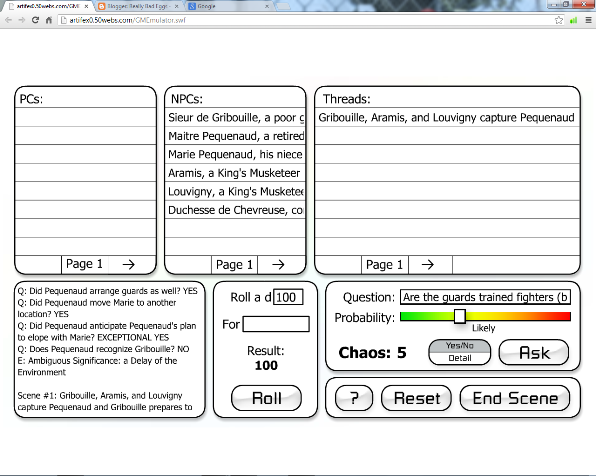
While most of my random encounter prep is done away from the table, out of game, one of the best features of the GME is that it can be used in real-time, at the table, during actual play. If a situation arises in game for which I don't have a clear-cut. obvious answer, or when a number of possibilities are more-or-less equally likely, I often kick the question to the GME - I keep the flash-based emulator open next to my wiki on my laptop when I'm running the game.

From yesterday's scenario, I learned that wealthy vintner Maître Péquenaud stands between his niece and the poor gendarme Gribouille, and that the duchesse de Chevreuse plans the capture of Péquenaud to give Gribouille and Marie a chance to elope. I want to develop some potential consequences from this, and since there are a number of ways I could see this go, I'm going to fire up the flash GME and see what it spits out by way of complications.


After establishing the characters and the the thread - who's involved, and why - the emulator immediately kicks back an event, a "delay of the environment" of "ambiguous significance." I interpret this to mean that a sudden storm delays Gribouille's attempt to get to Marie - this prolongs the duration of Péquenaud's imprisonment, increasing the chance of discovery or perhaps giving him an opportunity to escape.

Now, I start asking questions about what happens next - the probability is shown in parenthesis.
Q: Does Pequenaud recognize Gribouille? (Likely) NO - apparently Péquenaud is flustered enough that he doesn't recognize one of the 'masked ruffians' as his erstwhile future nephew-in-law; Gribouille catches his first break.
Q: Did Pequenaud anticipate Gribouille's plan to elope with Marie? (Likely) EXCEPTIONAL YES - forced to leave Marie home with this wife, Péquenaud anticipated that Gribouille might try something; the "exceptional" nature of the answer increases the scope of his potential preparations by increasing the probability of future answers (e.g., from "Likely" to "Very Likely").
Q: Did Pequenaud move Marie to another location? (Very Likely) YES - the obvious location to stash a single girl to protect her from marriage abduction is, of course, a convent.
Q: Did Pequenaud arrange guards as well? (Very Likely) YES - suspenders AND belt.
Q: Are the guards trained fighters (bravos, soldiers)? (Likely) YES - the grizzled veteran is able to call up some skilled fighters to defend his interests.
Q: Are the guards associated with another suitor? (50/50 or Unsure) NO - the guards are associates of Péquenaud, not of a romantic rival to Gribouille; that would've been an interesting twist, and depending on how this all shakes out, questions about a rival will be worth asking again.
Q: Do the guards outnumber Gribouille's party? (50/50 or Unsure) EXCEPTIONAL YES - ouch, I'll call that twice as many guards as there are members of Gribouille's party; since these are trained soldiers, I'm gonna say that Péquenaud called upon the local provost-martial to arrange for protection in his absence, so the guards are dragoons.
Q: Is Pequenaud's place of imprisonment discovered? (50/50 or Unsure - originally I'd call this Unlikely, but the storm delay shifts this into Unsure instead) YES - Aramis chooses an out-of-the-way location to hold the vintner, but apparently someone stumbles upon the prisoner and the Musketeers nonetheless.
Q: Does Pequenaud escape? (50/50 or Unsure) EXCEPTIONAL NO - the 'exceptional' quality leads me to ask another question . . .
Q: Does Pequenaud die in captivity? (50/50 or Unsure) NO
Q: Is the captive himself discovered? (Unlikely) NO - so while the Musketeers are noticed in the out-of-the-way location, the prisoner himself remains undetected.
Q: Does anyone come to investigate the presence of the Musketeers? (50/50 or Unsure) NO - this suggests that whoever discovers them wants to avoid trouble, but of course the captors can't be sure of that . . .
And finally, perhaps the most important question of all.
Q: Will Marie elope with Gribouille if he's successful? (A Sure Thing) YES
Now throughout this I've made no reference at all to the player characters. This is the rough sequence of events that takes place absent the actions of the adventurers. What the players decide their characters do may affect this in large or small ways - maybe they guard Péquenaud or maybe they free him, maybe they ride with Gribouille to find Marie or perhaps they warn the provost-martial, or maybe they ignore the whole situation altogether, right from the outset. Whatever their choices, I have a framework from which to respond.

The GME is just one part of Mythic Role Playing; MRP is a generic roleplaying game - a darn good one, in my opinion - with tools to facilitate both gm-less and solo play. Random events are an important part of the game, so next I want to create an encounter using these rules. Events - the "focus" - are determined by a roll on a table, and the specifics - the "context" - is provided by the players and/or referee, in conjunction with the Fate Table which lies at the heart of game master emulation as well as task resolution in the game.

A roll of 1d100=59 produces a "PC Negative" Event Focus, which is described thus.
Something bad, or good, happens to a player character, or non-player character, whichever is indicated on the event focus table. If there is more than one player character or NPC then randomly determine who the subject is. The event meaning will help determine what happens although logical ideas should begin springing to mind. These can be major, or minor, events. Perhaps the slumbering monster in the chamber awakens and attacks the poor, chosen character. Or, maybe while hiking through the desert the character discovers that the only food he has packed is beef jerky. He hates beef jerky.

This can be a very vague event focus, so you will have to rely much upon the event context and event meaning. All this focus tells you is who is directly effected, and if the effect is good or bad.
After the Event Focus is rolled, two more rolls are made for Event Meaning, one for Action and one for Subject; taken together, they form "a two-word sentence" which lends "spin" to the context and the focus of the event. Rolls of 1d100=79, 1d100=3 result in an action and subject, respectively, of "79. Intolerance" and "3. Environment."

There are a number of ways I could use this in my campaign. A MRP Event Focus can be paired with a result from the Flashing Blades random encounter table, plugged-in in place of the random motivations table results; I've done this a number of times with satisfying results.

But my favorite application of MRP's events is at the level of the 'campaign turn.' Time spent on career pursuits in Flashing Blades passes in blocks of one month - frex, a Musketeer lieutenant must spend four months of each year in the discharge of his duties, with an additional six months if his company goes on campaign, while a priest who is a member of a bishop's curia must spend three months each year performing his ecclesiastical duties. I use MRP's Event Focus table to determine what sort of activities arise out of the adventurers' careers, consulting the table on a roll of six on 1D6 for each month spent 'on the job.'

Absent the context essential to this event, I'm not going to flesh this one out further - mostly I wanted to show how MRP handles random encounters, and its applications to my own campaign.

On Thursday, improvising random encounters, courtesy of The Usual Suspects.

Monday, December 10, 2012

Random Encounters: Robots & Rapiers' Swashbuckling Adventure Scenario Generator

Robots & Rapiers was a roleplaying game based on the premise of AI robots at a resort planet continuing to fulfill their roles long after a galactic war eliminated all their potential human visitors - I say "was," as it appears the game itself no longer in print and playtest files can no longer be downloaded, though the setting .pdf is still there.

One other piece of Robots & Rapiers remains available, as well, the swashbuckling adventure scenario generator. In principle, it is similar to the Tavern Trawling tables for Backswords & Bucklers; in practice, however, the Robots & Rapiers generator is both more detailed and more extensive, at the cost of yielding results which can be somewhat unwieldy to apply.

First I roll for a scenario goal, 1d10=1.
Table I. Scenario Goal
Rescue the [Victim] from the [Foe].
A good example of swashbuckling adventure fare. The results direct me to Section A of the generator, which details the following steps in creating the scenario.
1. Roll on Table II to determine how the characters find out about the adventure
2. Roll on Table III to determine who the Victim is that needs rescued
3. Roll on Table IV to determine who the Foe is who’s imprisoned the Victim
4. Roll on Table A(1) to determine the Foe’s motive.
Table II determines how the scenario is introduced to the adventurers; my rolls are 1d10=8, 1d10=1, so I take the first result on the second table.
Table II: How the Scenario Begins
Characters stumble into the event as its being perpetrated
So the scenario opens in media res. Next I determine who the Victim is, rolling 1d10=1, 1d10=6, 1d10=1.
Table III: Who’s the Victim?
1. Commoner – roll on table III(c)
6. The individual indicated
1 and 1d10=3 An old farmer
Next I roll for the Foe. Each foe belongs to a faction which is determined before the actual foe is diced up. My rolls are 1d10=4, 1d10=10.
Table IV: Who’s the Foe?
4. Foes of the King
10. GMs own invention, or – roll twice, it’s a conspiracy!
Since my goal here is to put the generator through its paces - and I like conspiracies! - I'll roll twice, 1d10=5, 1d10=8.
5. An ambitious noble looking to increase their power
8. A plot by the Queen and her agents against the king’s wishes
So, why do an ambitious noble and the Queen want to capture an old farmer? Next I roll to determine the conspirators' motives, 1d10=7.
Table A(1): Why were they taken prisoner?
7. [T]he Foe is mad with love for them or for a relative of theirs (Roll on Table III (b)) [to determine who the object of affection is]
1d10=9 The individual’s…
1d10=9 Other
Since the table provides for immediate family already, then "Other" can be someone like a niece or nephew, a grandchild, a ward, or neighbor. I'm thinking niece, to keep it in the family.

So the noble, with the help of the queen's agents, is abducting an old farmer because the noble is madly in love with the old farmer's niece, against the king's wishes. Lots of possibilities here.

Looking at the scenario, my first question is, play it serious, or play it light-hearted? Comedy is hard, but situations which are not what they seem are a staple of cape-and-sword adventures, and they make for entertaining choices for the players and their characters.

Maître Péquenaud is a veteran, a loyal sergeant once honored by Henri IV himself for his courage and ferocity. With his pension and his savings, he purchased land enough to make a comfortable living as a vintner, and in the years since his retirement he's become a pillar of the community, churchwarden for his local parish and an officer of a confraternity and participating as a delegate to the Estates General in 1614, where he was introduced to Louis XIII. Despite his many blessings, however, he has not been able to produce a child, leaving his brother's daughter as the heir-presumptive to his vines and cellars.

The young Marie Péquenaud, pre-deceased by her father, lives with her uncle and his wife. She is a lovely girl, and as heiress to her grandfather's vineyard, she is a catch which her grandfather plans to parlay to his advantage, to advance his interests and hers. However, Marie has fallen head-over-heels in love with the sieur de Gribouille, a poor but handsome nobleman, a trooper in the comte de Soissons gendarmerie company and a favorite of Soissons himself. Péquenaud believes he can do much better for his niece, as the king himself promised, than this penniless country knight, however, and forbids her to so much as speak of Gribouille.

Gribouille's pining for Marie has reached the ears of the duchesse de Chevreuse, confidante of the Queen and one of the foremost conspirators of the royal court. Seeking to curry favor with Soissons in her schemes against both the king and Cardinal Richelieu, Chevreuse offers to help Gribouille elope with Marie, by capturing and holding Péquenaud during a visit with the king's ministers at Fontainebleau. Chevreuse dispatches two of her own agents, the King's Musketeers Aramis and Louvigny, to seize Péquenaud and stash him somewhere while Gribouille races off to steal away the willing Marie and marry her before the old soldier can interfere.

The player characters stumble upon this abduction in progress. The first sign of something amiss is the sound of a shot followed by a riderless horse racing past them and someone shouting in the distance. Approaching the source, they spy three masked men surrounding a surprisingly vigorous old codger who grips and old arquebus by the barrel and swings it at the trio while yelling for the provost-marshal. One of the three clutches a bleeding arm, another is covered in dust where it appears he fell from his horse, and the third waves his sword menacingly at the old man. If the adventurers take a moment to observe the scene, they will notice that the mounted man with the sword does not attempt to stab the old man, despite having opportunities to do so.

What happens next is wholly dependent on what the adventurers choose to do. Both of the player characters in my campaign are friendly with Louvigny and Aramis, so a surprising reveal is possible. Do they then involve themselves in the scheme to marry the farmer's daughter niece? And if they do, how does it play out from here? What sort of complications arise?

The R&R swashbuckling adventure scenario generator is full of amazingly evocative possibilities and produces wonderfully convulated twists and turns. Many of them are geared toward the specific setting for R&R, including the factions and named non-player characters - hey, there's that named npcs in random encounters thing again! - but I've found they are easy enough to adapt.

My only issue with the generator - aside from the fact that no one's made a flash version of it yet - is that, if one is scrupulous about observing the rolls, it makes for great scenarios but awkward random encounters, at least if those encounters are tied to a location. Frex, a generated scenario may begin in a fishing village and end in the New World, which means that it's a poor fit as written for an encounter at the royal palace. Many gamers won't have this issue, as they simply ignore rolls that don't fit, but part of my fun comes from not changing the rolls - you may've noticed I'm 'rolling in the open' for the encounters I'm generating in my posts - so if the generated scenario doesn't fit the location for which it's rolled, then it becomes a rumor the adventurers may hear instead.

Tomorrow, sussing out the possible complications of the abduction of Maître Péquenaud using the Mythic Game Master Emulator.

Friday, December 7, 2012

Random Encounters: Backswords & Bucklers

Backswords & Bucklers is one of my favorite D&D variants to come out of the OSR. Beedo at Dreams in the Lich House posted a very good review from which I will quote liberally here.
The default classes are fighting man, scoundrel, and wise woman/cunning man. There are no spell-casting classes just yet (the wise class uses a bit of dowsing and herbalism to achieve some game effects). Equipment and money are Elizabethan. There are some tweaks to combat - missiles and firearms are very deadly, and there's a neat rule around zero hit points and dying that makes rapiers and puncture weapons deadlier that could be worth pulling into any D&D game as a house rule.

However, the strength of the two products is in providing a campaign framework and advice for running urban D&D style adventures in lieu of dungeon delves. Their term is "Tavern Trawling", and it's introduced in the first rules book but developed further in book 2. The idea is to build a tavern environment as the home base, replete with regulars, occasional visitors, and patrons, and use the urban landscape for missions that take the place of dungeon delves. It's very episodic and would feel quite a bit like a TV show in terms of ensemble cast and narrative structure. Characters hail from the lower echelon of society, and the missions, adventures, and fictional interludes are in the picaresque vein, more like the fiasco situations that spiral out of control in a Tarantino film than the grand moments of high fantasy.

Here's why I went bizonkers over these books and wanted to do an immediate review - the techniques presented for generating the taverns and patron situations are very toolboxy and could be used in a wide range of settings for brainstorming urban adventures. I could easily transplant the suggestions to any D&D game where there's the potential for city adventuring. I'll definitely return back to this product sometime after the Black City, when I work on that future low magic/horror themed sandbox. And for folks wanting to use the books to run their own Elizabethan urban crawl as is, there are like 12 scenarios in outline form and a full blown adventure ready to go. The ratio of value-to-cost is really high and I'd recommend checking it out.
I had the same reaction as Beedo - the tavern trawling tables, particularly the expanded tables in book 2, immediately caught my eye. While they are written for 16th century Elizabethan England, adapting them to 17th century Bourbon France is easy enough to do on the fly.

Five tables - Patron, Who They Represent, Type of Job Offered, Reward, and Complications - each consisting of twenty entries make up the Tavern Trawling system. Aside from a few suggestions appended to the entries, which I'll include where applicable below, the interpretation of the results is up to the referee. My five rolls are 1d20=1, 1d20=12, 1d20=20, 1d20=7, 1d20=19, producing the following results.
Table 1. Patron: Mysterious Stranger - "Cloaked, disguised"
Table 2. Who They Represent: Noble
Table 3. Type of Job Offered: Seduction - "Sexual, Political"
Table 4. Reward: Arms/Other Equipment - "I'll give you my father's pistol"
Table 5. Complications: No Complications
The absence of complications toward the player characters for a seduction for hire is a curious twist. From the set-up I'd expect some sort of blowback, so it suggests that the target is someone who won't - or can't - retaliate, t least not effectively.

Now my first thought - don't judge me here - is that the seduction is for sexual gratification: the noble is a cuckold fetishist. Indeed, the situation could open doors to a whole subculture within the French nobility, but while a cape-and-sword campaign which delves deeply in the alternative sexual lifestyles of Louis XIII's court could be fun for the right group of gamers, frankly we're not that group, and this is not that campaign, so I'm just gonna table that idea for the time being.

The notion that the seducee is the noble's spouse has some (admittedly tawdry) possibilities, however. Perhaps the noble believes his or her consort is being unfaithful and decides to 'test' the spouse's fidelity. One advantage of this scenario is it can be run for a variety of player character sexual identities - frex, a gay adventurer could be hired to seduce the male spouse of a noblewoman, exposing both his infidelity and his orientation. In fact, since one of the player characters in our campaign is gay and looking to kick up his heels a bit, this might be an interesting encounter for him.

As a general rule, I avoid creating encounters specifically aimed at a particular player character, preferring to focus on in-genre encounters applicable to whoever the adventurers happen to be. However, as the adventurers gain notoriety and build relationships in the game-world, it follows that they should be approached by others looking for their help. The way I handle this is to put player character-specific scenarios into my list of prepared random encounters, paired with a generic encounter - if the adventurer is present and the scenario fits the circumstances, then the player character-specific encounter takes place, otherwise I default to the generic encounter instead.

There is, however, a significant problem with steering this encounter toward our gay character - he's closeted to protect his reputation, and an attempt by the noblewoman to expose not only her husbands infidelity but his orientation risks exposing the player character, and per the conditions established by the tavern trawling tables, there should be no complications for the player characters arising directly from the encounter.

So rather than make this specific to one player character, I'll make it generic. In fact,the mysterious stranger will make the offer to the adventurer with a reputation as a womaniser - the Don Juan Secret - or the highest Charm score among the player characters.

The mysterious stranger who quietly offers to buy the adventurers' drinks gives his name as Enfou - an obvious alias - comes straight to the point: he seeks a man of discretion to seduce another man's wife, Madame de Malvoir. Enfou hints that revenge is the motivation, but the reality is more complex.

The husband, the sieur de Malvoir, is a magistrate in the Cour de Comptes in Paris, formerly a procureur in the Parlement de Bourgogne. He married the daughter - twenty years his junior - of a wealthy bourgeois burgher, from whom he received a generous dowry, but the marriage contract stipulated that Malvoir was excluded from inheriting the burgher's fortune, a codicil to protect the family's wealth for the burgher's heir. However, the sudden and unexpected death of both father and son meant the family fortune passed to Madame de Malvoir, exclusive of her marriage. His first path of recourse is the courts, to get the marriage contract revised, but the burgher was clever and thorough, and a family lawyer is making this difficult, therefore Malvoir wants to pursue another play. The magistrate has long suspected his wife of infidelity, and now he hopes to take advantage of her unfaithfulness. By proving adultery, Malvoir can get his wife sentenced to a convent and take control of her finances. He is a nasty piece of work, proud and cruel.

Lonely and humiliated by her cold, avaricious husband, the vivacious Madame de Malvoir is indeed an adulterer, but she is discrete and discriminating and through the loyalty of her servants she has avoided being compromised in her dalliances. She fears Malvoir, with good reason, and she resists allowing him to take control of her inheritance, conspiring with a lawyer and family friend from her youth to protect her assets. She's a sweet kid, and shrewd, like her father.

Enfou assures the seducer that his safety is in no way at risk and asks only that evidence of the seduction be left on the sheets, which will be collected by the maids in the morning - in fact, Malvoir plans to burst in on the couple in flagrante delicto. In exchange for this service, the seducer will receive a gift of a flintlock arquebus, chased in silver, made by the king's personal gunsmith, Marin de Bourgeoys.

Per the randomly-rolled guidelines, the situation should no have complications for the player chaacters - Malvoir will honor the bargain struck by Enfou, as he is interested in the fortune, not the adultery. But if I (role)play my cards right, the players and their characters may feel some sympathy for Madame de Malvoir's situation, and perhaps a little sense of responsibility for her fate.

And if they don't, they get a nice shiny hunting piece - provided they can pull off the seduction of Madame de Malvoir.

Tomorrow Monday, the swashbuckling adventure scenario generator for Robots & Rapiers.

Thursday, December 6, 2012

Random Encounters: Rory's Story Cubes

Rory’s Story Cubes are a remarkably simple and effective means for inspiring creative thinking and problem solving in all of us. Simply toss all the dice, examine each of the nine face-up images and let them guide your imagination through a story that begins with “Once upon a time…”.

The nine dice, each with an image on six sides, hold a total of 54 images. This means that with every roll, there are over 10 million combinations for you to use as the inspiration for your story. The uses for Rory’s Story Cubes are boundless. Whether it’s in a classroom or business, the process of creating and telling your own story can provide untold understanding of our language, of the world we live in and of ourselves.

The secret is not to think too deeply. Simply ‘gulp’ in the images and start talking. The story will reveal itself through the cubes and in so doing, will unleash creativity, freedom of expression and frequently, an insight to how to solve a seemingly intractable personal or business problem.
I don't recall where I first stumbled across Rory's Story Cubes, but after reading a bit about them, I was eager to check them out, for a couple of reasons. First, my daughter loves to write and tell stories, and I knew this was right in her wheelhouse, and second, the applications to my style of campaign preparation were obvious.

There are actually three different sets of Story Cubes: the original set, the Actions set, and the Voyages set. The nine blue-inked Actions dice icons feature little stick figures or drawings - "picto-verbs™" - of actions, while the nine green-inked Voyages dice icons represent places or travel. That's twenty-seven dice offering an astounding 1,023,490,369,077,469,249,536 possible combinations; the only real limitation is my own imagination in interpreting the various icons.

I'm been using the Story Cubes in a couple of ways: first, generating random encounters, either in conjunction with the tables contained in Flashing Blades or on their own, and second, to create events in the lives of various non-player characters whom the player characters know. They provide a means of creating a more complex backstory to an encounter than the random motivations table, and because they are geared to creating short stories, they give me a means of introducing some sort of random conflicts into the lives of their friends and allies, conflicts in which the player characters may choose to involve themselves out of loyalty, or be drawn into by virtue of a patron-client relationship. They are also very good for creating rumors.

My usual method for using the Story Cubes is to toss all twenty-seven dice into a container of some sort - in this instance, it's my son's travel-team baseball cap, left lying on the ottoman - and grab out a handful of dice. Here's my throw, and my initial free associations for each.
Helmet - armor, defense
Ball bouncing - playing tennis
Domed towers - Central Asia or Arabia
Drawing a picture - creating art
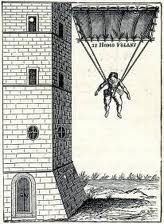
Parachutist - controlled descent, da Vinci invention?
Torii - Japan, Far East
Rocket crashing - fireworks?
Since I'm thinking about life at 17th century Fontainebleau at the moment, the parachutist and the rocket crashing appear to be anachronisms - typically in these instances I treat them as metaphors, as in the parachutist representing a 'controlled descent,' perhaps a courtier falling from the king's good graces and struggling to keep his offices, pensions, and so forth in the process. But I also recall that Leonardo da Vinci designed a parachute, and a Google search reveals that not only was he not the first person to illustrate the concept, there are claims that a working parachute was tested by Croatian inventor, Faust Vrančić or Fausto Veranzio, sometime between 1590 and 1617.

So perhaps the parachute isn't metaphorical after all. Now to turn this into an encounter.

At the tennis courts (bouncing ball) at Fontainebleau, there's a spirited discussion among several players of a rake leaping from his mistress' bedroom window into a moat in order to escape her husband's guards (helmet). Someone opines that such an exit is a dicier proposition without water to break the fall (rocket crashing). Another player of the group says that a missionary with the Spanish ambassador's entourage, recently returned from Tartary (domed towers), described how dancers in the Far East (torii) leaped from high platforms with large silk parasols to break their fall. Not to be outdone, the first player relates that a secretary of the Venetian ambassador's party spoke of a marvelous invention, a canopy from which a man was suspended and could float to the ground in perfect safety (parachutist) - it's said he even has an illustration of the machine (drawing a picture). The veracity of the claims is debated, and a wager to test the theory is offered.

Perhaps the adventurers decide to follow up with the Portuguese missionary or the Dalmatian secretary, to learn more about these marvels, with an eye to some future application or even to win the wager. Maybe they ignore it all together. This encounter or rumor is what I think of as grist for the mill - it establishes facts of the game-world for the player characters, to use or not at their discretion, which in my experience is an important part of running a sandbox-style campaign. And as a bit of historical background, it's kinda fun in its own right, a small way of bringing the historical period to life for the players.

Now, this probably sounds like a butt-load of work for very little return - in fact, the whole process took me less than ten minutes, including the Google searches - but here's the thing: I would never, ever have come up with anything even remotely like this on my own. The Story Cubes lead my imagination to wholly unexpected places, which is what makes them so much fun. I'll have more on this in a later post.

Tomorrow, creating a random encounter using the Backswords & Bucklers job tables.

Tuesday, December 4, 2012

Random Encounters: Flashing Blades Core Rules

As described yesterday, random encounters "represent the 'living world' which the adventurers inhabit, serving up a variety of unfolding events and chance meetings." Today i'd like to go through how I put a random encounter together, using the encounter tables provided in the core rules for Flashing Blades, plus a couple of house rules borrowed from Traveller and a random motivations table created for 4e D&D I stumbled across which seems to have since disappeared from the intrewebs.
Whenever player characters spend time traveling or in a specific locality, they will meet individuals and groups of people there. These normal everyday encounters may be used to add color and suspense to the game, or they may be expanded into adventures of their own. Powerful non-player encounters may become Patrons for characters. If characters are looking for an adventure and/or patronage, the Gamemaster may roll to see what a possible Patron wants on the Patronage table at the end of this section.

Frequency and types of encounters vary by situation and location, as detailed in the subsections below.
The description of random encounters in Flashing Blades fits very well with the principles I developed from Mad Mesa, of encounters which are complete in-and-of-themselves as well as encounters which may carry future consequences for the player characters, including the possibility of patronage arising from the encounter.

FB's encounter tables are divided between "city" and "countryside"; there are five city tables - tavern, marketplace, palace, ministry or townhall, and church - and three countryside tables - open countryside, forest, and King's Roads. I'm presently working on encounters for the royal palace of Fontainebleau for my campaign - Fontainebleau is a sprawling complex in 1626, which includes the palace proper, two chapels, and wings devoted to the royal ministers who accompany the king, plus gardens, nearby hôtels belonging to various noble families, and the forest which is the king's hunting preserve. This means developing encounters from the palace, church, ministry, forest, and King's Roads tables for Fontainebleau and its environs.

The number of random encounters I prepare in advance for a location is based on how much use I expect it to receive in actual play. Sites likely to receive regular visits from the adventurers may have a dozen encounters preparede, while less frequented locations may have just three readied. I also keep a list of drop-in encounters for locations which I improvise in actual play.

I'm going to put together an encounter for the palace of Fontainebleau proper, so my initial roll is on the Encounter at Palace table: 1d20=3, a Baroness and a possible Patron - 1d20=20, "The Patron offers the character a permanent position in his service, with some sort of special deal or pay for services rendered lin this care, it is similar to the Secret: 'Secret Loyalty.'" So, if the player characters sufficiently impress the baroness, they may be offered some sort of clientage relationship to her. An interesting start.

I incorporated the reaction, surprise, and encounter range tables from original, 'classic' Traveller into my campaign house rules for the simple reason that I know them by heart from long usage. The baroness' reaction roll is a natural 2d6=12, which corresponds t, "Generally friendly." This tells me a little something about her: she's gracious and at ease in her surroundings - a courtier, perhaps? Surprise determines whether or not a character can evade an encountert; the baroness' roll is 1d6=4, which is on the high end - she is neither blissfully unaware nor particularly vigilant. Range measures the distance between the adventurers and the baroness; with a roll of 2d6-5=2, she is at Close range, 0-4 meters away.

Finally, I roll for a motivation: 1d100=76, cooking and eating. Since she is not likely to be cooking for herself at Fontainebleau, I take this to mean she's enjoying something - a cup of chocolate, or coffee, both recently introduced novelties at the French court?

Next, per my house rule, I roll again for another encounter; if a second encounter occurs, on a roll of 5-6 on 1D6, then two encounters are merged into a single event. The second roll, 1d6=5, indicated that a second encounter is included, and it will be rolled on the Encounter at Palace table again. The second encounter is 1d20=9, a Duke, Archduke, or Grand Duke, with 2D6 (2d6=7) Attendants and 1D6 (1d6=4) sycophants, also a possible Patron - the roll for patronage is 1d20=8, "The Patron wishes to have a message taken to someone in a dangerous position (a prisoner in the Bastille, perhaps, or a soldier on the front)."

An encounter with a duke, peer, or foreign prince - the titles of archduke and grand duke are house-ruled out of my campaign - means I will incorporate an actual historical figure if I can; while I've invented a great many fictional nobles for the campaign, for the upper nobility I prefer to use the historical personages of Louis XIII's court - interacting with powerful historical figures is one of the conceits of the cape-and-sword genre. Fortunately, a possibility immediately springs to mind: the duc de Bellegarde.

Bellegarde was a mignon, one of the close circle of favorites around King Henri III; after that king's untimely end, the duke caroused regularly with his successor, the libidinous Henri IV. He is the governor of the province of Burgundy and, as grand squire of France, one of Great Officers of France. Bellegarde is a notorious gallant - a playa, in the parlance of the time - who even has the temerity to flirt with Louis' prim, uptight Spanish queen, Anne. Though he's in his sixties now, he's still vigorous and, as I roleplay him, incorrigible.

Okay, let's see how the rest of this unfolds. The duke's reaction is 2d6=8, Interested; his surprise roll, 1d6=1, is modified to 3 based on skills and military experience - his mind is elsewhere, but long habit makes him hard to catch unawares. Range, based on a roll of 2d6-5=7, is Medium, 8-24 meters away - this means that the baroness and the adventurers are effectively out of earshot of the duke, at least for a moment.

Because the duke is a known, established character, I don't feel the need to roll for a random motivation for him, and the way the encounter is shaping up, I have a pretty good idea of why he's there anyway.

I roll once more to see if a third encounter gets folded into this emerging scene: 1d6=4 - no, just the baroness and the duke and his cronies.

The next question is, who is the baroness? Do I have a non-player character already created who fits well in this spot, or do I need to create a new character instead? Searching through my list of npcs, I don't have a baroness character waiting in the wings, though I do have a few barons - could she be someone's wife? There's the baron de Gras, a member of the queen-mother's household; the baron de Saint-Jurs, a Provençal soldier, and the baron d'Île-de-Batz. I know Saint-Jurs is married, but there's no reason for his wife to be at court at the moment. Gras is a courtier to the Queen-Mother, Marie de' Medici, so he's a possibility for a baroness. D'Île-de-Batz is an agent of Cardinal Richelieu - he has mistress, a rather notorious courtesan, but there's no reason why he can't have a wife at court as well - in fact, making her a lady-in-waiting to the Queen-Mother would fit.

So, the adventurers encounter the baronne d'Île-de-Batz, courtier to Marie de' Medici, strolling in the Galere des Cerfs, perhaps, or along the Grand Parterre overlooking the gardens, sipping a cup of chocolate from a Chinese porcelain cup, occasionally stirring it with a small silver spoon. She offers a gracious nod to the characters - or a deep curtsy, if their social rank warrants it - as they pass, when the booming voice of the Grand Squire, Bellegarde, is heard, approaching. He and his coterie of aides and hangers-on are fresh from the royal stables, trailing clouds of dust and shedding clods of mud - and worse - from their boots. The duke sees the baronne and makes straight for her.

She leans slightly toward the player characters and, as the duke whips off his hat and brushes even more of the dust from his clothing as he strides toward the baronne, whispers quickly, "Sang dieu! Please, save me from this old goat! Follow my lead!" Depending on how the characters respond, she will introduce one of them as a cousin, visiting court, with whom she's eager to catch up. As introductions are made, one of Bellegarde's aides, knowing his master's predilections, whispers something in his ear, to which the duke smiles. Bellegarde is gracious to the "cousin," asking a couple of polite questions, when the aide interjects that perhaps the "cousin" and his companions could be of some small service to the Grand Squire of France.

Now the players have choices: help the baronne escape the amorous attentions of the duke, provide a service to the duke and perhaps gain the favor of a member of the king's household, or perhaps weasel their way out of the whole situation, to avoid getting dragged into the affairs of their betters. Decisions, decisions . . .

And there you have it. I need to develop the character of the baronne d'Île-de-Batz, Bellgarde's trusted aide, and one of the duke's sycophants, a boor who will mock the adventurers' discourtesy should they turn the duke's offer of service down - perhaps a duel is in order? Wife of a faithless husband, lady to the Queen-Mother, the baronne offers all sort of interesting possibilities right out of the gate, and by fleshing out her background, such as her relations, opens up other doors as well.

So that's how I do that.

On Thursday, incorporating Rory's Story Cubes into random encounters.

Monday, December 3, 2012

Random Encounters That Don't Suck

. . . or, How a Long-Forgotten Adventure Module Called Mad Mesa Made Me the Referee I Am Today.

I'm not going to waste time and space on the rationales for including random encounters in a roleplaying game - it's already been done better by someone else, and at this point, most gamers either get it or they don't.

One of the reasons random encounters get shat upon is, to paraphrase, 'wandering monsters are boring and distract from the adventure.' Now, bearing in mind that one of the roles of the referee is to make encounters interesting and integrate them with the setting, if you look only at the tables in, say, a published adventure like In Search of the Unknown - "Orcs (1-4)," "Giant Rats (2-5)," "Berserkers (1-2)" - and applied them uncritically - unthinkingly - by rote - then it's kinda-sort understandable why they might seem boring. However, the random encounter tables in most early sources were far more engaged and integrated with the setting, like the echoing footsteps and settling ruins, the hunting tick and the bandit reinforcements, of The Village of Hommlet. Other games and products ramped this up tremendously, from the fairly sparse on detail but gonzo and evocative Judges Guild's Wilderlands of High Fantasy to the myriad slice-of-life-in-Sanctuary encounter tables in Chaosium's wonderful Thieves World box set to the gold standard of published sandbox settings, Chaosium's Griffin Mountain for RuneQuest. When I've described my approach to running a roleplaying game campaign on different intreweb forums over the years, I've been told many times that it sounds a lot like Griffin Mountain, which was interesting in that I'd never actually seen Griffin Mountain before finding a copy this past year - now that I have seen it, then I can say, yeah, my campaigns are a lot like that.

My original inspiration for random encounter design wasn't Griffin Mountain, however - it was TSR's Mad Mesa for Boot Hill.

Mad Mesa is something of an odd bird. It's a solo module, written in a 'choose-your-own-adventure' format - "6. You are standing on Broadway opposite the north window of building 21. You may go west 62 or east 5." - set in a town on the verge of a range war between rival ranchers. There're intrigues and mishaps, and depending on the player's choices and the luck of the dice, the adventurer can either make a tidy fortune or or be gunned down by one of the factions, or the law. The format makes solo play a bit stilted - 'But I wanna peek in the window of building 21, and then I wanna climb on the roof!' - but it's an entertaining setting full of fun Western clichés. The module includes notes for running it for a group of player characters as well.

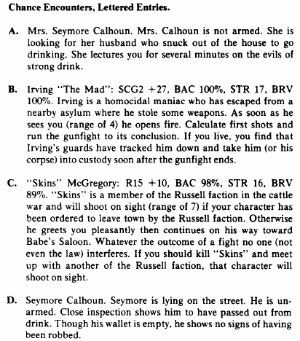
But it's the "Chance Encounters" table that left a lasting impression on me.

First, every chance encounter is with a named individual - no "Orcs (1-4)" - with a distinctive motivation and a brief but revealing backstory - the brash kid out to make a name for himself, the snake oil salesman, the drunk and his temperance-preaching wife. This is, in my experience, what "Orcs (1-4)" should bring to the table, and in the hands if a capable referee, it does, but for some gamers this was a conceptual hurdle they apparently never managed to cross - generic 'wandering monsters' appeared at random and disappeared the same way, with no real connection to anything in the setting. There were certainly many more examples of random encounter tables that were woven into their locations - before I played Mad Mesa, I typically tied random encounters to locations with the adventure site - patrolling guards from the gatehouse, rats from the warren on level 1, Imperial Marines from the Dagger-class cruiser in docking bay 93, a pair of enemy agents conducting surveillance from a panel van. But a big part of what I took away from Mad Mesa's chance encounters was a sense of random encounters as strands in space leading off into the undiscovered portions of the game-world, of implications reaching beyond the immediate circumstances of the locale where the encounter takes place - Irving "the Mad" has nothing to do with the events taking place in Mad Mesa - rather, he is a part of the larger game-world.

Second, several of the chance encounters are integrated into the backstory of Mad Mesa's range war. The player character may run across members of the Russell and Kane factions, and depending on the locations visited in the course of the adventure, the encounter could prove inconsequential or deadly. This created a continuous feedback loop between the chance encounters and the keyed adventure locations - if your character kills Skins McGregory in a chance encounter after being warned to leave town by the Russell faction, then ol' Skins isn't available for the climactic gunfight of the module should your character take part. There's also lil' Joey Black, paperboy for the Mad Mesa Gazette, who for the price of a buffalo nickel can fill you in on the the range war backstory - random encounter as game-world exposition.

What impressed me at age fifteen - and still impresses me today - was how the different pieces fit together in a non-linear way. The chance encounters - and can I add that "chance encounters" as a term of art kicks the everlovin' crap out of 'random encounters' or 'wandering monsters?' - were part of the events of the town, past and present, but they could be presented in a way that didn't require a pre-fabricated plot to unfold for them to make sense. The nature of a chance encounter with Skins McGregory and his Winchester is determined by when the encounter takes place and by the circumstances of the meeting, rather than by a particular order of events necessary to advance 'the story.' What story there is arises from the interplay of encounters.

Random encounters in my campaigns are an important part of the game-world delivery system. They represent the 'living world' which the adventurers inhabit, serving up a variety of unfolding events and chance meetings. When I sat down with the idea of running a cape-and-sword campaign, I compiled a short list of genre tropes appropriate to the campaign. "Coincidences abound" was the second one on my list: in swashbuckling tales, characters run into each other at opportune - and inopportune - moments, so I wanted that to be part of the campaign. The non-linear interaction between site-based encounters and random encounters provides a mechanism for introducing real, dice-driven coincidences into actual play, without the need for dropping a plot-hammer on the players. One such encounter already took place - a chance encounter with a duelist was followed up by another chance encounter with the same duelist at the horse-market. A visit to the Temple enclosure, the Black Cross club, the Louvre, or the Knights of Saint John commandery in Marseilles all include the possibility of meeting this same character as well. Absent other factors, such as player choices or consequences arising out of a chance meeting, the character's appearance is governed by the roll of the dice, and his story in the actual play is a record of his interactions with the adventurers.

Some random encounters in the campaign are pretty straightforward; like Chris Miller, Mad Mesa's would-be gunslinger, they draw first and ask questions later, if at all. An encounter with a band of highwaymen on a King's Road, or a brawler in a tavern, doesn't need to be loaded down with deep connections - they are slices of life in the swashbucklers' world of the 17th century. There are no recurring characters, no additional chance meetings - once you've met Irving the Mad, Wild West homicidal maniac, you're unlikely to meet him twice . . . one way or the other. But some of these encounters also get slightly more involved backstories. An encounter with a drunken nobleman in a tavern may have a strand that connects him through his brother, a parish priest, back to Cardinal Richelieu - imagine Chris Miller's brothers coming to avenge his death. By giving even simple encounters a small backstory which reaches out into the setting, everything the adventurers do may carry unexpected, far-reaching consequences, for better or worse.

This week I'm going to look at the ways and means by which I create random encounters for Le Ballet de l'Acier, my Flashing Blades campaign. Tomorrow I'll begin by putting together a random encounter using the tables provided by Flashing Blades itself.

Saturday, December 1, 2012

A Word About Dice Conventions

If you follow the various random tables I've posted here, you may notice that they tend to be either d20 or d6, d6 tables. There's a pretty simple reason for this: the d20 and d6 are the only dice required for playing Flashing Blades, and since most of my content is generated with my own campaign in mind, I tend to keep to FB's conventions.

Now, I'll be the first to admit that this is kinda silly. It's not like I don't own other polyhedral dice. I have a score of d4s, d8s, d10s, and d12s in my beat-up clear plastic Ziplock dice bag - fancy I ain't - but there's an sort of aesthetic symmetry which appeals to me about aligning my own content with that of the published game.

And considering that we have a whole blog devoted to the d12 and a game book built around the d30 - popular with these guys, no doubt - and even a game which goes out of its way to use some of the most obscure dice produced, I feel like my stuff comes off, well, a bit plain by comparison.

Then again, one of the things I like about Traveller and The Fantasy Trip is that you can raid a Yahtzee set for all the dice you need to play the game, so keeping the funny dice to a minimum isn't all bad.

And d20 and d6 were good enough for OD&D, so Flashing Blades is in fine company.

But don't be too surprised if I sneak a d16 or d24 table in on you at some point. Variety's good, too.

Thursday, November 22, 2012

Off the Shelf: Philosophy Texts

From time to time adventurers may find themselves in libraries and other places where books can be found. Some players will want to know exactly what's on those shelves, so with that in mind, Off the Shelf consists of lists of book titles for the referee to use in rolling or choosing exactly what the adventurers find.

Philosophy texts are used in pedgogy and as reference works for fields such as law and natural history, and as such may be found in a wide variety of libraries maintained by those working in education, theology, and law. Roll 1D6+2 for the number of texts, then roll 1D20 for the individual titles. Duplicate rolls may be treated as additional copies of the same volume or re-rolled at the referee's discretion. On a roll of 1 o 1D6, the text is personally signed by the author.

1. Novum Organum, Francis Bacon, Viscount St. Alban
2. Essais, Michel de Montaigne
3. De animae immortalitate, Giovanni Pico della Mirandola
4. Horae Subsecivae, Anonymous*
5. Quod nihil scitur, Francisco Sanches
6. Quaestiones celeberrimae in Genesim, Marin Mersenne
7. Apologia compendiaria fraternitatem de Rosea Cruce suspicionis et infamiae maculis aspersam, veritatis quasi Fluctibus abluens et abstergens, Robert Fludd
8. De incertitudine et vanitate scientiarum atque artium declamatio invectiva, Heinrich Cornelius Agrippa
9. Theologia Platonica de immortalitate animae, Marsilio Ficino
10. Civitas Solis, Tommaso Campanella
11. Disquisitionum magicarum libri sex, Martin del Rio
12. De l'Infinito Universo et Mondi, Giordano Bruno
13. De optimo reip. statv, deque noua insula Vtopia, libellus uere aureus, nec minus salutaris quam festiuus, Sir Thomas More
14. Les Six livres de la République, Jean Bodin
15. De hominis dignitate, Giovanni Pico della Mirandola
16. Il Principe, Niccolò Machiavelli
17. Della ragion di Stato, Giovanni Botero
18. Bewijs van den waren Godsdienst,** Hugo Grotius
19. Discorsi sopra la prima deca di Tito Livio, Niccolò Machiavelli
20. De Constantia Libri Duo, Qui alloquium praecipue continent in Publicis malis, Justus Lipsius

* Attributed to Thomas Hobbes
** Published in Latin as De veritate religionis Christianae

A final note: most of the books in this list were published prior to 1630, reflecting Renaissance rather than many more famous Early Modern philosophers - I'll add another list or two for later in the 17th century in the future.

Friday, October 26, 2012

Everyone Talks About the Weather

Now someone's finally done something about it.

Friend of the blog Bren at RPG Net created a nifty weather table for use with his Honor + Intrigue campaign, set in 1623 France. Inspired by an old RuneQuest supplement, the table allows weather to change over the course of days based on the current conditions, something all good weather tables should do.

Check it out.

Monday, October 8, 2012

Stupid Dice Tricks

I have mixed feelings about novelty randomisers.

Novelty randomisers aren't new to roleplaying games - Crimson Cutlass , for example, used Tarot cards as a randomiser in 1979 - but I'm guessing most gamers are familiar with more recent examples such as Deadlands' playing cards and poker chips or Dread's Jenga tower. Once in awhile a would-be game designer at Big Purple pops up with an idea for some other means of generating random outcomes - my impression is usually that it's less about the outcome and more about the novelty, a grab for attention.

And yet, I think, Hmmm, swashbucklers dueling in a burning building, or a ship drifting toward a dangerous reef - the Jenga tower would be perfect for modeling that!

Perhaps that explains my fascination with LEGO dice.

We picked up the LEGO board game Pirate Plank on a trip to LEGOLAND last year - the image at right is the buildable die from that game. In Pirate Plank, the goal is to avoid walking the plank. During the game, you roll the (initially blank) die - you can either add a color tile matching that of one of the other players' pieces, or, if color tiles are already on the face, you may move an opponent's piece a number of spaces equal to the number of matching color tiles. The skull-and-crossbones face allows you to either move one of your opponents' pieces one space forward or your own piece two spaces back. Each turn then presents a choice of move your opponent now or build up as many colors on the die face as you can and move your opponent's piece further later in the game. My son - who picks up game strategy incredibly quickly - and I play this one quite often.

The LEGO die frames just call out to me for a roleplaying game application - and I'm not the only one, apparently. In that thread I noted that the LEGO die makes a useful condition track - each tile could represent something like a successful skill check, frex.

I considered adding the LEGO die to the Flashing Blades dueling system - each round in which you successfully hit an opponent without being hit in return allows you to roll the die and either add a tile or use the number of tiles of your color as a bonus to an attack or parry in the next round. I was reminded of this by the Honor + Intrigue Advantage track earlier this year.

One of the great things about the LEGO die as a condition track is that once a tile is added to the frame, it stays there until it's removed, so it allows a condition to be tracked over long periods of time without note-keeping - and it can't be bumped off the track when a character sheet gets jostled. With this in mind, I looked at ways to use the LEGO die with the homebrew courtier minigame rules I'm picking away at. One possible application is tiles on the the LEGO die representing the circle of the King's closest courtiers - each time the adventurers either gain one of the courtiers as a Contact or gains a Favor from one of these courtiers, or even potentially takes over one of those positions, the color changes to that of the character. Anytime the adventurers attempt to sway the King to their course of action, the die is rolled, and the difference between the number of the adventurers' tiles and that of the other courtiers becomes a bonus or penalty to the die roll. This allows me to track the extent of the characters' influence at court over a long period of time.

While both of these applications - and another half-dozen or so floating around in the corners of my mind - appeal to me, I'm also acutely aware that I have a solution in my hand while searching for problems to fix with it, which is really kind of an ass-backwards way to do things - novelty for novelty's sake. It's why I haven't actually unveiled any of my own stupid dice tricks just yet.