Showing posts with label A to Z 2012. Show all posts

Monday, May 7, 2012

R is for Reflections

Time to put the Blogging from A to Z Challenge to bed.

First, I wrote last week that I didn't think I would do this again next year. It felt very limiting, yet looking back I still managed to cover a couple of topics that I planned to write about ever since I started this blog, like the unbuilt trope in cape-and-sword roleplaying games and using 'soft power' to address player character choices in actual play. I liked how the post about interpreting the rules of the game turned out. In the end, the whole thing ended up feeling very contrived; I was writing about topics because they fit the format, not because they were necessarily the topics I wanted to talk about that day, so overall it wasn't a terribly satisfying experience

After a week to let the results sink in, I think I may try this again next year, but with a narrower focus. Really Bad Eggs already has a pretty tight focus as it is, that tiny niche within the niche that is cape-and-sword roleplaying games, and I felt that trying to draw that net even tighter would make it harder to find things to write about - and judging from some of the pure fluff I posted, it was a little hard at times. But I have an idea for a list of A to Z topics for 2013 that both fits the focus of my blog and wouldn't be overly difficult to match to the format. So I'm keeping an option on 2013 after all.

Second, Really Bad Eggs' followers increased by 50% over the course of the month, while page-views dropped by 20%. At the host blog, participants are urged to "spike the blog numbers!" so that every blog in the challenge ends up with at least a hundred followers. While I understand the sentiment, and I appreciate everyone who chooses to follow Really Bad Eggs, for me the payoff of blogging is not counting noses, but rather the exchange of ideas. If I can be said to have a rubric for success, the highest tier is participation through comments. My goal is to inspire and inform, and comments are integral to that process. In any case, I hope that the people who choose to follow this blog do so because Really Bad Eggs has something to say to them, not to run up the score.

Last, I'm slowly playing catch up reading other participants' blogs. April was not the cruelist month, but it certainly was the busiest of the year to date. Camps, carnivals, sports, amusement parks - my already thin leisure time was emaciated last month. I don't anticipate getting through the whole list, but my present goal is to read and comment on at least one hundred blogs.

So that's it until next April.

Badge courtesy of Mark at The DM's Screen

Monday, April 30, 2012

Z is for Zorro

One of the rituals of growing up in California is the fourth grade mission project. Every fourth grader in California learns the history of the twenty-one missions built by the Spanish in Alta California. In our school, we each built a model of a mission - the building materials of choice were sugar cubes and popsicle sticks - and we went on a field trip to Mission San Fernando Rey de España, where we learned about life at the mission, or at least its material culture and subsistence practices - instruction on the forced conversions of the disease-ravaged indigenous Tongva by the Franciscans was notably absent in hindsight.

The missions are frequent tourist destinations, to break up long drives up and down the state. We visited Mission San Juan Capistrano on a camping trip to Mission Bay in San Diego, and Mission Santa Barbara on another camping trip to Morro Bay. Our church youth group visited Mission San Gabriel Archangel on an outing. It's a pretty common experience for anyone growing up near the California coast.

The missions are California's most significant architectural vestige of our colonial history, as a part of New Spain. Nearly all of them have been restored to one degree or another - in a land of wildfires, floods, and earthquakes, buildings made of mud bricks tend to be ephemeral. Adobes from the Spanish era in California are vanishingly rare.

Perhaps that's why I so strongly associate the missions with Zorro.

I saw Tyrone Power's The Mark of Zorro for the first time around the same time as our mission projects - either the autumn before or the autumn after - on a Saturday tee-vee matinee. Up to then, swashbucklers were musketeers in Paris or pirates in the Caribbean, but now here were dueling swordsmen right here in California! Even to a guero from the suburbs - unless you grew up here, you'll never really understand "Mexican Radio" - it was filled with names and places that were intimately, immediately familiar in a way that The Three Musketeers or Captain Blood couldn't be.

I eventually found The Curse of Capistrano in either my school or community library, but though Johnston McCulley wrote scores of Zoro stories, most were buried and largely forgotten in the magazines where they were first published. Still, Zorro remains my swashbuckler.

One of these days I'll show my kids The Mark of Zorro on dvd. They'll get to see two great movie swordsmen - Tyrone Power and Basil Rathbone - in a classic duel, and hear all those names that were new and yet familiar to me.

But first I'll take them to Mission San Juan Capistrano.

Sunday, April 29, 2012

Y is for Yurt

The setting sun was casting its level rays across the steppe grass as the last of the beaters brought in their game on the back of pack horses. The game was piled by the shores of the lake where Khlit, the Cossack of the Curved Saber and Kha Khan of the Jun-gar Tatars, had ordered the night's encampment. Through the ranks of the hunters spurred a powerful man with a scarred face, who reined his horse to a halt before the kibitka of Khlit.

"Our outriders, lord," he cried to the Cossack, who was standing before his tent, "have come upon the one who says that he is from the Holy City. He wears the orange robe of a Chutuku lama, and his name is Dongkor Gelong."

Khlit raised his gray head and scanned the messenger keenly. Although his costume of furred coat with wide sash and horse-hide boots was similar to those of his companions, the Cossack was taller. His hard gray eyes were not aslant like those of the Tatars. He had taken off his heavy woolen cap and his gray hair hung to his powerful stooped shoulders. A veined hand tugged thoughtfully at his dropping white mustache. The deep lines of his browned face alone showed his age.
I discovered Khlit the Cossack about six years ago through the auspices of the tireless software at Amazon. I purchased Robert E Howard's The Lord of Samarcand and Other Adventure Tales of the Old Orient, and Recommended for Me was wolf of the Steppes, the first of four volumes collecting Harold Lamb's tales of the aged cossack.

As a boy I'd read Mr Lamb's Durandal, about the Crusader, Sir Hugh of Taranto, who joins the Golden Horde of Ghengis Khan. Since I was a boy I was fascinated by the tales of Sinbad and the Arabian Nights. The Silk Road was the pathway of my dreams, its cities - Khiva, Tashkent, Samarkand, Kashgar - their citadels. Even now there is nothing more exotic to me than the lands in the shadow of the Roof of the World.

But though I'd read, and loved, Durandal, I'd never heard of Khlit, the old warrior cast out of the Cossack sietch who wandered East, across Tartary, to Ming Dynasty China and Moghul India, and through those cities and along those paths which lay at the heart of my imagination.

Khlit is both a conventional and unconventional hero, a great swordsman and brilliant general, but clever first and foremost. Harold Lamb manages to tread the fine line between the furious action his pulp readers demanded and complex tales of intrigue and mystery in an artfully rendered ancient land.

I was inspired to run Flashing Blades after reading Robert E. Howard's "The Shadow of the Vulture," about the 1529 siege of Vienna by Suleiman the Great, from Lord of Samarcand. The stories of Khlit take place in the first decades of the 17th century, little more than a decade before the start of our campaign, and I've drawn inspiration both from the tales themselves and his amazingly evocative setting. There are rumors and legends in Le Ballet de l'Acier which may lure the adventurers east, to the Levant, to Persia and Tartary, and to the Roof of the World itself, in search of fortune and glory. Will our swashbuckling adventurers trade the palaces of Paris and Turin for a felt yurt or a dusty caravanserai, their Andalusians for shaggy Tatar ponies? Will their rapiers clash with Mongol sabres someday? That will be for the players to decide, of course - such is the nature of sandboxes - but among the tales of Khlit are those of his friend, the Afghan mansabdar Abdul Dost, and the English trader, Sir Ralph Weyand.

Swashbucklers on the Silk Road? That's got an helluva ring to it, doesn't it?

Friday, April 27, 2012

X is for Xiphos

Courtesy of Knight's Edge, an online retailer of medieval arms and trinkets:

The xiphos is a sword that was used by the ancient Greeks. The sword featured a double-edged, leaf-shaped blade that was perfect for cutting, slashing and thrusting. Xiphos was a short and thus, single-handed sword. The sword was used as a secondary, close combat weapon and it was used when the primary weapon, the spear was discarded. The very early Xiphos swords were made of bronze. Similarly shaped swords were in existence throughout the Europe under various different names.
The description of the xiphos makes an intersting point - for millenia, swords were secondary weapons, for close combat. Spears and lances were the primary weapons of warriors, both on foot and on horseback.

The long straight stick with the pointy bit at the end would endure a dizzying array of variations, but it would remain the basic weapon until firearms dominated the battlefield in the latter half of the 17th century, and bayonets - pointy bits affixed to the end of the firearm - would carry on the tradition for at least another three centuries.

It's interesting that swords represent martial puissance more than spears. There are a slew of reasons why: swords were often restricted to certain social classes, particularly in the post-Roman world; they required additional training and skill to use effectively; they were much more expensive to produce and therefore dearer to the owner; swords could be more durable than spears and lances, and pass through generations. One sees swords in heraldry far more often than the spear or lance, reinforcing the notion that swords are exclusive relative to the common man's spear. In romances, the sword is the weapon most likely associated with a champion rather than his lance.

The sword captures the popular imagination, but it is the spear upon which empires were built.

Thursday, April 26, 2012

W is for Wacky

And I've noticed the same phenomenon in the A to Z Blogging Challenge, the blogs with the quirky titles tend to have the quirky content. There are some very strange people out there…and some very funny ones too.

Really Bad Eggs Wacky.
So the 2012 A to Z Blogger Challenge winds down.

Early impression? I'm glad I tried this, and I doubt I'll do it again next year.

As of the time I write this, I've only managed to visit about a score of other blogs. April has been an insanely busy month - holidays, birthday parties, anniversary, vacation, baseball and football games, all on top of work and family routines - and it's been a challenge just keeping up with my own posts. Exploring other blogs has taken a back seat, unfortunately, but I do hope to visit many more, and offer a comment or three, in the coming months. Even just reading through that score or so, I'm left with an unmistakable impression: wow, there are a lot of authors out there.

I've received a number of interesting comments over the past few weeks. I imagine that to many, like Fiona Maddock quoted above, this all must seem rather strange. Roleplaying games are a niche hobby, and cape-and-sword roleplaying games are a tiny niche within that niche. A grown man writing about the finer points of pretending to be a pirate or musketeer must seem very wacky indeed.

One of the reasons I enjoy roleplaying games is that they are an avenue for me to scratch a creative itch in a distinctive, perhaps unique way. Writing a story holds little appeal for me - and acting in a play even less - but creating a vast web of characters linked by intrigue, and playing them out in real-time, with actions resolved by the rules of the game, hits me like an endorphin rush. Most of all, I like roleplaying games for the ways in which they are not like writing or performing. There's nothing else quite like it.

Wacky it may be, but my muse carries dice in her hand.

Saturday, April 21, 2012

R is for Recap

I've mentioned my Flashing Blades campaign, Le Ballet de l'Acier - The Dance of Steel - a number of times in different posts, to highlight an example, but I haven't discussed it at any length.

The campaign began in in the chill winter February 1625, as a French soldier, Adrien Sannom, an ensign of pikemen in the Picardy Regiment, was sent to Paris to deliver dispatches for his colonel. Left to his own devices pending the return to his regiment, he wandred the fair and stopped a trio of gentlemen threatening an old man and his daughter then got into a scuffle at the theatre. Later he delivered a missive for another soldier to his mistress, and carried a message to the royal fortress at Vincennes and narrowly avoided freezing to death on the road back to Paris, then was nearly killed by an innkeeper who was beating his wife. Finally he returned to his regiment and was dispatched to forage for supplies for his company - and completely missed uncovering a Spanish plan for invading Picardy. (Life During Wartime, a one-shot at a Meetup)

The long winter showed little sign of easing in March 1625 when a sergeant of the King's Musketeers, Riordan O'Neill, visited the fair at Saint-Germain. He rescued an acrobat from three carousing fops then received an invitation to the theatre. Coming home from the theatre, he encountered the aftermath a duel, two gentlemen dying in an alley as one of the dead men's servants claimed that it was murder. The two duelists retire after marking Riordan well. (Gallant Madness)

At his earliest opportunity, Riordan O'Neill returned to the theatre at Saint-Germain, in the company of his friend Charles Duran, to ask out the actress-sister of the acrobat he rescued; the Musketeer was chagrined to discover that she is a prostitute. Chastened, he and Charles took up an invitation from another Musketeer to join him at a small tavern. They spotted a man and a woman in poor disguises about to be set upon by a gang of bravos - the trio defeated the bravos in a dark alley, capturing two, then learned that the two disguised nobles were the duchesse de Chevreuse and her English lover, Lord Holland. The duchesse charges them with sneaking her and Lord Holland back into the Louvre. (The Instruments of Darkness)

A plan is formulated, and Musketeer uniforms procured, to sneak the pair into the palace. Another friend, Charles Petit, an apothecary, is summoned to aid the injured Lord Holland, to rouse him enough to get him into the palace. While Riordan bribes one officer and bluffs another, one of the captured bravos convinces Petit to let him go, on the promise that he will give up the leader of the bravos who escaped earlier in the evening. After Riordan discovers the deception, the second prisoner is killed and dumped into the Seine, then the adventurers set off in search of the bravo leader. Staking out the tavern, they find the prostitute with whom the bravo was earlier seen, and attempt to bully her into giving up the bravo, but she refuses; later they tail her to a church, but they are put off by a priest before they can question her further. On returning to their lodgings at the Black Stork Inn, a mysterious man offers them thanks for aiding the duchesse, and delivers them a purse of gold francs and ring with a red stone. (No Hunting Like the Hunting of Man)

Charles Duran returns to his family in Dijon for a time, leaving Riordan O'Neill and Charles Petit to make good on the promised bribe to the officer at the Louvre, a German mercenary. Tracking him down, they discover that he's destroyed a tavern in a drunken rage, and they convince the cuckolded tavern owner to not summon the provost-marshal by paying for the damages themselves. March passed into April, and Charles Petit hears a rumor that a Savoyard noblewoman, the vicomtesse de Praz-de-Lys, is setting up household in Paris and looking for staff - a fencing master and tutors for her sons, a banker to handle the family finances, and so forth. Riordan and Charles present themselves for the positions of fencing master and tutor respectively, and are hired; Riordan takes the opportunity to flirt with the vicomtesse's layd in waiting. Returning to the Black Stork, Riordan is insulted by three men in the market of the Place Maubert; the three are waiting for a duelist, and mistake Riordan for the man's second. Once the duelist arrives, Riordan offers to be his second, and in the subsequent duel the three are killed. The duelist introduces himself Gil de Berault, and thanks him profusely, telling Riordan to look him up if ever he needs a second. They continue to work for the vicomtesse, and Riordan flirts with her lady-in-waiting. One day Riordan is summoned to the hôtel de Tréville; Tréville informs him that the duel upon which he happend back in March, on the way home from the theatre, involved a son of a Lorrainois count and two courtiers to the Queen-Mother. One of the courtiers is making inquiries, trying to learn Riordan's identity. and Tréville warns Riordan to be careful. Finally they meet Lorrainois count, who offers them his gratitude for delivering his son to a priest before he died. (A Thousand Friends)

Charles Petit and Riordan O'Neill continue to work for the vicomtesse as April turns to May. One day she asks if they can assist in purchasing a horse for her eldest son, and with the boy and another friend, Bruno Faucon, Riordan's assistant, they set off for the Paris horse market. At the market Riordan spots one of the two courtiers, who introduces himself to Riordan. The courtier and another nobleman are arguing over the merits of two horses, and a race is arranged, with Riordan agreeing to ride on behalf of the nobleman. Riordan wins the race through the Cours-la-reine and is invited to a party to be held by the nobleman in May. Later Riordan, with Charles and Bruno in tow, seeks out the vicomtesse's lady-in-waiting and finds her Les Halles, the main market, in the company of a young soldier. She goads Riordan and the soldier into a duel, as Charles and Bruno try in vain to warn him off. Bruno tails the soldier, and discovers him entering the residence of the Cardinal Richelieu at Place Royale. Convinced that they will be ambushed by the Cardinal's Guards, Riordan casts a wide net for help, pulling in three of his friends among the Musketeers. Arriving at the Hôpital Saint-Louis, where the duel is to be held, Charles sneaks in and finds the Cardinal's Guards clearing out the vagrants congregated there. The adventurers decide to turn the tables on them, ambushing two of the Guards and capturing the guardsmen's horses, killing one of the Guards in the process. (Best-laid Schemes)

The Cardinal's Guards discover Riordan O'Neill, Charles Petit, and Bruno Faucon, along with three other King's Musketeers, in the process of stealing the guardsmen's horses, and the adventurers are forced to flee as musket fire rattles around them. They realize that if word reaches the king, they could be in trouble, so they set off for Tréville's, to ask him to intercede with His Most Christian Majesty, but Tréville isn't at his townhome, and the delay allows the Cardinal to reach the king first. One of the Musketeer officers finds a place for the adventurers to stay until Tréville returns; meanwhile the guardsmen's captured horses are turned loose in the Tuileries gardens to browse on the royal shrubbery. That night word arives that the king is furious, and the Musketeers are exiled from Paris. The barber-surgeon of the Musketeers, Guillaume Sébastien, who treated the injured after the fight with the guardsmen, decides to flee as well, as he is likely to be branded a co-conspirator by the vengeful Cardinal. Two of the Musketeers decide to head south, to Toulouse; the third accept an offer from the comte de Challons, a friend of Tréville's, to join his mercenary company heading off to the war in Savoy, and Riordan, Bruno, and Guillaume join him. (A Hard Place to Leave)

The trip to Grenoble, where Challons' company is forming, is brutal as the adventurer attempt to avoid agents of the Cardinal by travelling through the mountainous heart of Burgundy, where they encounter and kill an angry boar. Afraid they will wreck their horses, they decide to take to the river, and head south on barges to Vienne. Leaving the river, they take the road to Grenoble, and are ambushed by bravos in the middle of an empty waste. Taking refuge on a hilltop, a battle with pistols and swords ensues, and the bravos are routed. Arriving in Grenoble at last, the adventurers discover that the officer they were to meet is missing, along with thousands in borrowed silver. (Into the Wild)

Guillaume, Riordan, and Bruno investigate the disappearance, eventually discovering a hidden compartment in the officer's lodgings at a Grenoblois inn. The hidden compartment leads the local provost-marshal to identify the culprits, a Dutch banker and a Venetian fencing master, who flee the city. Riordan takes over the company in the officer's absence, but makes a poor showing of it. A case of Anjou wine arrives from Paris for Riordan, but it is laced with poison and the Musketeer is saved only by the ministrations of Guillame.(The Hands Will Solve)

After a brief period of training, the company, with Riordan O'Neill as cornet and Guillaume Sébastien as surgeon, with Bruno Faucon as a camp-follower, sets out for Savoy in June 1625, to join the French army fighting alongside the Savoyards against the Genoese and Spanish. Challons and his officers are invited to a party hosted by the principessa di Piemonte, the sister of King Louis XIII. At the party a Savoyard count with Spanish sympathies insults Riordan and Guillaume, but Riordan maintains his compsure. Later the adventurers are approache by a expatriot French nobleman, who tries to recruit them to seize his brother's castle in Dauphiny, claiming that the brother is responsible for death of the officer in Grenoble. The men are invited to dance with the princess' ladies, and only Riordan manages to pull off the steps successfully, earning him the admiration of his partner, from whom he asks for a favor to carry into battle. Challons carabiniers are put into action against Imperial cavalry, Albanian and Polish mercenaries, raiding behind the lines. Their first action is a defeat, as the Albanians manage to slip away; their second, against the Poles, is inconclusive. Finally, Challons' company manages to ambush the Poles in their encampment and scores a decisive victory, with Riordan taking the Polish banner in the process. (Let Him Who Loves His Country)

October turns to November as Riordan O'Neill and Guillame Sébastien travel to Turin with the comte de Challons, where Riordan is honored by the duke of Savoy for his meritorious conduct in during the summer campaign; during the ceremony, the expat nobleman once again approaches them about taking his brother's castle, and Challons invites Riordan to participate in a duel at Casale with the Imperial cavalry commander. Riordan celebrates by seducing a pair of tavern wenches and Guillame finds himself seduced in turn by a French marquise in Turin. The lady-in-waiting with whom Riordan flirted at the princess' party renews her acquaintance, focing Riordan and Guillame to figure out a way to slip her out of a church under the eyes of two guards assigned as her escorts. To distract the priest and guards, Guillaume, a Huguenot, claims to want to convert to Catholicism, and the priest declares it a miracle. The lady-in-waiting manages to sip away in her maid's cloak, and she and Riordan spend an afternoon riding together in the countryside. The next day, as Riordan prepares to leave with Challons for the duel at Casale, he is issued another challenge, by the officer he was supposed to duel in Paris months ago. That challenge is put off as the adventurers ride for Casale. (Darker Than the Swoon of Sin)

. The cavalry duel at Casale is a five-on-five affair held outside the walls of the city, as a company of Spanish musketeers watch from across the river. The surgeon, Guillaume Sébastien, is placed under guard by the Monferrini as the ten combatants meet on the field. Riordan O'Neill defeats two of the Imperials and captures a third as the French are victorious, escaping under a hail of musket fire from across the river. Guillame is shot and left for dead by the Monferrini sergeant, who steals his medical instruments. They retire to a town to find a surgeon to heal their wounds. (The Spur That Pricks)

What's next for our intrepid swashbucklers? The expat noble and the castle in Dauphiny still awaits, as does the duel with the French officer. There's Riordan's mistress and the lusty marquise waiting for Riordan and Guillaume's return to Turin. A diplomat is on his way to Monferrat with a proposed mission to Milan for the swashbucklers, along with word of a pardon and their return to Paris - or perhaps they will stay in Savoy when the campaign is renewed in the spring? And who set the bravos and the poisoned wine on them?

The future beckons.

Thursday, April 19, 2012

Q is for Quixotic

Rodriguez wished that he could have had a less ambition than to win a castle in the wars, for in those glades and among those oaks he felt that happiness might be found under roofs of thatch. But having come by his ambition he would not desert it.

Now rushlights were lit in the great cottage and the window of the long room glowed yellow. A fountain fell in the stillness that he had not heard before. An early nightingale turned a tentative note. "The forest is fair, is it not?" said Miguel.

Rodriguez had no words to say. To turn into words the beauty that was now shining in his thoughts, reflected from the evening there, was no easier than for wood to reflect all that is seen in the mirror.

"You love the forest," he said at last.

"Master," said Miguel, "it is the only land in which we should live our days. There are cities and roads, but man is not meant for them. I know not, master, what God intends about us; but in cities we are against the intention at every step, while here, why, we drift along with it."

"I, too, would live here always," said Rodriguez.

"The house is yours," said Miguel. And Rodriguez answerd: "I go to-morrow to the wars."

- Don Rodriguez: Chronicles of Shadow Valley, Lord Dunsany

Wednesday, April 18, 2012

P is for Pirates


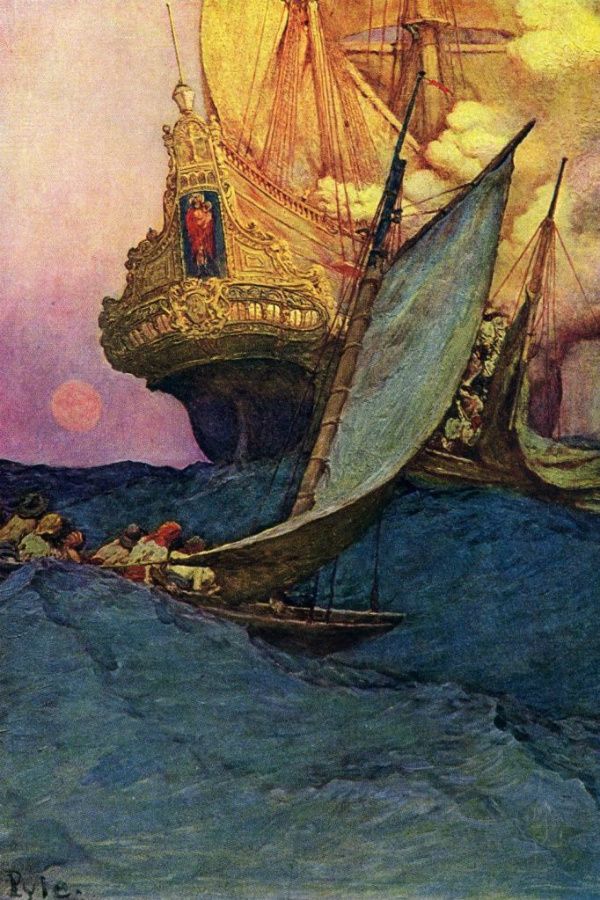
This week's guest illustrator is Howard Pyle, the dean of pirate painters.

Tuesday, April 17, 2012

O is for Other

A modest proposal to Wizards of the Coast: how about including a more diverse representation of ethnic background in your core product? You’re working on Dungeons & Dragons Next — some call it D&D Fifth Edition — and I think now would be a great time to welcome new players. A product where white wasn’t the default would be a welcome addition to the hobby. I’m not talking about niches like Oriental Adventures either; I mean in your main bread and butter books.
A short essay by Mordicai Knode at Tor.com lit up tabletop roleplaying forums last week by suggesting that fantasy roleplaying game artwork should be more inclusive in its depiction of ethnicity. While many gamers expressed support for the suggestion, others decried what they consider forcing roleplaying games to pursue a "politically correct" agenda, with a few ignorant, hateful cranks pathetically descending into outright racism.

Sadly, this conversation isn't new among gamers. The perception, and even support for the perpetuation, of tabletop roleplaying games as a hobby by white guys for white guys runs deep, and as such extends into discussions of gender representation in roleplaying games as well.

I've thought long and hard about this with respect to historical roleplaying games in particular. The 17th century, in which my Flashing Blades campaign, Le Ballet de l'Acier, is set, is anything but egalitarian - it's rife with religious, ethnic, and gender intolerance, rigid social stratification and vast wealth inequality, so in putting together a campaign, I have choices to make. I could flip the switch to full alt.history, and run a fanciful egalitarian campaign in which, say, women can join the King's Musketeers without raising more than a couple of scandalised eyebrows at court who tut-tut about how things were different back in their day.

I can also hew closer to the actual history, which means that potential prejudices abound. A few gamers have suggested that this is tantamount to endorsing racism, sexism, and intolerance - why bring all of this into what is supposed to be a leisure activity when it can leave women, gays, or persons of color feeling marginalised during play? Shouldn't roleplaying games be an opportunity to escape prejudice and social restraints?

While I'm sympathetic to this view, I find it problematic in that it presumes that all gamers want the same experience from playing roleplaying games. One of the reasons that players enjoy playing historical roleplaying games in particular is to capture the feel of the period in which the campaign is set - they want not just historical trappings but a chance to pretend to be a character in that time and place, including the historical mores. Prejudice and inequality are features, not bugs, in such a campaign. To leave out the mores of the period would diminish the experience.

But given that players do approach games with different expectations, I believe it should be made crystal clear that historical campaigns will hew closely to those mores, so that prospective players can make an informed choice about whether or not it's a game they want to play. In the players' guide section of my campaign wiki, I describe the role of history in the campaign, and touch upon prejudice and intolerance.

Finally, a note about ‘-isms.’ Part of the appeal of historical roleplaying for many gamers is exploring the past. Recapturing the experience of living in another era may include cultural values different from our own. Racism, sexism, heterosexism, and in particular religious intolerance are prevalent in the Early Modern era, and as such they may be encountered in the course of the game.

It’s important to bear in mind, however, that exceptional individuals are a feature of every era, and an attempt to recreate the experience of history cannot overlook these figures. For example, women owned businesses and property, served in the armies and navies (sometimes disguised, sometimes openly), founded religious organizations, and ruled great states in the seventeenth century – a few even fought duels; using the idea of sexual discrimination against female characters to unduly limit their options would make
Le Ballet de l’Acier less historical, not more.

And though it shouldn’t need to be said, here it is anyway: while racism, sexism, and the rest may be encountered in-game, they will not be tolerated out-of-game; any player who cannot treat everyone else at the table with respect will be asked to leave the game.
I've found a tendency among gamers who take issue with including gender, ethnic, and religious prejudices in historical roleplaying games to assume a setting painted with a broad brush, but in my experience they miss the significance of exceptions to the prevailing mores of a period. If we accept that prejudice and intolerance are facts of life in an Early Modern setting like that of Le Ballet de l'Acier, then we must also account for exceptional individuals who overcame those limitations, such as Juan de Pareja, Hortense Mancini, and the chevalier d'Eon de Beaumont.

In fact, two of the player characters in my campaign can be numbered among those exceptions: a Jewish woman masquerading as a Catholic swordsman, and a gay physician and polymath.

I believe that women gamers, LGBT gamers, and gamers of color should be able to see their own reflections in the world around them, and there's no reason why this shouldn't extend even to something as trivial as roleplaying games. The muse behind the blog Sarah Darkmagic, Tracy Hurley, has a Kickstarter project, Prismatic Art Collection, aimed at facilitating just that.

Prismatic Art Collection is a free library of art representing heroes of all backgrounds. In geek culture, there are plenty of Lukes, but not enough Landos or Leias. We want to change that. We're raising funds to hire a diverse group of artists to create fantasy art depicting heroes of all backgrounds.
I'd like to see more Leias and Landos - and more Juans and Hortenses - in roleplaying games.

Monday, April 16, 2012

N is for Networked

When I decided I wanted to run a swashbuckling campaign, I went to a couple of gaming forums to ask for opinions on games.

Once I settled on Flashing Blades, I ordered .pdf copies of the rules.

To help me run the campaign, I created a wiki to manage my notes.

When I decided I was ready to run the campaign, I recruited players through a website and a Yahoo group and a local Meetup.

Once we settled down to playing, we organized our game-days by e-mail. When one of the players moved home to Scandanavia after finishing his post-doc, we began playing by both e-mail and Skype.

And after spending literally years thinking about this stuff, I decided to start a blog.

The intrewebs changed tabletop roleplaying games for the better, offering gamers unprecedented connectivity, from finding obscure games through eBay and online retailers to locating other players with like interests to sharing campaigns via wikis to playing by forum post, email, intreweb chat, Skype, and Google+ to creating and sharing new games, supplements, and adventures to simply building and maintaining the niche community of hobbyists who play these silly games.

I can even roll my dice online if I like.

Thursday, April 12, 2012

K is for KIA

I come to bury the chevalier de Saint-Sauvan, not to praise him.

According to the designers the Mythic Game Master Emulator is intended to facilitate gamemaster-less play. My previous experience with the Emulator was as a tool for refereeing my Flashing Blades campaign, but I was curious to see how the Emulator worked for solo play.

I was pleasantly surprised by the results, enough to go back and repeat the expeience a few more times with my character, Urbain de Foresta, the chevalier de Saint-Sauvan.

Unfortunately the dissolute gambler met his end at the hands of a Marseillais bravo named La Gautier. There was bad blood between Foresta and La Gautier, after Foresta defeated La Gautier by flipping his cape over the bravo's head and running him through, leaving La Gautier for dead in the street not far from a tavern known as Lo Diable - the Devil.

But La Gautier survived Foresta's thrust, and - as subsequently determined by the Emulator - sought out the chevalier to take his revenge. Last Thursday I had a few free hours, and as Foresta made his way to a tavern seeking a game of chance and some feminine companionship, he encountered La Gautier once again.

This time no trick could save him and La Gautier, the better swordsman, left the hapless nobleman bloody and dying on the cobbles.

If roleplaying games can be said to have loss conditions, it's hard to argue that this is one of the biggest losses a player can suffer. While I accept death may come to my characters in the course of playing the game, it's rare that there isn't some measure of disappointment attached to the experience. Foresta wasn't a terribly likeable character - a fop, with all that that entails - but he was fun to play and I saw some interesting adventures in his future, if he was spared.

But by the roll of the dice, that wasn't meant to be.

So I lay the poor chevalier to rest, his future abruptly cut short, his potential unrealized. Such is the life of a gambler and rake in 1625 Marseille, and such is the fate of a player character when the dice don't break his way.

I'm not ready to give up on the solo gaming thing, however, so I hit up a dice roller for a new set of character stats, and thus was Peyrot La Planca, an occasional actor and would-be bravo, born in the chevalier's stead.

Many roleplaying games have rules which allow characters to cheat death in any number of ways, but those games hold little appeal for me. If anything can be said to be real in a game which takes place almost wholly in the imagination, it's the roll of the dice.

Friday, April 6, 2012

F is for Field of Honor

Once again, you are challenged to a duel. Roll 1D20 to determine the actual location where the duel takes place.

1. On a coral reef at low tide while sharks cicle in the nearby lagoon.

2. Amid the vine-choked ruins of a lost temple deep in the jungle, while drums throb in the distance.

3. Atop a galley's ram as it protrudes from the side of a galleon while cannons blast overhead.

4. In the candlelit crypt beneath an ancient abbey.

5. In the middle of a court ballet during a masquerade ball.

6. On a swaying rope bridge suspended above a rushing torent.

7. Inside a church campanile as the bells peal for a requiem mass.

8. Atop a clocktower as shafts of lightning from an approaching thunderstorm illuminate the sky.

9. Hanging from the creaking sails of a slowly spinning windmill.

10. Aboard a wildly-rocking gondola drifting on the Grand Canal.

11. In the twisting alleys of a tall garden hedge-maze.

12. While racing around the Piazza del Campo during the Palio di Siena, using horsewhips and daggers.

13. Amid the canvas shrouds of a sailmaker's loft.

14. In a lantern-lit mine tunnel where gaping shafts nearby lay concealed by shadows.

15. Amid the silk carpets and satin cushions of a Turkish seraglio as the sultan's concubines make bets or throw fruit at the duelists.

16. In a dusty caravanserai, between the resting camels and their yelling, jeering drivers.

17. On the slippery, crackling ice bridge over a yawning glacial crevasse.

18. Between sulphurous hot springs and bubbling mudpots as a steaming geyser rumbles menacingly.

19. Over a half-dissected corpse in an operating theatre in the middle of a crowded surgical lecture.

20. In a tavern crowded with drunken revelers - hey, they can't all be exotic.

Thursday, April 5, 2012

E is for Exegesis

Roleplaying gamers have a sometimes contentious relationship with the rules of our games.

The rules for a roleplaying game may only number a handful of paragraphs, or run to literally thousands of pages across scores of books. Gamers refer to games as 'light' or 'heavy' depending on their perceived complexity. We draw distinctions between 'crunch' - the rules that determine how actions are resolved - and 'fluff - the descriptive text of the game and the game-world.

Even with all of this attention to the rules, roleplaying games, particularly complex games with many pages of rules, frequently require judgement calls in how the rules are applied. For example, the third edition of Dungeons and Dragons offered players the opportunity to play a magically awakened (intelligent) animal as a character. Years ago, I posed a question based on the idea of playing a knight's awakened warhorse. What happens if the warhouse character tries to climb a sheer cliff? Is the action resolved by rolling a Climb skill check for the hourse as with any other character? Does the horse suffer a penalty to climbing because of his equine body? Or is it simply impossible for the horse to climb a cliff at all?

The answer, according to the rules, was all of the above.

The precursor to roleplaying games was the wargame, and since the 19th century wargames often included a referee or umpire, a neutral third party whose role is to determine the success or failure of moves made by the players and resolve conflicts that arise from the application of the rules to the players' moves. This concept was adopted for roleplaying games very early in their history, of a referee or judge or game master - or more fancifully Dungeon Master, Administrator, Watcher, or Hollyhock God - as, among other things, the final arbiter of questions that arose from the rules.

This is not the only solution to the often-fractious question of WHO DECIDES? in roleplaying games. Early games like En Garde! and Boot Hill could be played without a referee, relying on consensus among the players over questions that arose during the game; later games expanded on this consensus approach by adding specific rules about how consensus would be acheived, or, if interpretation of the rules was vested in an individual, how that person's judgement could be reviewed and overridden.

But the traditional method, of a referee or game master as final arbiter, remains the most common.

So referees necessarily become familiar with the rules.

I found myself poring over the rules of Flashing Blades following our last game-day, for a hole I discovered in the rules some time ago came up in play. In FB, characters in combat may take two normal actions or one long action each turn; for example, a character might choose to thrust and parry (two normal actions) or lunge (one long action). If a character is stunned, then in the following round the character loses one normal action and may not take a long action.

With me so far?

So during our last game-day, one of the non-player characters in a duel was stunned by an attack - I determined in the following round that his one action would be to parry the likely attacks from the player character. The player, seeing the opportunity to take advantage of the stun, decided to attack and counter; a counter is akin to a riposte, turning a parry into an attack.

Except there was no attack for the player to counter, so per the rules this was a wasted action. According to the rules, the only way to get two fencing attacks per round is to attack and counter, regardless if an opponent is stunned or not. Despite the fact that the non-player character was stunned, the player's character could not gain an advantage.

As the referee for the game, my ruling at the time was to let the rules as-written stand, with the promise that I would revisit the subject. Sitting down with the rules, I searched to discern the intent behind the rule as-written. Was this really a hole, or was I just failing to understand the design intent? What aspect of fencing was this intended to simulate? How could I explain this in terms of what the characters would experience in the game-world?

The big question in my mind, is, does allowing a second attack against a stunned opponnent confer too much of an advantage? For example, a character can fire two pistols in a round, so two fencing attacks didn't seem unreasonable when limited to stunned opponents. A character can parry more than one attack in a round with the parry action, and it takes two stuns to make a character helpless in the following round.

Putting all of this together, it makes sense that a character can attack a stunned character twice, and thus another house rule - a rule specific to our campaign - gets added to the lexicon.

Years ago I listend to a rabbi explaining midrash, the interpretation of Torah, to understand the motivations and meaning behind the stories told in the sacred texts, and I was struck by the secular similarity to referees interpreting the sometimes Byzantine rules of tabletop roleplaying games. Specifically, midrash reminded me of that example of that horse trying to get up the cliff, where three different answers found in the rules were all correct, subject to the referee making the interpretation. In one campaign, the horse is able to surge up the cliff, sparks flying from its hooves, while in another, a horse would be forced to find another way around like a horse that we would expect in our own mudane world.

It may seem like having multiple interpretations of the same text is a failure on the part of the system, and their are many games who argue exactly that when asked. But each of those answers gives the campaign played by the referee and the players a distinctive feel, in the same way that rabbis have written different midrashim to understand the implications of a particular passage of Torah.

Exegesis is the search for the truth of a text, but referees may arrive at multiple truths from the text of the game's rules.

And that's a good thing.