It's Book Faire week at my kids' school, and I met my son's class this morning to check out the selection with him - and to keep him from blowing his money on crap toys, the number of which seems to proliferate each year, unfortunately.
He picked out a book on baseball's greatest hitters, and another on snakes - complete with 3D glasses - and finally, You Wouldn't Want To be a Ninja Warrior! a book I pointed him toward knowing his love of Ninjago.
I'd never heard of the You Wouldn't Want to Be . . . series before, but in addition to the book on ninja warriors, I also purchased two other titles, You Wouldn't Want to Be a Samurai! and - this will surprise no one - You Wouldn't Want to Be a Pirate's Prisoner!
Pirate's Prisoner describes the fate of a Spanish treasure ship captain captured by pirates in 1716. The book opens with a description of the treasure and supplies aboard the captain's galleon, a map of the Caribbean, and a description of sailing in convoy for protection. After the ship is separated from the convoy, English pirates swoop in aboard a fast-moving sloop and capture the galleon. What follows describes the trials and tribulations inflicted on the Spanish captain as the pirates attempt to learn more about the treasure fleet's course. In the process the book covers everything from how ship's crews manage their food and water to the rules of piracy to what the various crew members on a ship are called and what they do - and it also describes, in clear-eyed detail, different tortures inflicted by the pirates on their prisoners, including flogging, keelhauling, and more, as well as the fate of the pirates once they are captured and brought to justice.
I'm impressed by this book for a couple of reasons. First, I like that it doesn't attempt to talk down to kids. The darkly comic illustrations manage to present the gravity of the Spanish captain's situation - and the reality of pirates' treatment of prisoners - without devolving into grotesque horror. Second, it's a remarkable resource on life at sea in the late seventeenth and early eighteenth centuries.
For gamers who want run or play in a historical roleplaying game campaign, children's books, particularly the study guides found in teachers' supplies stores, offer a great alternative to academic history texts or even popular history books. They present details of daily life in ways that many history books written for adult audiences don't; if you want to know the material culture of a medieval knight, or a Renaissance painter, or a wagon train scout, you could do far worse than finding a children's book on the Crusades or Michelangelo or Westward Expansion. Better still, they tend to be much more extensively illustrated than history written for adults. In short, children's books often have exactly the sorts of details which gamers want for running a historical campaign.
Showing posts with label historical roleplaying. Show all posts
Tuesday, October 23, 2012
Saturday, September 8, 2012
Lazy Saturday Link Dump
FXR's Honor + Intrigue campaign, De cape et d'épée, is underway - check out the adventure logs, and if your French isn't up to the task, remember that Translate is your friend.
The campaign starts in the midst of a trip to the market, a duel interrupted, the king thrown from his horse . . . and the assassination of Concino Concini!
If you're on Obsidian Portal and you haven't added this campaign to your favourites . . . well, why the heck haven't you added it yet?!
Beedo recounts a Gencon seminar on historical roleplaying, which he summarises thus: "The overarching advice that came out of the seminar, a guide to solving all problems that arise when running a period game, is to use common sense, don't be an ass, and have a clear understanding what everyone at the table wants from the game." This is a topic I've thought about a bit, and I always like to read others' take on it.
Daystar Eld has a great piece on offering meaningful choices to the players and their characters. Hint: tough choices are good, and knowing they're tough choices is better.
The campaign starts in the midst of a trip to the market, a duel interrupted, the king thrown from his horse . . . and the assassination of Concino Concini!
If you're on Obsidian Portal and you haven't added this campaign to your favourites . . . well, why the heck haven't you added it yet?!
Beedo recounts a Gencon seminar on historical roleplaying, which he summarises thus: "The overarching advice that came out of the seminar, a guide to solving all problems that arise when running a period game, is to use common sense, don't be an ass, and have a clear understanding what everyone at the table wants from the game." This is a topic I've thought about a bit, and I always like to read others' take on it.
Daystar Eld has a great piece on offering meaningful choices to the players and their characters. Hint: tough choices are good, and knowing they're tough choices is better.
Wednesday, September 5, 2012
Hot Babes
I love Frank Frazetta's women.
I love their generous, often muscular curves, their powerful sexuality, their gratuitous lack of clothing.
I also understand why some people find them to be objectional, objectified charicatures.
And I'm okay with that.
Four months ago, a Whizbros art director published a short essay on sexism in fantasy art and soliciting opinions on the future art direction of the brand. A couple of weeks ago, a poster at RPG.net called for signatures on a petition to be sent to Whizbros, asking that D&D artwork be more inclusive with respect to women and people of color.
This week, a blogger, forum administrator - of a forum on which I post regularly, I should mention - game designer, and paid consultant for the development of 'D&D Next' decided to stir the pot, calling for a petition to Whizbros to include "hot babes" in their future artwork. Tweaking the progressive gaming community's noses, like his rants about "feminazis" and "political correctness," is this guy's signature style, and honestly, it should be taken with agrain fifty-pound bag of salt and seen for exactly the sort of childish taunting it is, because while this guy thrives on creating a dickish persona, he's really not an idiot.
That said, this blogger's screed speaks to those roleplaying gamers who feel put-upon when the things they like - such as stripper ninja artwork - are pointed out as problematic by others. I don't feel the need to recount their defensiveness here - they're easy enough to find for those who are interested - because their denials and false equivalences completely and utterly miss the point.
No one's telling them they can't like what they like.
All that's being asked is, could a wider range of images be offered so that other people can see what they like, also?
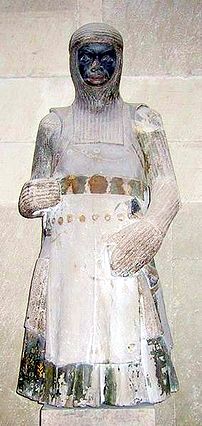
You want a picture of a naked witch summoning a demon? Sounds cool, but could we also have some pictures of women warriors dressed less like bikini models and more like Jeanne d'Arc, too? Does every paladin have to look like Saint George, or could we have more who look like Saint Maurice as well?
Is it really such a bad thing for gamers to want to see themselves in the artwork for roleplaying games?
And nothing about increasing the depth and breadth of represenation in game-art requires sacrificing the quality or originalty or excitement, of course.
I've thought about this subject quite a bit, actually, as there are problematic elements in cape-and-sword roleplaying games.
Running a campaign set in the early 17th century, I'm acutely conscious of the impact of discrimination associated with the period and neither do I soft-peddle it nor use it to severely - and ahistorically - limit player choices. I've read forum posts by gamers who believe that this does a disservice to women, LGBT, and gamers of color by putting them in a situation where the discrimination they feel in real life becomes part of the campaign. While I'm sympathetic to the argument, I accept that it's problematic for some gamers but integral to playing a historical roleplaying campaign for others. My response is to make clear from the outset what the campaign is like, so that anyone interested in playing can make an informed choice about whether or nor to participate.
The source literature which I try to emulate isn't always sensitive to the roles of women and others, either. Consider that d'Artagnan is a rapist and that the most important recurring female character in the Alatriste saga is a murderous racist.
And I do struggle to represent the diverse non-player characters in the game-world, as both period and contemporary artwork is short of swashbucklers of color and I'm not flush enough to commission the art myself for the campaign. But I do the best I can with what I can find.
So I accept that there are elements of my campaign which are problematic, and I acknowledge them as such, without feeling the need to dramatically change them to suit moral and ethical convictions, my own or anyone else's. There is sexism in the setting, but there are also powerful women who overcome, or at least work around, it. There is racism and intolerance, but 'Portuguese merchants' - Jews - and Moors and Turks are among those whom the adventurers may count as allies and rivals. I'm comfortable with the notion that adults can separate what happens in the game-world from the real one, that playing at intolerance doesn't reinforce it in our behavior and attitudes toward real-life human beings - and that to believe otherwise is to crawl down the Jack Chick rathole.
So bring on the naked, curvy Frazetta women, and the women in sensible armor, too - they're all hot babes to me.
I love their generous, often muscular curves, their powerful sexuality, their gratuitous lack of clothing.
I also understand why some people find them to be objectional, objectified charicatures.
And I'm okay with that.
Four months ago, a Whizbros art director published a short essay on sexism in fantasy art and soliciting opinions on the future art direction of the brand. A couple of weeks ago, a poster at RPG.net called for signatures on a petition to be sent to Whizbros, asking that D&D artwork be more inclusive with respect to women and people of color.
This week, a blogger, forum administrator - of a forum on which I post regularly, I should mention - game designer, and paid consultant for the development of 'D&D Next' decided to stir the pot, calling for a petition to Whizbros to include "hot babes" in their future artwork. Tweaking the progressive gaming community's noses, like his rants about "feminazis" and "political correctness," is this guy's signature style, and honestly, it should be taken with a
That said, this blogger's screed speaks to those roleplaying gamers who feel put-upon when the things they like - such as stripper ninja artwork - are pointed out as problematic by others. I don't feel the need to recount their defensiveness here - they're easy enough to find for those who are interested - because their denials and false equivalences completely and utterly miss the point.
No one's telling them they can't like what they like.
All that's being asked is, could a wider range of images be offered so that other people can see what they like, also?
You want a picture of a naked witch summoning a demon? Sounds cool, but could we also have some pictures of women warriors dressed less like bikini models and more like Jeanne d'Arc, too? Does every paladin have to look like Saint George, or could we have more who look like Saint Maurice as well?
Is it really such a bad thing for gamers to want to see themselves in the artwork for roleplaying games?
And nothing about increasing the depth and breadth of represenation in game-art requires sacrificing the quality or originalty or excitement, of course.
I've thought about this subject quite a bit, actually, as there are problematic elements in cape-and-sword roleplaying games.
Running a campaign set in the early 17th century, I'm acutely conscious of the impact of discrimination associated with the period and neither do I soft-peddle it nor use it to severely - and ahistorically - limit player choices. I've read forum posts by gamers who believe that this does a disservice to women, LGBT, and gamers of color by putting them in a situation where the discrimination they feel in real life becomes part of the campaign. While I'm sympathetic to the argument, I accept that it's problematic for some gamers but integral to playing a historical roleplaying campaign for others. My response is to make clear from the outset what the campaign is like, so that anyone interested in playing can make an informed choice about whether or nor to participate.
The source literature which I try to emulate isn't always sensitive to the roles of women and others, either. Consider that d'Artagnan is a rapist and that the most important recurring female character in the Alatriste saga is a murderous racist.
And I do struggle to represent the diverse non-player characters in the game-world, as both period and contemporary artwork is short of swashbucklers of color and I'm not flush enough to commission the art myself for the campaign. But I do the best I can with what I can find.
So I accept that there are elements of my campaign which are problematic, and I acknowledge them as such, without feeling the need to dramatically change them to suit moral and ethical convictions, my own or anyone else's. There is sexism in the setting, but there are also powerful women who overcome, or at least work around, it. There is racism and intolerance, but 'Portuguese merchants' - Jews - and Moors and Turks are among those whom the adventurers may count as allies and rivals. I'm comfortable with the notion that adults can separate what happens in the game-world from the real one, that playing at intolerance doesn't reinforce it in our behavior and attitudes toward real-life human beings - and that to believe otherwise is to crawl down the Jack Chick rathole.
So bring on the naked, curvy Frazetta women, and the women in sensible armor, too - they're all hot babes to me.
Monday, August 27, 2012
Snapping the Suspenders of Disbelief
My son and daughter are playing Mario Kart on the Wii. The race track for this particular race is in orbit around the Earth. Suddenly my daughter pipes up, "How come they aren't wearing space helmets? If they're in space they need helmets to breathe."
Combustion engine vehicles racing on a track floating in the deep cold and searing radiation of space? No problem. No helmets? Boggle.
The threshold beyond which our willing suspension of disbelief is exceeded varies from person to person, but as BryanMD argues at IntWisCha, "reality playing games" facilitate immersion in actual play.
One of the objections from gamers I read when the subject comes up is that concerns about verisimilitude may add to the referee's burden of preparation in exchange for very little actual play return. BryanMD disagrees, citing the example of James Cameron, at the suggestion of astrophysicist Neal DeGrasse Tyson, changing a starfield in Titanic to correspond to the actual stars visible from the ship at the time of the scene.
That's about fifteen in-game years in the future in our campaign, by the way.
It's really not hard to look at that and agree with those who see this level of detail, which is largely invisible to the players and may never even come up in play, as a waste of time. While this bit of background does help me to roleplay the character by helping me to understand his motivations, and perhaps increase the players' level of immersion in the events of the campaign, there's another underlying reason.
It's fun.
I like reading history, and like many people who enjoy history, I like daydreaming about what-ifs. Speculating how this seminal event in the history of his family and his kingdom may impact the mindset of a proud young soldier is a pleasant diversion in its own right, as well as contributing in some small but potentially significant way to the campaign. One of the joys of running a sandbox is placing something in the game-world with no concrete idea how it may come into play, and Don Carlos de Nivero is just such a feature of the campaign.
For a another look at suspension of disbelief, check out two posts by Nick at Troll in the Corner as well.
Combustion engine vehicles racing on a track floating in the deep cold and searing radiation of space? No problem. No helmets? Boggle.
The threshold beyond which our willing suspension of disbelief is exceeded varies from person to person, but as BryanMD argues at IntWisCha, "reality playing games" facilitate immersion in actual play.
Strange as it may seem, the more a story, even one that takes place outside reality, is grounded in empirical data and supported by accepted facts, the faster we'll fall into it. A story's ability to mirror the reality we've already accepted is directly proportionate to our willingness to immerse ourselves in it. You can call it believability, or connection, or familiarity, but the bottom line is getting the audience to buy into the events and emotions that are woven into the tale you tell. . . . The more 'real' one can make their story seem, the more investment others will make into it. That mutual connection seems well worth a few laps around the internet.I've written about using both an 'Appendix N' of source literature and historical research to facilitate that suspension of disbelief. A shared understanding of fictional tropes tapped to build a game-world may contribute to verisimilitude as much as its relationship to the real world.
One of the objections from gamers I read when the subject comes up is that concerns about verisimilitude may add to the referee's burden of preparation in exchange for very little actual play return. BryanMD disagrees, citing the example of James Cameron, at the suggestion of astrophysicist Neal DeGrasse Tyson, changing a starfield in Titanic to correspond to the actual stars visible from the ship at the time of the scene.
When I hear stories like those above, my instincts scream "NERD!" at the top of their psychological lungs. To hold a fictional film to such a rigid empirical standard seems dishonest, and carries the potential to damage one's enjoyment of the experience. Why would anyone inflict this intense scientific scrutiny on a leisure past time? These questions burn in my brain; and then I'm reminded of my own factoid fixation when it comes to RPGs.A few days ago I found myself reading about the battle of Alcácer Quibir as background for a Portuguese nobleman in Spanish service, an npc who, if he is spared in the course of actual play, may become an important figure in the Portuguese Restoration in 1641.
Did it really matter in my fan fiction that the constellations my Half-elf Ranger was said to be looking at could actually be viewed from his geographical location on Earth? . . . Was it so important to discover which heavy metal, readily available in the late 19th century, had the highest density and therefore the highest relative weight by volume for use in a potion? . . . Can the need really exist to research the descendants of a dead Puritan preacher to find out if any of them actually ended up in England, or check Google Maps to find out if the London church my character attends is within walking distance of her family home near Picadilly Circus? . . . There are a myriad of other examples I could give, but all of them follow the same formula: "Do I really need to know ________ in order to have fun playing __________?" Curiously, all of them have the same conclusion: "Who cares? I looked it up anyway."
That's about fifteen in-game years in the future in our campaign, by the way.
It's really not hard to look at that and agree with those who see this level of detail, which is largely invisible to the players and may never even come up in play, as a waste of time. While this bit of background does help me to roleplay the character by helping me to understand his motivations, and perhaps increase the players' level of immersion in the events of the campaign, there's another underlying reason.
It's fun.
I like reading history, and like many people who enjoy history, I like daydreaming about what-ifs. Speculating how this seminal event in the history of his family and his kingdom may impact the mindset of a proud young soldier is a pleasant diversion in its own right, as well as contributing in some small but potentially significant way to the campaign. One of the joys of running a sandbox is placing something in the game-world with no concrete idea how it may come into play, and Don Carlos de Nivero is just such a feature of the campaign.
For a another look at suspension of disbelief, check out two posts by Nick at Troll in the Corner as well.
Tuesday, April 17, 2012
O is for Other
A modest proposal to Wizards of the Coast: how about including a more diverse representation of ethnic background in your core product? You’re working on Dungeons & Dragons Next — some call it D&D Fifth Edition — and I think now would be a great time to welcome new players. A product where white wasn’t the default would be a welcome addition to the hobby. I’m not talking about niches like Oriental Adventures either; I mean in your main bread and butter books.A short essay by Mordicai Knode at Tor.com lit up tabletop roleplaying forums last week by suggesting that fantasy roleplaying game artwork should be more inclusive in its depiction of ethnicity. While many gamers expressed support for the suggestion, others decried what they consider forcing roleplaying games to pursue a "politically correct" agenda, with a few ignorant, hateful cranks pathetically descending into outright racism.
Sadly, this conversation isn't new among gamers. The perception, and even support for the perpetuation, of tabletop roleplaying games as a hobby by white guys for white guys runs deep, and as such extends into discussions of gender representation in roleplaying games as well.
I've thought long and hard about this with respect to historical roleplaying games in particular. The 17th century, in which my Flashing Blades campaign, Le Ballet de l'Acier, is set, is anything but egalitarian - it's rife with religious, ethnic, and gender intolerance, rigid social stratification and vast wealth inequality, so in putting together a campaign, I have choices to make. I could flip the switch to full alt.history, and run a fanciful egalitarian campaign in which, say, women can join the King's Musketeers without raising more than a couple of scandalised eyebrows at court who tut-tut about how things were different back in their day.
I can also hew closer to the actual history, which means that potential prejudices abound. A few gamers have suggested that this is tantamount to endorsing racism, sexism, and intolerance - why bring all of this into what is supposed to be a leisure activity when it can leave women, gays, or persons of color feeling marginalised during play? Shouldn't roleplaying games be an opportunity to escape prejudice and social restraints?
While I'm sympathetic to this view, I find it problematic in that it presumes that all gamers want the same experience from playing roleplaying games. One of the reasons that players enjoy playing historical roleplaying games in particular is to capture the feel of the period in which the campaign is set - they want not just historical trappings but a chance to pretend to be a character in that time and place, including the historical mores. Prejudice and inequality are features, not bugs, in such a campaign. To leave out the mores of the period would diminish the experience.
But given that players do approach games with different expectations, I believe it should be made crystal clear that historical campaigns will hew closely to those mores, so that prospective players can make an informed choice about whether or not it's a game they want to play. In the players' guide section of my campaign wiki, I describe the role of history in the campaign, and touch upon prejudice and intolerance.
Finally, a note about ‘-isms.’ Part of the appeal of historical roleplaying for many gamers is exploring the past. Recapturing the experience of living in another era may include cultural values different from our own. Racism, sexism, heterosexism, and in particular religious intolerance are prevalent in the Early Modern era, and as such they may be encountered in the course of the game.I've found a tendency among gamers who take issue with including gender, ethnic, and religious prejudices in historical roleplaying games to assume a setting painted with a broad brush, but in my experience they miss the significance of exceptions to the prevailing mores of a period. If we accept that prejudice and intolerance are facts of life in an Early Modern setting like that of Le Ballet de l'Acier, then we must also account for exceptional individuals who overcame those limitations, such as Juan de Pareja, Hortense Mancini, and the chevalier d'Eon de Beaumont.
It’s important to bear in mind, however, that exceptional individuals are a feature of every era, and an attempt to recreate the experience of history cannot overlook these figures. For example, women owned businesses and property, served in the armies and navies (sometimes disguised, sometimes openly), founded religious organizations, and ruled great states in the seventeenth century – a few even fought duels; using the idea of sexual discrimination against female characters to unduly limit their options would make Le Ballet de l’Acier less historical, not more.
And though it shouldn’t need to be said, here it is anyway: while racism, sexism, and the rest may be encountered in-game, they will not be tolerated out-of-game; any player who cannot treat everyone else at the table with respect will be asked to leave the game.
In fact, two of the player characters in my campaign can be numbered among those exceptions: a Jewish woman masquerading as a Catholic swordsman, and a gay physician and polymath.
I believe that women gamers, LGBT gamers, and gamers of color should be able to see their own reflections in the world around them, and there's no reason why this shouldn't extend even to something as trivial as roleplaying games. The muse behind the blog Sarah Darkmagic, Tracy Hurley, has a Kickstarter project, Prismatic Art Collection, aimed at facilitating just that.
Prismatic Art Collection is a free library of art representing heroes of all backgrounds. In geek culture, there are plenty of Lukes, but not enough Landos or Leias. We want to change that. We're raising funds to hire a diverse group of artists to create fantasy art depicting heroes of all backgrounds.I'd like to see more Leias and Landos - and more Juans and Hortenses - in roleplaying games.
Subscribe to:
Posts (Atom)