Showing posts with label Mythic Game Master Emulator. Show all posts

Tuesday, December 11, 2012

Random Encounters: Mythic Role Playing

I've written at some length about using Mythic Game Master Emulator as a refereeing tool and for solo play. Today I want to follow up on yesterday's post, using the emulator to identify complications arising from a random encounter, and then look at how Mythic Role Playing handles random events.

While most of my random encounter prep is done away from the table, out of game, one of the best features of the GME is that it can be used in real-time, at the table, during actual play. If a situation arises in game for which I don't have a clear-cut. obvious answer, or when a number of possibilities are more-or-less equally likely, I often kick the question to the GME - I keep the flash-based emulator open next to my wiki on my laptop when I'm running the game.

From yesterday's scenario, I learned that wealthy vintner Maître Péquenaud stands between his niece and the poor gendarme Gribouille, and that the duchesse de Chevreuse plans the capture of Péquenaud to give Gribouille and Marie a chance to elope. I want to develop some potential consequences from this, and since there are a number of ways I could see this go, I'm going to fire up the flash GME and see what it spits out by way of complications.
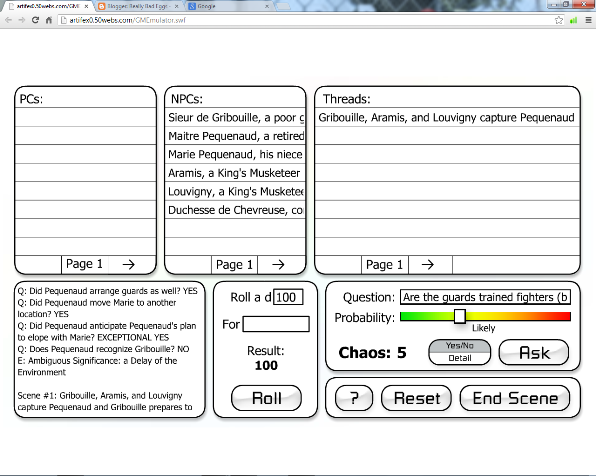

After establishing the characters and the the thread - who's involved, and why - the emulator immediately kicks back an event, a "delay of the environment" of "ambiguous significance." I interpret this to mean that a sudden storm delays Gribouille's attempt to get to Marie - this prolongs the duration of Péquenaud's imprisonment, increasing the chance of discovery or perhaps giving him an opportunity to escape.

Now, I start asking questions about what happens next - the probability is shown in parenthesis.
Q: Does Pequenaud recognize Gribouille? (Likely) NO - apparently Péquenaud is flustered enough that he doesn't recognize one of the 'masked ruffians' as his erstwhile future nephew-in-law; Gribouille catches his first break.
Q: Did Pequenaud anticipate Gribouille's plan to elope with Marie? (Likely) EXCEPTIONAL YES - forced to leave Marie home with this wife, Péquenaud anticipated that Gribouille might try something; the "exceptional" nature of the answer increases the scope of his potential preparations by increasing the probability of future answers (e.g., from "Likely" to "Very Likely").
Q: Did Pequenaud move Marie to another location? (Very Likely) YES - the obvious location to stash a single girl to protect her from marriage abduction is, of course, a convent.
Q: Did Pequenaud arrange guards as well? (Very Likely) YES - suspenders AND belt.
Q: Are the guards trained fighters (bravos, soldiers)? (Likely) YES - the grizzled veteran is able to call up some skilled fighters to defend his interests.
Q: Are the guards associated with another suitor? (50/50 or Unsure) NO - the guards are associates of Péquenaud, not of a romantic rival to Gribouille; that would've been an interesting twist, and depending on how this all shakes out, questions about a rival will be worth asking again.
Q: Do the guards outnumber Gribouille's party? (50/50 or Unsure) EXCEPTIONAL YES - ouch, I'll call that twice as many guards as there are members of Gribouille's party; since these are trained soldiers, I'm gonna say that Péquenaud called upon the local provost-martial to arrange for protection in his absence, so the guards are dragoons.
Q: Is Pequenaud's place of imprisonment discovered? (50/50 or Unsure - originally I'd call this Unlikely, but the storm delay shifts this into Unsure instead) YES - Aramis chooses an out-of-the-way location to hold the vintner, but apparently someone stumbles upon the prisoner and the Musketeers nonetheless.
Q: Does Pequenaud escape? (50/50 or Unsure) EXCEPTIONAL NO - the 'exceptional' quality leads me to ask another question . . .
Q: Does Pequenaud die in captivity? (50/50 or Unsure) NO
Q: Is the captive himself discovered? (Unlikely) NO - so while the Musketeers are noticed in the out-of-the-way location, the prisoner himself remains undetected.
Q: Does anyone come to investigate the presence of the Musketeers? (50/50 or Unsure) NO - this suggests that whoever discovers them wants to avoid trouble, but of course the captors can't be sure of that . . .
And finally, perhaps the most important question of all.
Q: Will Marie elope with Gribouille if he's successful? (A Sure Thing) YES
Now throughout this I've made no reference at all to the player characters. This is the rough sequence of events that takes place absent the actions of the adventurers. What the players decide their characters do may affect this in large or small ways - maybe they guard Péquenaud or maybe they free him, maybe they ride with Gribouille to find Marie or perhaps they warn the provost-martial, or maybe they ignore the whole situation altogether, right from the outset. Whatever their choices, I have a framework from which to respond.

The GME is just one part of Mythic Role Playing; MRP is a generic roleplaying game - a darn good one, in my opinion - with tools to facilitate both gm-less and solo play. Random events are an important part of the game, so next I want to create an encounter using these rules. Events - the "focus" - are determined by a roll on a table, and the specifics - the "context" - is provided by the players and/or referee, in conjunction with the Fate Table which lies at the heart of game master emulation as well as task resolution in the game.

A roll of 1d100=59 produces a "PC Negative" Event Focus, which is described thus.
Something bad, or good, happens to a player character, or non-player character, whichever is indicated on the event focus table. If there is more than one player character or NPC then randomly determine who the subject is. The event meaning will help determine what happens although logical ideas should begin springing to mind. These can be major, or minor, events. Perhaps the slumbering monster in the chamber awakens and attacks the poor, chosen character. Or, maybe while hiking through the desert the character discovers that the only food he has packed is beef jerky. He hates beef jerky.

This can be a very vague event focus, so you will have to rely much upon the event context and event meaning. All this focus tells you is who is directly effected, and if the effect is good or bad.
After the Event Focus is rolled, two more rolls are made for Event Meaning, one for Action and one for Subject; taken together, they form "a two-word sentence" which lends "spin" to the context and the focus of the event. Rolls of 1d100=79, 1d100=3 result in an action and subject, respectively, of "79. Intolerance" and "3. Environment."

There are a number of ways I could use this in my campaign. A MRP Event Focus can be paired with a result from the Flashing Blades random encounter table, plugged-in in place of the random motivations table results; I've done this a number of times with satisfying results.

But my favorite application of MRP's events is at the level of the 'campaign turn.' Time spent on career pursuits in Flashing Blades passes in blocks of one month - frex, a Musketeer lieutenant must spend four months of each year in the discharge of his duties, with an additional six months if his company goes on campaign, while a priest who is a member of a bishop's curia must spend three months each year performing his ecclesiastical duties. I use MRP's Event Focus table to determine what sort of activities arise out of the adventurers' careers, consulting the table on a roll of six on 1D6 for each month spent 'on the job.'

Absent the context essential to this event, I'm not going to flesh this one out further - mostly I wanted to show how MRP handles random encounters, and its applications to my own campaign.

On Thursday, improvising random encounters, courtesy of The Usual Suspects.

Saturday, August 18, 2012

Game Master Emulation Lite

Dissatisfied with the Mythic Game Master Emulator - too fiddly and too slow - Spacejacking at Tiny Solitary Soldiers hacked together his own solo roleplaying game system and I gotta say, it ain't half-bad.

I personally haven't run into a problem with the GME either fiddly or cumbersome, but I think part of that comes from using the Flash version of the Fate Table - it works as fast as I can type the questions - so I can see why a more streamlined version appeals.

Thursday, April 12, 2012

K is for KIA

I come to bury the chevalier de Saint-Sauvan, not to praise him.

According to the designers the Mythic Game Master Emulator is intended to facilitate gamemaster-less play. My previous experience with the Emulator was as a tool for refereeing my Flashing Blades campaign, but I was curious to see how the Emulator worked for solo play.

I was pleasantly surprised by the results, enough to go back and repeat the expeience a few more times with my character, Urbain de Foresta, the chevalier de Saint-Sauvan.

Unfortunately the dissolute gambler met his end at the hands of a Marseillais bravo named La Gautier. There was bad blood between Foresta and La Gautier, after Foresta defeated La Gautier by flipping his cape over the bravo's head and running him through, leaving La Gautier for dead in the street not far from a tavern known as Lo Diable - the Devil.

But La Gautier survived Foresta's thrust, and - as subsequently determined by the Emulator - sought out the chevalier to take his revenge. Last Thursday I had a few free hours, and as Foresta made his way to a tavern seeking a game of chance and some feminine companionship, he encountered La Gautier once again.

This time no trick could save him and La Gautier, the better swordsman, left the hapless nobleman bloody and dying on the cobbles.

If roleplaying games can be said to have loss conditions, it's hard to argue that this is one of the biggest losses a player can suffer. While I accept death may come to my characters in the course of playing the game, it's rare that there isn't some measure of disappointment attached to the experience. Foresta wasn't a terribly likeable character - a fop, with all that that entails - but he was fun to play and I saw some interesting adventures in his future, if he was spared.

But by the roll of the dice, that wasn't meant to be.

So I lay the poor chevalier to rest, his future abruptly cut short, his potential unrealized. Such is the life of a gambler and rake in 1625 Marseille, and such is the fate of a player character when the dice don't break his way.

I'm not ready to give up on the solo gaming thing, however, so I hit up a dice roller for a new set of character stats, and thus was Peyrot La Planca, an occasional actor and would-be bravo, born in the chevalier's stead.

Many roleplaying games have rules which allow characters to cheat death in any number of ways, but those games hold little appeal for me. If anything can be said to be real in a game which takes place almost wholly in the imagination, it's the roll of the dice.

Tuesday, March 6, 2012

Solo

After using the Mythic Game Master Emulator from my side of the screen for awhile, I decided to take it for a solo spin a couple of months ago.

I was playing around with a dice roller awhile back, and I asked it to spit out a set of character stats, 3d6 in order. I liked the stats, and turned them into a Flashing Blades character, Urbain de Foresta, a chevalier with a checkered family history and a penchant for games of chance and women of easy morals.

So with a character in hand, I fired up the flash-based version of the emulator to see how Monsieur de Foresta would do.

The chevalier visited a Marseillais tavern to do some gambling. He was invited to play cards by a debauched marquis, and after cleaning the libertine's clock, found another man's rapier slapped across his coins. The tavern keeper told them to take it elsewhere, and the chevalier followed the bravo out of the tavern, after collecting the coin and one of the cheap trollops servicing fawning over the marquis.

Outside the chevalier found himself ambushed by the bravo, then attacked by the trollop he picked up in the tavern and another ruffian, one of the marquis' lackeys.

A three-on-one fight did not look good for the chevalier. The bravo was a better swordsman, so the chevalier would not be able to defend himself against the other two. The chevalier decided to try a trick, entangling the bravo in his cape, then running him through. In a flash the most dangerous of the three opponents was down, but the chevalier didn't count on the trollop, who managed to grapple him and try to choke the life out of him as the other guy bashed away at him with a bastinado. Unable to fight back due to the deathgrip of the trollop, he took a hard shot to the ribs.

Finally breaking free from the trollop and brandishing his sword, the lackey decided he'd had enough and ran away. The trollop, on the other hand? Again she tried to choke the chevalier, then when he broke free again, she aimed a vicious kick straight at his junk, then tried to tackle him! Unwilling to cut down a woman, but hemorraghing hit points from her relentless attacks, he smacked her twice with the flat of his sword, and she backed off at last, screechig insults at the chevalier.

The commotion attracted an audience, three cut purses with drawn daggers. The chavalier, weary and hurt from the attacks, decided to beat a retreat, but the cut purses followed, so he looked for a place to make a stand, finding a stairway where the thieves could only come at him one at a time. Faced with the prospect of fighting a swordsman by turns, the three slunk away in the darkness to find easier prey.

The chevalier made his way back to his lodgings, his winnings stuffed safely in his doublet.

I used a mix of rules, from the Flashing Blades core and some Traveller rules I ported over for my campaign, and the emulator, and I have to say, it was much more fun than I expected it to be. The emulator allows me to throw out ideas as they come up and kick back replies that often take the action in unexpected directions - that's perhaps the hardest thing to come by in solo play.

Frex, I never considered that the trollop the chevalier picked up for a roll in the hay was in league with the bravo and the lackey until the encounter began; I tossed the question to the emulator, and in short order she was kicking the chevalier's ass.

At one point the chevalier was about to lose what little coin that remained to him; at another his life came down to making a parry successfully as a rapier slashed at his head. The 'session' was exciting and funny by turns, and I found myself hanging on the die rolls to see what would happen next.

I've done the solo dungeon exploration thing with D&D and the solo merchant trader thing with Traveller, and I can say this was a notably different experience, fun in ways I didn't expect. After using the GME with my regular game, it proved to be a fascinating tool for solo play.

I kept a log as I played and wrote the whole thing up as an adventure log on my campaign wiki as well. I enjoyed the experience enough to try it a couple more times.

Nothing can replace the social aspect of gaming, the back and forth between the players and the referee. But I'm also acutely aware of the fact that that social time can be very hard to come by. A little fix of solo play now and again seems like a good way to keep the fire burning.

Friday, March 2, 2012

Using Mythic Game Master Emulator as a refereeing tool: two actual play examples

A brief note: Being that I have a whole month-and-a-half of blog posts under my belt, to celebrate Old Stuff Day I decided to dig something up I originally posted on Big Purple last year.

I like stochasticity in roleplaying games.

When I'm refereeing a game, I like being surprised and reacting to what's happening in the game at least as much as the players do. Toward this end, I lean on random rolls for many of the events and features of the games I run - random encounters, random reactions, random maps, random treasure, random npcs, random harlots.

Perhaps the most intriguing quarrel in my quiver these days is the Mythic Game Master Emulator. The GME is a collection of subsystems from the Mythic roleplaying game - a game that I think deserves a lot more attention than it gets - designed to facilitate no-preparation play, with or without a referee, with a group of players or solo.

The heart of the system is the Fate Chart, a cross-indexed table that is used in Mythic to resolve skill tests; it's also designed to provide weighted answers to yes-or-no questions, and it's this feature which is used to run the game, with either the player(s) or the referee interpreting the outcome. The GME also provides a random event system to add twists to the game, and I'm using this as well.

Here are two examples of how I'm using the GME in running our Flashing Blades campaign.

I. THE DUELISTS
While travelling home to his lodgings after a night at the theatre, an adventurer stumbled upon the aftermath of a duel, and I wanted to gauge the reaction of the duelists to begin discovered by a stranger. I rolled for the reaction of one of the duelists, the chevalier de Didonne; as the better swordsman of the pair, I judged Didonne would be the one to initiate combat with the interloper. However, his reaction was positive - not friendly necessarily, but not at all hostile, either. In light of what I knew of Didonne's personality - arrogant, indifferent to others - I decided he simply didn't care that the duel was discovered.

After the game ended, I dug out my copy of the GME, to see what the duelists would do next, if anything. Here are the questions I posed, the odds I gave them, the result, and my interpretation.

Will Didonne seek out Riordan (the adventurer) to intimidate or silence him? (Unlikely.)
NO. I set the likelihood to 'Unlikely' based on the in-game reaction roll, and from the emulator result apparently Didonne really wasn't concerned about being discovered at the bloody scene - and knowing what I knew of the duel, I could understand why: he was the baron de Gras' second and the duel was initiated by the sieur de Gercourt, who was bleeding out on the ground, so he felt he could make a decent case for his own involvement, which coupled with the protection offered by his patron, the chevalier de Vendôme, and his own status as a knight of Saint John meant he was unlikely to face either social or legal complications from the duel.

But what about the baron?

Will the baron de Gras seek out Riordan to intimidate or silence him? (Unsure.)
EXCEPTIONAL YES. An 'exceptional' result is generated by the Fate Chart if the roll is in the upper or lower fifth of the range, so apparently the baron, a courtier and gentleman of the Queen-Mother's bedchamber (an honorary title - he's not bonking Marie de Medici) was very concerned about their discovery at the scene of the duel. Again, this fit well with the facts on the ground: Gras was secretly wearing armor, a mail shirt under his doublet and a secrete (metal skullcap) under his hat, which, while not uncommon among duelists, is still considered thoroughly dishonorable. His reputation is much at stake, for a number of reasons.

Will Gras try to kill Riordan if he gets the chance? (Likely.)
YES. The baron apparently wants no loose ends . . .

Are the baron's agents able to immediately locate Riordan? (Unlikely)
NO. Wanting to find someone, and actually finding them, are two different things. Riordan is a distinctive figure, tall and powerfully built, who works in the Louvre, but he wasn't wearing his Musketeer's tunic and Paris is a big damn city full of men (and a few women) with swords - setting the odds to Unlikely (as opposed to Very Unlikely or No Way) was probably generous to the baron. Still, the identity of the Musketeer remains unknown to the baron.

Will Gras recognize Riordan if he sees him again? (Unsure.)
YES. As I've described elsewhere, many of the named npcs in my campaign appear in random encounters, so there's a chance the baron and the Musketeer may yet run into one another once again.

So that's where things stood after December's game-night; flash forward to last month's game-night, and Riordan runs into the chevalier de Didonne (a random encounter at the Paris horse-market); this prompted a follow-up question.

Does Didonne report on Riordan's identity to the baron? (Unsure.)
YES. At last the baron knows who his quarry is . . .

II. THE AMBUSH
The adventurers believed a duel was about to turn into an ambush by the Cardinal's Guards, and they decided to turn the tables on their ambushers. They concocted a complicated plan which required a lot of things to go right, and instead everything went south almost immediately. The result was a dead guardsman and eight stolen horses. Now they are potentially on the hook for dueling in defiance of royal edicts, horse theft, and murder - capital crimes all.

Immediately after they escaped, the adventurers returned to the hôtel of the musketeers' captain-lieutenant, Tréville, to report on the incident in the hopes that Tréville could smooth things over with the king.

This time I used a flash-based version of the emulator, and it immediately introduced a random event, a "negative alteration." I decided this meant that the Cardinal got to the king first. (Note: the change in format is an artifact of cutting-and-pasting from the flash site.)

Does The Cardinal convince The King that his guards were at the Hôpital St-Louis to arrest O'Neill for dueling? (Likely.)
YES. This is a lie, by the way - they were there because a nephew of a lieutenant of the Cardinal’s Guard challenged one of the adventurers to a duel, and the lieutenant wanted to make sure his sister’s son didn’t get killed.

Is The King inclined to punish the adventurers and musketeers? (Very likely.)
YES. Tréville's task is now more difficult, which means I’ll push the odds against him.

Do the musketeers convince Tréville to intercede with The King on their behalf? (Unsure.)
EXCEPTIONAL YES. Tréville believes that the Cardinal's Guards planned an ambush and has his Musketeers’ backs to the last!

Is The King angry with Tréville? (Likely.)
YES. Again, this pushes the odds out of Tréville’s favor.

Will The King permit Tréville an audience anyway? (Unlikely.)
YES. Despite the odds against, Tréville is able to use his relationship with the king to plead his case.

Does Tréville convince The King that the Cardinal's Guards planned to ambush the musketeers and adventurers, rather than arrest them? (Very Unlikely – the odds are steadily stacking up against the adventurers now.)
NO. The king is still inclined to believe Cardinal Richelieu’s lie.

Does Tréville convince The King to be lenient in punishing the musketeers and adventurers for the guardsman's death? (No Way.)
YES Against steep odds (No Way means there was only a 15% chance of a yes answer), Tréville made a persuasive argument here, and this is where my knowledge of the setting comes into play. How do I get from an angry king to a merciful king, especially Louis 'the Just' (who could be anything but . . .)?

First, Louis wants to save face with the Cardinal, not punish his Musketeers, and Tréville gives him the means to do so: any punishment meted out to the Musketeers must also be meted out to the lieutenant’s nephew, who was party to the duel that started the whole thing. This allows the king to put the Cardinal back on his heels. Second, duelists frequently received pardons, either from a magistrate specifically or from the Church as part of a general amnesty on criminals.

So, assuming the adventurers didn't do anything to dig this hole deeper - no guarantees of that, of course - they faced a six-month banishment from Paris until they could receive a letter of remission or some other form of pardon. Through a friend of Tréville's, they headed for Grenoble to join a company of gentlemen soldiers going to war in Italy.

Will The Cardinal pursue retribution for the death of the guardsman? (Has to Be)
YES. I think it’s significant that the answer is not an ‘exceptional yes’ - clearly the Cardinal will attempt to make the adventurers' lives miserable at some point, but it's not a priority for him, more something to pursue when the opportunity arises.

Now, I know the question some of you are thinking: why bother?

As I said at the outset, the stochasticity of roleplaying games is, for me, one of their main selling points. It's one of the features that I believe makes them distinct from novels and short stories, movies, television shows, and other like media. I like that the unexpected hangs on every die roll, that preconceptions about characters and plots in other media need not apply.

I like not knowing exactly what happens next, on either side of the screen, and increasing random elements in the game adds to that for me. What the GME does is add a discrete system for introducing and managing stochasticity with some interesting switchs and buttons to manipulate - on the surface, it's really no different than saying, 'Okay, roll a six sider: odd means no, even means yes,' but features like the Chaos factor, which is cross-factored with the Odds and changes the range of values for each answer, add another layer of twists to the outcomes. Instead of trying to guess the odds, I simply decide the likelihood of a given outcome and reference the table; the odds are calculated for me, making it fast and efficient to use in actual play.