Showing posts with label corsairs. Show all posts

Sunday, February 24, 2013

The Pen and the Sword: The Sea-Hawk

They were returning home from a trip to Genoa when one evening as they were standing off Minorca in the Balearic Isles they were surprised by a fleet of four Muslim galleys which came skimming round a promontory to surround and engage them.

Aboard the Spanish vessel there broke a terrible cry of "Asad-ed-Din" — the name of the most redoubtable Muslim corsair since the Italian renegade Ochiali — the Ali Pasha who had been killed at Lepanto. Trumpets blared and drums beat on the poop, and the Spaniards in morion and corselet, armed with calivers and pikes, stood to defend their lives and liberty. The gunners sprang to the culverins. But fire had to be kindled and linstocks ignited, and in the confusion much time was lost — so much that not a single cannon shot was fired before the grappling irons of the first galley clanked upon and gripped the Spaniard's bulwarks. The shock of the impact was terrific. The armoured prow of the Muslim galley — Asad-ed-Din's own — smote the Spaniard a slanting blow amidships that smashed fifteen of the oars as if they had been so many withered twigs.

There was a shriek from the slaves, followed by such piteous groans as the damned in hell may emit. Fully two score of them had been struck by the shafts of their oars as these were hurled back against them. Some had been killed outright, others lay limp and crushed, some with broken backs, others with shattered limbs and ribs.

Sir Oliver would assuredly have been of these but for the warning, advice, and example of Yusuf, who was well versed in galley-fighting and who foresaw clearly what must happen. He thrust the oar upward and forward as far as it would go, compelling the others at his bench to accompany his movement. Then he slipped down upon his knees, released his hold of the timber, and crouched down until his shoulders were on a level with the bench. He had shouted to Sir Oliver to follow his example, and Sir Oliver without even knowing what the manoeuvre should portend, but gathering its importance from the other's urgency of tone, promptly obeyed. The oar was struck an instant later and ere it snapped off it was flung back, braining one of the slaves at the bench and mortally injuring the others, but passing clean over the heads of Sir Oliver and Yusuf. A moment later the bodies of the oarsmen of the bench immediately in front were flung back atop of them with yells and curses.

When Sir Oliver staggered to his feet he found the battle joined. The Spaniards had fired a volley from their calivers and a dense cloud of smoke hung above the bulwarks; through this surged now the corsairs, led by a tall, lean, elderly man with a flowing white beard and a swarthy eagle face. A crescent of emeralds flashed from his snowy turban; above it rose the peak of a steel cap, and his body was cased in chain mail. He swung a great scimitar, before which Spaniards went down like wheat to the reaper's sickle. He fought like ten men, and to support him poured a never-ending stream of Muslimeen to the cry of "Din! Din! Allah, Y'Allah!" Back and yet back went the Spaniards before that irresistible onslaught.

Sir Oliver found Yusuf struggling in vain to rid himself of his chain, and went to his assistance. He stooped, seized it in both hands, set his feet against the bench, exerted all his strength, and tore the staple from the wood. Yusuf was free, save, of course, that a length of heavy chain was dangling from his steel anklet. In his turn he did the like service by Sir Oliver, though not quite as speedily, for strong man though he was, either his strength was not equal to the Cornishman's or else the latter's staple had been driven into sounder timber. In the end, however, it yielded, and Sir Oliver too was free. Then he set the foot that was hampered by the chain upon the bench, and with the staple that still hung from the end of it he prised open the link that attached it to his anklet.

That done he took his revenge. Crying "Din!" as loudly as any of the Muslimeen boarders, he flung himself upon the rear of the Spaniards brandishing his chain. In his hands it became a terrific weapon. He used it as a scourge, lashing it to right and left of him, splitting here a head and crushing there a face, until he had hacked a way clean through the Spanish press, which bewildered by this sudden rear attack made but little attempt to retaliate upon the escaped galley-slave. After him, whirling the remaining ten feet of the broken oar, came Yusuf.

Sir Oliver confessed afterwards to knowing very little of what happened in those moments. He came to a full possession of his senses to find the fight at an end, a cloud of turbaned corsairs standing guard over a huddle of Spaniards, others breaking open the cabin and dragging thence the chests that it contained, others again armed with chisels and mallets passing along the benches liberating the surviving slaves, of whom the great majority were children of Islam.

- The Sea-Hawk, Raphael Sabatini

Friday, August 10, 2012

A Dark Sail on the Horizon

High Seas, the piracy supplement to Flashing Blades, includes a random encounter table most applicable to the waters of the West Indies and Europe; however, it's poorly suited to the maritime activity of the Mediterranean. Accordingly, I made my own.

Encounters at Sea - Mediterranean

Roll (d6, d6) Encountered Ship(s)
11 A lightly armed French merchant tartane (Corsair)
12 A lightly armed patrol ship (Small Galley) belonging to the nearest sea power
13 A heavily armed Spanish Galleon
14 A heavily armed Pirate/Privateer Corsair
15 A lightly armed Barbary Small Warship
16 A heavily armed English defenceable ship (merchant Small Warship)
21 A Dutch convoy of two lightly armed Merchantmen and two heavily armed Small Warships
22 Two heavily armed Spanish Galleons
23 Two lightly armed Sallee Rover Corsairs
24 A heavily armed Knights of Saint John greatship (Large Warship)
25 A heavily armed Spanish Merchantman
26 A heavily armed Large Warship belonging to the nearest sea power searching for Pirates/Privateers
31 A lightly armed English pinnace (Corsair)
32 A heavily armed Ragusan argosy (Galleon)
33 A small Spanish fleet (1D6 Large Galleys plus a lightly armed Merchantmen)
34 A heavily armed Venetian Merchantman
35 A heavily armed Barbary Pirate (Small Warship)
36 Two lightly armed pinnaces (Corsairs) belonging to the nearest sea power
41 A heavily armed Ottoman Merchantman
42 A small French fleet (1D6+1 lightly armed Small Galleys)
43 Two lightly armed Genoese Merchantmen
44 A heavily armed Barbary Pirate Corsair (1-3)/Small Galley(4-6)
45 A lightly armed French Merchantman
46 A lightly armed Dutch Merchantman
51 A small Barbary fleet (1D6+1 Small Warships)
52 A heavily armed Venetian Large Galley
53 Two heavily armed patrol ships (Small Galleys) belonging to the nearest sea power
54 A lightly armed Greek tartana (Corsair)
55 A heavily armed Spanish or Ottoman Large Galley
56 An English convoy of two heavily armed defenceable ships (merchant Small Warships) escorted by two heavily armed Large Warships
61 A Barbary Fleet (2D6 heavily armed Small Warships)
62 An English Fleet (1D6 merchant Small Warships and 1D6 Large Warships)
63 Sallee Rovers Pirate Fleet (2D6 heavily armed Corsairs)
64 Spanish or Ottoman Galley Fleet (2D6 heavily armed Large Galleys)
65 A heavily armed Dutch Galleon
66 Spanish or Ottoman Treasure Fleet (1D6 heavily armed Galleons escorted by 1D6 heavily armed Large Warships)

Notes -
  • "Knights" refers to the galleys and roundships of the Knights of Saint John (Malta) (1-4) or Knights of San Stefano (Tuscany) (5-6)
  • English and Ragusan ships always have reinforced hulls (+ 5 Hull Hit Points)
  • Dutch ships always have reinforced masts and superior quality sail canvas and ropes (+5 Rigging Hit Points) and are close-hauled and fitted with superior rudders (+ 1 Handling)
  • Spanish ships always carry the maximum number of marines possible
  • "Spanish" include Neapolitan ships
  • "Pirate/Privateer" encounters consist of European pirates (1-3), perhaps wold-be renegadoes on their way to join the Barbary corsairs, or privateers (4-6) employed by one of the Mediterranean sea powers (1-4) or the Knights of Saint John (5-6)
  • Ottoman Warships and Galleons carry the maximum number of cannons royal allowed
  • "Barbary" referes to the corsair fleets of Algiers, Tunis, and Tripoli
  • "Sallee Rovers" referes to the pirate fleet of the Republic of Salé along the cost of modern Morocco
  • Greek ships may be Ottoman (1-3) or Venetian (4-6)
  • "Spanish or Ottoman" is a special case - if the encounter takes place west of Sicily, the encountered ships are Spanish, and if the encounter takes place east of Sicily, the encountered ships are Ottoman
  • "Treasure Fleet" refers to either Spanish ships carrying specie to Genoa or Naples or Ottoman ships carrying tribute from Alexandria to Constantinople

Monday, July 2, 2012

Of Corsairs and Conquistadors

Beyond the glittering palaces and perfumed nobles of Europe lies a far-flung frontier for swashbucklers to explore.

Nate at d20 Pirates continues to write about Mediterranean corsairs; unfortunately the posts aren't grouped by a tag, but they're easy enough to find using the post list on the blog. My favorite so far is a mini-gazetteer of the Med.

Meanwhile Bill at The Crown and the Ring is tossing around some ideas for a fantastic conquistadors setting; who doesn't love warriors dressed in jaguar skins carrying obsidian-edged swords?

Both bloggers include lots of historical tidbits and ideas for roleplaying along with their game stats, so even if I can't use the latter, I'm getting lots of good stuff from the former. Enjoy!

Monday, May 7, 2012

Pirates of the Middle Sea

Nate at d20 Pirates posted the first in a series on corsairs, the pirates of the Mediterranean.

The story of the corsairs fascinates me, and in fact I started reading a book, Catholic Pirates and Greek Merchants: A Maritime History of the Mediterranean by Princeton professor Molly Greene, this weekend, one of a number of books on the subject on my shelves.

With the inspiration for my Flashing Blades campaign coming from a story about the Ottoman siege of Vienna, and with books like The Sea-Hawk and Pirates of the Levant in my Appendix N, you can be sure corsairs lie in wait just over the horizon should the adventurers set sail across the Mediterranean or visit its ports.

I'm looking forward to the rest of Nate's posts.

Monday, February 6, 2012

Sunday at the Movies

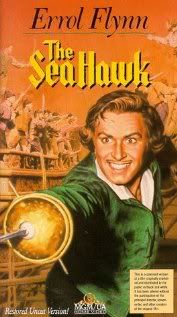
I spent Sunday afternoon taking apart a futon and clearing out our computer desk as we prepare to move our desktop computer from the spare bedroom - slated to become my son's room in a few months - into the master bedroom. Fortunately it turned out to be a good day for Errol Flynn movies - no, I don't watch the Super Bowl - with The Adventures of Robin Hood and The Sea Hawk on TCM.

Among gamers of a certain age, The Adventures of Robin Hood is akin to a sort of sacrament. It was Errol Flynn and Basil Rathbone battling in Nottingham Castle that Gary Gygax wanted to emulate with the hit point rules in OD&D, to capture the back-and-forth of the duelists on the castle steps.

The Sea Hawk is less well-known. Peripherally drawn from the Rafael Sabatini novel of the same name, Errol Flynn plays Captain Thorpe, one of Queen Elizabeth's "Sea Hawks" and a thorn in the side of the Spanish. Thorpe believes the Spanish are preparing to attack England with a great Armada and sets out to expose and foil their plans. The movie concludes with a dramatically-lit duel in the throne room of Winchester Palace.

The Sea Hawk is a fun movie, but it's an even more fascinating book. Mr Sabatini's novel takes place after the Armada and features the exploits of an English sailor and an Algerian pirate. It's an engrossing portrait of the lives of the Barbary corsairs at the turn of the 17th century, of slaves captured in England and held in the banios of Algiers, of renegadoes - Europeans who engaged in piracy under the flags of Algiers, Tunis, and Tripoli - of 'turning Turk,' adopting the Muslim religion, and of the politics of ransom.

An earlier silent version was filmed in 1924, directed by Frank Lloyd; the Errol Flynn movie, filmed sixteen years later, used footage from the earlier film, including full-sized replica ships in action off Santa Catalina Island, just off the California coast (and not far from where the Pirates of the Caribbean sequels would be filmed some eighty years later). I've not seen the Lloyd version of The Sea Hawk, but it sounds like it was much closer to Mr Sabatini's tale.

I would love to see a remake of The Sea Hawk, one that hews closer to the Sabatini book. In addition to swashbuckling action among the galleys and corsairs of the Mediterranean, it's a remarkable tale about a largely forgotten period of contact and conflict between Christian Europe and Muslim Africa.