Read the bill of fare for the Inn of the Welcome Wench in The Village of Hommlet. If I start my campaign with nothing but the village of Hommlet, I know that there's a place called Keoland which exports reasonably priced brandy and wine. That could mean the quality is merely middling, or it's simply closer and therefore less expensive to ship - most likely it's some combination of the two. I get a sense that the vintners of Urnst enjoy some natural advantages over the Keoish, and that the two are probably trade competitors. I'm also pretty sure that Veluna is someplace special, because their wine is in demand enough to be found in a small country inn at a price few locals could ever hope to pay.Crossposted at Promise City.
I can build a region from a wine list, a wine list that is something with which the adventurers can interact from the first time we sit down to play.
I didn't need to detail Keoland, or how it came to be called Keoland, or what it was called a thousand years before it was called Keoland, or what the terrain of Keoland was like ten thousand years before that and then a hundred thousand years before that, in order to plant the seeds - grape vines, actually - of a place called Keoland in the minds of the players.
My bullshit detector works really well, and it tells me the difference between 'stuff that matters to the players' and 'stuff that's primarily written for me.' My first order of business as referee is create stuff that matters to the players, and that means understanding what they are likely to want to do.
You know why Traveller UWPs work so well? Because they answer the questions player want to know first: can I fuel my starship? will the air kill me? can I pack heat? what kinds of gear are available?

Showing posts with label Dungeons and Dragons. Show all posts
Showing posts with label Dungeons and Dragons. Show all posts
Sunday, November 26, 2017
The Wine List of The Welcome Wench
What follows is a reply to a thread at theRPGsite in which I put forth my idea of what's important in preparing a game-world that's meant to be played, as opposed to a game-world which is a referee's plaything. I've referenced this a few times in various online discussions.

Tuesday, February 16, 2016
Campaign Turn
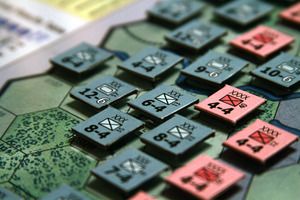
Having picked the time period already, I needed to select the scale of the game. Theater of War (ToW) has three to chose from; Strategic, Grand Tactical and Tactical. The strategic covers an estimated 4000 x 4000 sq. miles and uses the seasons, Spring, Summer, Fall and Winter for the campaign turns. This was too large for what I had in mind.Allocating a block of time in-game to resolve certain kinds of action wasn't at all uncommon in roleplaying games back in the day. Searching for rumors or a patron is a week-long activity in Traveller. Original, little brown book D&D uses the week as the basic scale of time-keeping, with one day devoted to dungeon exploration and the rest to rest and refitting: "The time for dungeon adventures considers only preparations and a typical, one day descent into the pits." A campaign turn in Boot Hill is a week or a month at the referee's discretion. The knights in Pendragon typically have one adventure per year. En Garde! turns are one week long, and the game also uses the month and the season as units of time in resolving action.
Grand Tactical covers a smaller area roughly 400 x 400 sq. miles and uses months as a campaign turn. So 12 turns equals a year. This is more in line with what I was thinking.
The tactical covers an area of 50 x 50 miles and the campaign turn is a week and the campaign ends after the 4th week or more.
The month also appears in Flashing Blades as a standard measure for resolving campaign-level action. Career commitments are measured in months, as is the time spent for gaining new skills, practicing martial skills, or pursuing minor jobs; frex, a priest's annual commitment to performing his duties is six months, with the other six months available for training, practice, pursuing another career or job, or, most importantly, adventuring. Interestingly, the time commitment for a career is flexible: "Each year, a Priest must spend six months, distributed as he likes, performing his religious duties." This gives many careers the feel of a sinecure rather than a nine-to-five job, but it's not inconsistent with how some offices were administered in l'ancien régime.
There is a significant exception to this flexibility: the military campaign. Soldiers and knights on campaign are committed for six months to action at 'the front,' which is resolved through a fun mini-game which condenses the action into three 'encounters.' These encounters begin with the risk of wounds, then may lead to a special event such as an individual battle with an enemy soldier while defending a strategic position, breaking out after being surrounded, or capturing an enemy's flag. Prisoners may be taken and ransom and booty claimed. Military campaigns are waged over six consecutive months, as determined by a die roll, and adventurers whose units are on campaign must serve. The campaign mini-game draws many FB players to military careers for their characters.
Campaign turns in wargames often condense large swathes of activity, particularly involving strategic movement and logistics. Avalon Hill's Kingmaker was a good example of this, with a player's turn involving moving his faction's nobles and their pretenders until a battle broke out or Parliament was convened, in which case the action changed to tactical level combat between forces or the negotiation and treachery of marshaling votes and declaring a king; The Rise and Fall of the Third Reich, another AH board-and-chit game, begins each turn with allocating basic resource points to simulate the logistics of production and supply, followed by strategic movement, and it's only after these are resolved that combat between fleets and armies may take place.
In a roleplaying game, campaign turns may be an opportunity for a mini-game, such as the aforementioned military campaign for Flashing Blades or the cattle drive mini-game published in Reilly Associates' Variant magazine back in the early Eighties for 2e Boot Hill, or they may be something akin to one or more sorts of montages. One could, for example, imagine a Flashing Blades' priest's six months of "religious duties" as a series of vignettes: collecting alms for the poor, praying in his cell, saying Mass, leading a saint's day procession, hearing confession, and so on.
As a referee, I often find myself asking the players something like, "Tell me what it is you want to accomplish," instead of asking for single, discrete steps - "You want to find out if Baron de Bauchery was in town, so first you'll talk to the innkeeper at the Black Swan, and after that you'll take to the innkeeper at the Roe Deer, then . . . " becomes, "So you want to make the rounds of the local inns to find out if the Baron de Bauchery was staying in town when Princess Pinkflower disappeared? Tell me how you plan to approach this." Do they offer bribes? Do they attempt to intimidate the innkeepers? Do they present themselves as allies of the baron? Smart players will use campaign turns similarly, as an opportunity to pursue long-term character development and engagement with the game-world; perhaps our FB priest will use his six months of pastoral obligation to become acquainted with a seigneur and his family, or to research conflicts between Catholics and heretics from the Wars of Religion in his parish.
Beyond a means of condensing routine, non-'adventuring' action, campaign turns also perform an important pacing function. Rising action isn't rising action with falling action for contrast, and campaign turns serve as an opportunity for the campaign to periodically catch its breath. This can help a game-world feel like a living place, where the adventurers follow seasonal rhythms or discharge their responsibilities as figures in in-game society. My first experience playing in a 3e D&D campaign found our characters climbing multiple levels in mere weeks in-game; coming directly from a 1e AD&D background, with steeper experience point requirements and rules such as required training intervals to gain levels, the effect was disconcerting. In my experience, allowing the campaign to proceed in verisimilar cycles contributes to immersion in the game-world.
Monday, October 7, 2013
There Is Nothing Extraneous in the Players Handbook
On my lengthy list of things to do is a post about why 1e Advanced Dungeons & Dragons is a good game for running a swashbuckling campaign.
But Zak got the gist of it already, so go read his post instead.
But Zak got the gist of it already, so go read his post instead.
Monday, June 3, 2013
Social Skills and Roleplaying
Okay, let's get this out of the way right from the giddyup: roleplaying is not 'talking in funny voices.' In-character dialog may be a component of roleplaying, but it is not roleplaying in-and-of-itself.
At its most basic, roleplaying answers the question, 'What will my character do now?' Referring to one's character in the third person all the time is no less roleplaying than speaking only in-character. The is no purity or superiority in the latter approach; I personally enjoy first-person, in-character dialog, both as a player and as a referee, but I don't think less of gamers who prefer the remove of, 'My guy says . . .'
With that in mind, we can dispense with the notion that social skills diminish roleplaying any more than any other skills do. The overwhelming majority of the roleplaying games out there include some sort of rules for social interaction, whether they are as basic as reaction and loyalty rolls in D&D or as involved as Burning Wheel's Duel of Wits. The notion of resolving social interaction through 'pure roleplay,' without some sort of recourse to the rules, is limited to a tiny handful of games, or to gamers who choose to ignore the rules in games which include them; in my experience, the latter are far more common than the former.
So why do some gamers have a nutty over social skills? In my experience, there are a couple of reasons for this. First, some gamers are of the opinion, 'I can't thrust a rapier or swing from a chandelier at the table, so I need rules and rolls for those, but I can just say what my character says, and I don't need rules for that!' That's certainly true: adjudication of non-player character reactions can be handled by the referee without recourse to a die roll or an attribute score, but once again, very few games actually leave social interaction solely to the referee's discretion. The norm is to include rules for resolution, whether those rules are rendered with a broad-brush or crafted in intricate detail.
Second, some games give social skills a bad name, though not always deservedly so. Tales of d20 'diplomancers' optimised to take advantage of the Diplomacy or Bluff or Intimidate skills, breaking entire campaigns by turning a social skill into a form of mind control, can be found in the many different corners where gamers gather, on- and off-line. Despite the fact that at least some of these stories come from misinterpreting the actual rules associated with the skills, they reinforce the predilections of those who prefer to remove or ignore most or all of the rules for social interactions, or more rarely to find those few games with no such rules at all.
Third, as noted right at the beginning, gamers conflating roleplaying with in-character dialog - the 'amateur thespians' - express the opinion that social skills 'inhibit roleplaying!' by 'reducing social interaction to the roll of a die.' I think that's bollocks. Consider the following.
In the first example, you, the player, need to decide how the adventurers are going to get past the soldiers holding the bridge, and in the second you need to figure out how you're going to resolve the conflict between the courtiers in time to get the soldiers to the front. Your character's social skills resolve how well you accomplish what you set out to do.
Moreover, social skills are not charm spells. A non-player character made Helpful through the Diplomacy skill in d20 may be willing to take considerable risks on behalf of your highly persuasive character, but that doesn't make the npc a thrall. The npc will still look after his interests and pursue his agenda while offering assistance to the adventurers.
I've used rolls for social interactions in every game I've ever played, from the aforementioned Charisma-adjusted reaction rolls and loyalty scores for henchmen and hirelings in AD&D to the Contact rules in Top Secret to the social skills of d20 and now Flashing Blades, and in my experience they neither inhibit in-character dialog nor do they result in the players substituting skill rolls for actually having to figure out how to best use those skills to get what they want.
Now, if a game's social skills are being called into play, it follows that the stats of both player and non-player characters come into play. Next up, a quick look at stats for non-player characters.
At its most basic, roleplaying answers the question, 'What will my character do now?' Referring to one's character in the third person all the time is no less roleplaying than speaking only in-character. The is no purity or superiority in the latter approach; I personally enjoy first-person, in-character dialog, both as a player and as a referee, but I don't think less of gamers who prefer the remove of, 'My guy says . . .'
With that in mind, we can dispense with the notion that social skills diminish roleplaying any more than any other skills do. The overwhelming majority of the roleplaying games out there include some sort of rules for social interaction, whether they are as basic as reaction and loyalty rolls in D&D or as involved as Burning Wheel's Duel of Wits. The notion of resolving social interaction through 'pure roleplay,' without some sort of recourse to the rules, is limited to a tiny handful of games, or to gamers who choose to ignore the rules in games which include them; in my experience, the latter are far more common than the former.
So why do some gamers have a nutty over social skills? In my experience, there are a couple of reasons for this. First, some gamers are of the opinion, 'I can't thrust a rapier or swing from a chandelier at the table, so I need rules and rolls for those, but I can just say what my character says, and I don't need rules for that!' That's certainly true: adjudication of non-player character reactions can be handled by the referee without recourse to a die roll or an attribute score, but once again, very few games actually leave social interaction solely to the referee's discretion. The norm is to include rules for resolution, whether those rules are rendered with a broad-brush or crafted in intricate detail.
Second, some games give social skills a bad name, though not always deservedly so. Tales of d20 'diplomancers' optimised to take advantage of the Diplomacy or Bluff or Intimidate skills, breaking entire campaigns by turning a social skill into a form of mind control, can be found in the many different corners where gamers gather, on- and off-line. Despite the fact that at least some of these stories come from misinterpreting the actual rules associated with the skills, they reinforce the predilections of those who prefer to remove or ignore most or all of the rules for social interactions, or more rarely to find those few games with no such rules at all.
Third, as noted right at the beginning, gamers conflating roleplaying with in-character dialog - the 'amateur thespians' - express the opinion that social skills 'inhibit roleplaying!' by 'reducing social interaction to the roll of a die.' I think that's bollocks. Consider the following.
Example 1: "Ahead of you, on a curve in the stream, is a stone bridge. A carriage is overturned at the far end of the bridge, creating a barricade blocking passage to the road beyond. Behind the carriage you see the tips of a dozen pikes above an equal number of gleaming morions. To the right, across the stream, just inside the tree line, is a hastily-built stone revetment, and behind it the light through the trees glints off the barrels of a half-dozen arquebuses. Because of the curve in the stream, the revetment is at right angles to the bridge, giving the arquebusiers a clear field of fire across the open ground approaching the span."Here's the thing: social skills are used to resolve your attempts to accomplish a task. They don't do your roleplaying for you.
"Uh . . . I roll for Tactics."
Example 2: "The king's minister, Enfou, pulls you aside as dancers swirl to the musicians huddled in one corner of the ballroom. 'The king is desperate,' he says. 'The baron de Bauchery can raise enough mercenaries to defend the frontier, but he refuses to do so unless he the king promises him Princess Pinkflower's hand in marriage. Meanwhile the conte di Grognardo is the best commander we have, but he refuses to serve under de Bauchery, and he wants the princess' hand for his son.'"
"Uh . . . I roll for Diplomacy."
In the first example, you, the player, need to decide how the adventurers are going to get past the soldiers holding the bridge, and in the second you need to figure out how you're going to resolve the conflict between the courtiers in time to get the soldiers to the front. Your character's social skills resolve how well you accomplish what you set out to do.
Moreover, social skills are not charm spells. A non-player character made Helpful through the Diplomacy skill in d20 may be willing to take considerable risks on behalf of your highly persuasive character, but that doesn't make the npc a thrall. The npc will still look after his interests and pursue his agenda while offering assistance to the adventurers.
I've used rolls for social interactions in every game I've ever played, from the aforementioned Charisma-adjusted reaction rolls and loyalty scores for henchmen and hirelings in AD&D to the Contact rules in Top Secret to the social skills of d20 and now Flashing Blades, and in my experience they neither inhibit in-character dialog nor do they result in the players substituting skill rolls for actually having to figure out how to best use those skills to get what they want.
Now, if a game's social skills are being called into play, it follows that the stats of both player and non-player characters come into play. Next up, a quick look at stats for non-player characters.
Thursday, January 24, 2013
I Didn't Spend All Those Years Playing Boot Hill and Not Learn a Little Something About Bravery
A 2e Boot Hill character's attributes are Speed, Gun Accuracy, Throwing Accuracy, Bravery, Strength, and Experience. Five of the six affect how well your character fights; the sixth, Strength, determines how much damage the character can take.
The five attributes, including Bravery, which affect combat include modifiers to a character's speed and/or accuracy with various weapons. The Bravery attribute score increases or decreases a character's Speed and Accuracy, for example, providing a discrete, quantifiable impact on the character's performance in the game: a character with a high Bravery score is cool under fire, faster and more accurate than his counterpart with a low Bravery attribute value.
Consider a character who is a town marshal with a Coward Bravery rating and no Experience; maybe he got the job through a political connection, or maybe the townsfolk stuck the badge on him because no one else wanted it and he didn't have the guts to say no. Now a gang of bank robbers come to town, and it's the marshal's job to confront them.
Now here's the thing: there's nothing about the attribute itself rules-wise which determines if or how the marshal will confront the robbers; the attribute modifiers only speak to what happens if he tries to fire his gun at them. The attribute and the modifiers influence how successful the character is in a particular task; they say nothing about when or how the character decides to attempt the task.
So the marshal checks his six-shooters, grabs a double-barrel from the rack, and walks into the dusty Main Street to face-down the robbers. His hands shake like he has the palsy, sweat drips off his brow making his eyes sting, and his mouth is as dry as an arroyo in August so that when he shouts, "Throw up yer hands!" it comes out as little more than a hoarse whisper, and that is what is represented by the Bravery attribute modifiers, not the decision to confront the gang - that decision is solely the province of the player.
In thinking this through, I realised that the character's stats are reflected not in what the character does, but in how well he does it. By treating character attributes as a nothing more than a rules interface and not a determinant of personality, roleplaying and character stats exist independently of one another. Put another way, roleplay your character as you like, and let the stats take care of themselves.
Consider another example, this time the loquacious player who uses a 'social stat' like Charisma or Charm as his character's dump stat; whether you're using something as simple as a reaction roll-plus-modifier or something as complex as Duel of Wits, let the player be as charming and as eloquent as he likes, and let the dice handle the actual result. The player of a would-be warlord may deliver a stirring in-character speech, but if his Charisma modifier is in the negatives, however inspiring the player may believe it to be, the warlord isn't persuasive, for this is the limitation imposed by the character's actual ability, in the same way that his Strength or Dexterity may affect his effectiveness at fighting.
If the player wants the character to be better at something, then it's on the player to choose that for the character, by whatever means the system supports, whether that's adding skill points, raising an attribute, or whatever - a would-be Cassanova with a 5 Charisma needs to invest skill points in Bluff or Diplomacy or whatever, or accept that he's only going to get play when he's really, really lucky.)
I've floated this argument on different roleplaying gaming forums over the years, and I found it's one which reliably brings out the self-anointed real roleplayers to tell me I'm doing it oh-so-profoundly wrong, to accuse me of advocating 'roll-play over roleplay,' and on, and on, and on. Perhaps their most compelling - though by no means persuasive - argument is, 'But that's what the books say!' And pretty often they're right. There's a sort of schizophrenia between what some rule books say about attribute scores, and what they mean in actual play. One of the rules-rebuttals offered is the 2e AD&D PHB, in a section subheaded, "What the Numbers Man," which offers examples of interpreting character personality from the attribute scores.
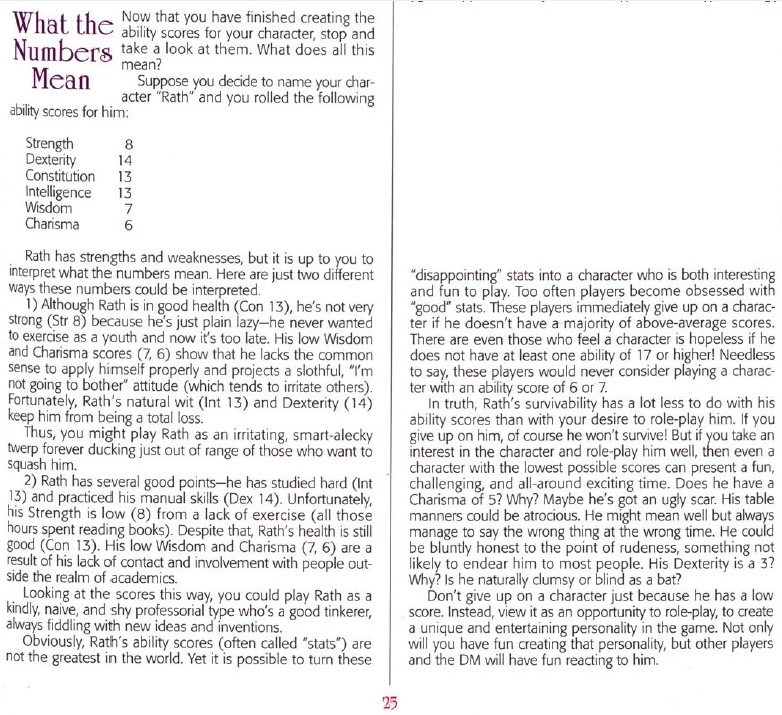
I have two specific issues with this. First, in the case of many roleplaying games but AD&D in particular, the implications of the attribute scores don't relate well to other parts of the game. Take this, frex, from the page above: "His Dexterity is 3? Why? Is he naturally clumsy or blind as a bat?" Well, if he's blind as a bat, is his chance of detecting secret doors lower? Is his outdoor encounter detection range reduced? Or if he's clumsy, is his movement reduced when he runs? Does it affect his melee attacks? Interpreting the stats this way has knock-on effects through other parts of the game with which Dex 3 simply doesn't interact. In 1e AD&D, Dex 3 means the character must be a cleric, that she cannot be a half-elf, elf or halfling, and that she suffers penalties to her reaction time, missle attacks, armor class, and certain saves. And that's it. Neither "blind as a bat" nor "naturally clumsy" fit because of the way attribute scores relate to the rest of the rules.
Second, insisting that attribute scores define personality may limit the range of potential characterisations to 'playing to type.' For example, maybe Rath, again from the 2e example, is a thief who really wants to be the leader of a gang, so he's forever trying to recruit cutpurses and bandits. But of course he's not a natural leader at all, no matter how hard he tries - I know this because his reaction rolls and loyalty scores suck when he tries to lead. The fun thing is, his rare successes simply reinforce his perception of himself, or offer him hope, so he keeps trying.
Playing against type can make for memorable characters. I have a great example of this from my Flashing Blades campaign, Riordan O'Neill, King's Musketeer, would-be Casanova with (originally) Charm 11. Most of his attempts at courtship and seduction are an uphill struggle, and luck is a huge factor in his successes. It's his repeated attempts at being the great lover in spite of lacking the natural acuity reflected by his Charm score that make him so much fun in actual play.
Or how 'bout the lily-livered Boot Hill town marshal I wrote about earlier? Maybe he took the job of marshal out of a sense of responsibility to his community, and he's determined to overcome his shakes when faced with the bank robbers. Or maybe he's a braggart and a bully who likes lording the position of marshal over the rest of the townsfolk, but like most bullies, deep-down he's gutless - he goes to face the bank robbers because he knows if he doesn't, he'll be exposed as yellow.
There's nothing wrong with playing to type, of course, but by unhooking personality from ability, a broader range of characterisations becomes available to the players.
'But what about immersion?' the real-roleplayers complain. 'An Int 6 barbarian shouldn't solve puzzles as well as an Int 18 magic-user!' There are a couple of weaknesses to this rebuttal as well. I don't mean to keep picking on D&D here, but since this argument comes up so often with respect to The World's Most Popular Roleplaying Game™, D&D examples provide a convenient gamer lingua franca. First, let's look again at what the rules say Intelligence actually provides to the character. In 1e AD&D, frex, Intelligence covers the number of possible languages spoken, the minimum and maximum number of spells a magic-user may know by level, the chance to learn a given spell, and the minimum score required to learn spells of a particular level; in 3e, Intelligence covers languages again, skill points, and the modifier for a number of skills. There is no mention of puzzle solving in there at all, and referees who 'slip clues' to players running characters with a high Intelligence score are adding something to the game that simply doesn't exist to compensate for this.
Looking more closely at the rules, what Intelligence, Wit, &c often provide in roleplaying games are resources, not abilities. Perhaps the player of the Int 6 barbarian solves sudokus in his sleep, but he's not solving a puzzle in a language his character doesn't understand until or unless someone translates it for him. Skills may also be gatekeepers, in that a character must learn a certain skill simply to be able to perform a given task. A player who's a master at pike-and-shot wargames is still limited to making brilliant maneuvers in Flashing Blades by first taking the Strategy skill and then rolling under one-third of his character's Wit. In each case, the player's ability is constrained by the character's resources.
In truth, I admit I couldn't care less if a player isn't roleplaying her character's Wit 6. Maybe it comes from starting with D&D way back when, but honestly, I expect players to metagame, to rely on their resourcefulness and experience, and I design my challenges accordingly. I never expected players to pretend their characters didn't know, say, that fire kills trolls; if I wanted them to face an unexpected challenge, then I would simply change things up on them, like trolls which are killed with salt instead of fire. One of the characters in my Flashing Blades campaign nearly died because his player ignored a clue - a case of Anjou wine - which came straight out of The Three Musketeers novel. Easter eggs from books or movies aren't there out of laziness or to try to be clever - they're there because they're fun for the players, and I fully expect them to take advantage of them, or I wouldn't include them in the first place. We're playing a game, and the experience should reward smart play.
Second, because attribute scores are often disconnected from other rules, what tends to snap my suspenders of disbelief isn't an Int 6 barbarian is solving puzzles, but rather roleplaying him as the same stupid lunk at 10th level as he is a 1st level. The barbarian's explored ancient ruins, fought men and monsters, survived poisoning, travelled across trackless wastes, seen priests drive off and destroy undead with a word, felt the power of magic, raised a horde and sacked an evil temple, maybe even been turned to stone and restored to flesh, and yet a few gamers would have that Int 6 trump all of the actual play experiences of the character - and no, that's not hyperbole.
There are roleplaying games out there which integrate both who a character is and how that does what she does - Pendragon is one of my favorite examples of 'personality mechanics' in a roleplaying game. Ability scores, however, are not personality rules, in my experience, and unfortunately even the rule books themselves sometimes confuse this.
The five attributes, including Bravery, which affect combat include modifiers to a character's speed and/or accuracy with various weapons. The Bravery attribute score increases or decreases a character's Speed and Accuracy, for example, providing a discrete, quantifiable impact on the character's performance in the game: a character with a high Bravery score is cool under fire, faster and more accurate than his counterpart with a low Bravery attribute value.
Consider a character who is a town marshal with a Coward Bravery rating and no Experience; maybe he got the job through a political connection, or maybe the townsfolk stuck the badge on him because no one else wanted it and he didn't have the guts to say no. Now a gang of bank robbers come to town, and it's the marshal's job to confront them.
Now here's the thing: there's nothing about the attribute itself rules-wise which determines if or how the marshal will confront the robbers; the attribute modifiers only speak to what happens if he tries to fire his gun at them. The attribute and the modifiers influence how successful the character is in a particular task; they say nothing about when or how the character decides to attempt the task.
So the marshal checks his six-shooters, grabs a double-barrel from the rack, and walks into the dusty Main Street to face-down the robbers. His hands shake like he has the palsy, sweat drips off his brow making his eyes sting, and his mouth is as dry as an arroyo in August so that when he shouts, "Throw up yer hands!" it comes out as little more than a hoarse whisper, and that is what is represented by the Bravery attribute modifiers, not the decision to confront the gang - that decision is solely the province of the player.
In thinking this through, I realised that the character's stats are reflected not in what the character does, but in how well he does it. By treating character attributes as a nothing more than a rules interface and not a determinant of personality, roleplaying and character stats exist independently of one another. Put another way, roleplay your character as you like, and let the stats take care of themselves.
Consider another example, this time the loquacious player who uses a 'social stat' like Charisma or Charm as his character's dump stat; whether you're using something as simple as a reaction roll-plus-modifier or something as complex as Duel of Wits, let the player be as charming and as eloquent as he likes, and let the dice handle the actual result. The player of a would-be warlord may deliver a stirring in-character speech, but if his Charisma modifier is in the negatives, however inspiring the player may believe it to be, the warlord isn't persuasive, for this is the limitation imposed by the character's actual ability, in the same way that his Strength or Dexterity may affect his effectiveness at fighting.
If the player wants the character to be better at something, then it's on the player to choose that for the character, by whatever means the system supports, whether that's adding skill points, raising an attribute, or whatever - a would-be Cassanova with a 5 Charisma needs to invest skill points in Bluff or Diplomacy or whatever, or accept that he's only going to get play when he's really, really lucky.)
I've floated this argument on different roleplaying gaming forums over the years, and I found it's one which reliably brings out the self-anointed real roleplayers to tell me I'm doing it oh-so-profoundly wrong, to accuse me of advocating 'roll-play over roleplay,' and on, and on, and on. Perhaps their most compelling - though by no means persuasive - argument is, 'But that's what the books say!' And pretty often they're right. There's a sort of schizophrenia between what some rule books say about attribute scores, and what they mean in actual play. One of the rules-rebuttals offered is the 2e AD&D PHB, in a section subheaded, "What the Numbers Man," which offers examples of interpreting character personality from the attribute scores.
I have two specific issues with this. First, in the case of many roleplaying games but AD&D in particular, the implications of the attribute scores don't relate well to other parts of the game. Take this, frex, from the page above: "His Dexterity is 3? Why? Is he naturally clumsy or blind as a bat?" Well, if he's blind as a bat, is his chance of detecting secret doors lower? Is his outdoor encounter detection range reduced? Or if he's clumsy, is his movement reduced when he runs? Does it affect his melee attacks? Interpreting the stats this way has knock-on effects through other parts of the game with which Dex 3 simply doesn't interact. In 1e AD&D, Dex 3 means the character must be a cleric, that she cannot be a half-elf, elf or halfling, and that she suffers penalties to her reaction time, missle attacks, armor class, and certain saves. And that's it. Neither "blind as a bat" nor "naturally clumsy" fit because of the way attribute scores relate to the rest of the rules.
Second, insisting that attribute scores define personality may limit the range of potential characterisations to 'playing to type.' For example, maybe Rath, again from the 2e example, is a thief who really wants to be the leader of a gang, so he's forever trying to recruit cutpurses and bandits. But of course he's not a natural leader at all, no matter how hard he tries - I know this because his reaction rolls and loyalty scores suck when he tries to lead. The fun thing is, his rare successes simply reinforce his perception of himself, or offer him hope, so he keeps trying.
Playing against type can make for memorable characters. I have a great example of this from my Flashing Blades campaign, Riordan O'Neill, King's Musketeer, would-be Casanova with (originally) Charm 11. Most of his attempts at courtship and seduction are an uphill struggle, and luck is a huge factor in his successes. It's his repeated attempts at being the great lover in spite of lacking the natural acuity reflected by his Charm score that make him so much fun in actual play.
Or how 'bout the lily-livered Boot Hill town marshal I wrote about earlier? Maybe he took the job of marshal out of a sense of responsibility to his community, and he's determined to overcome his shakes when faced with the bank robbers. Or maybe he's a braggart and a bully who likes lording the position of marshal over the rest of the townsfolk, but like most bullies, deep-down he's gutless - he goes to face the bank robbers because he knows if he doesn't, he'll be exposed as yellow.
There's nothing wrong with playing to type, of course, but by unhooking personality from ability, a broader range of characterisations becomes available to the players.
'But what about immersion?' the real-roleplayers complain. 'An Int 6 barbarian shouldn't solve puzzles as well as an Int 18 magic-user!' There are a couple of weaknesses to this rebuttal as well. I don't mean to keep picking on D&D here, but since this argument comes up so often with respect to The World's Most Popular Roleplaying Game™, D&D examples provide a convenient gamer lingua franca. First, let's look again at what the rules say Intelligence actually provides to the character. In 1e AD&D, frex, Intelligence covers the number of possible languages spoken, the minimum and maximum number of spells a magic-user may know by level, the chance to learn a given spell, and the minimum score required to learn spells of a particular level; in 3e, Intelligence covers languages again, skill points, and the modifier for a number of skills. There is no mention of puzzle solving in there at all, and referees who 'slip clues' to players running characters with a high Intelligence score are adding something to the game that simply doesn't exist to compensate for this.
Looking more closely at the rules, what Intelligence, Wit, &c often provide in roleplaying games are resources, not abilities. Perhaps the player of the Int 6 barbarian solves sudokus in his sleep, but he's not solving a puzzle in a language his character doesn't understand until or unless someone translates it for him. Skills may also be gatekeepers, in that a character must learn a certain skill simply to be able to perform a given task. A player who's a master at pike-and-shot wargames is still limited to making brilliant maneuvers in Flashing Blades by first taking the Strategy skill and then rolling under one-third of his character's Wit. In each case, the player's ability is constrained by the character's resources.
In truth, I admit I couldn't care less if a player isn't roleplaying her character's Wit 6. Maybe it comes from starting with D&D way back when, but honestly, I expect players to metagame, to rely on their resourcefulness and experience, and I design my challenges accordingly. I never expected players to pretend their characters didn't know, say, that fire kills trolls; if I wanted them to face an unexpected challenge, then I would simply change things up on them, like trolls which are killed with salt instead of fire. One of the characters in my Flashing Blades campaign nearly died because his player ignored a clue - a case of Anjou wine - which came straight out of The Three Musketeers novel. Easter eggs from books or movies aren't there out of laziness or to try to be clever - they're there because they're fun for the players, and I fully expect them to take advantage of them, or I wouldn't include them in the first place. We're playing a game, and the experience should reward smart play.
Second, because attribute scores are often disconnected from other rules, what tends to snap my suspenders of disbelief isn't an Int 6 barbarian is solving puzzles, but rather roleplaying him as the same stupid lunk at 10th level as he is a 1st level. The barbarian's explored ancient ruins, fought men and monsters, survived poisoning, travelled across trackless wastes, seen priests drive off and destroy undead with a word, felt the power of magic, raised a horde and sacked an evil temple, maybe even been turned to stone and restored to flesh, and yet a few gamers would have that Int 6 trump all of the actual play experiences of the character - and no, that's not hyperbole.
There are roleplaying games out there which integrate both who a character is and how that does what she does - Pendragon is one of my favorite examples of 'personality mechanics' in a roleplaying game. Ability scores, however, are not personality rules, in my experience, and unfortunately even the rule books themselves sometimes confuse this.
Friday, January 4, 2013
Gimli of Arabia
I've recounted the story of 'Gimli of Arabia' on different forums over the years; I think this may be one of the first such posts.
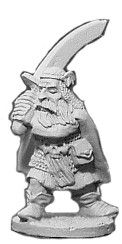 The character - who's actual name was Khazm, not Gimli - remains one of my favorite characters from any game and any campaign, but he also illustrates a couple of points about roleplaying games which are important to me.
First, Khazm developed not based on a 'character concept' dreamed up before the game started, but in response to the events of actual play.
What's important to me isn't who my character is at the start of the game, but who my character may become through suffering the slings and arrows of actual play. That means creating an involved backstory, or making up connections to non-player characters, or dreaming up funny mannerisms, or coining a catch-phrase, are trivial compared to my character's reaction to the unfolding events of the campaign. Planning for who my character will be in nineteen levels is just as inconsequential as trying to determine who he is before the campaign begins, and burgeoning rules complexity which leads to a lack of flexibility works directly against my style of play. In my experience, games which produce broad character archetypes work best for this; the more fiddly bits a character needs, the more difficult it can be to make changes on the fly. Simpler rules, without mastery traps, work best for this.
Second, with respect to those broad archetypes, Khazm was an otherwise bog-standard fighter, but adopting an atypical weapon and unusual cultural trappings for his race made him effectively unique in the game-world - this was the days before every demihuman race had an ice subrace and a sea subrace and a desert subrace and a jungle subrace, of course. It didn't take class abilities or feats or prestige classes to make him distinctive - the only rules-wise change to Khazm was spending a weapon proficiency slot on the scimitar after he leveled up - but rather I simply roleplayed him in ways, and surrounded him with trappings, which reflected his adopted culture.
Sometimes I hear that playing swashbucklers or gunfighters or gangsters is boring because all the characters are basically the same - guy with a rapier, guy with a Peacemaker, guy with a Tommy gun. There's nothing, they say, to differentiate one 5th level fighter from another without feats et al. Well, Khazm and I beg to differ.
I ran a typical hammer-throwing, axe-swinging dwarf fighter in a 1e AD&D game when I was in high school. At one point we found ourselves exploring a pyramid deep in a desert, and in the course of the adventure we found a +3 scimitar. The other fighter player characters in the party had died and the player was waiting to introduce his new character, so my dwarf was the only one in the party able to take advantage of this magical scimitar.
The dwarf was not proficient in the weapon, so he was less accurate when wielding it (and this was before weapon specialization in UA) until he could burn a proficiency slot, but it was a powerful magic weapon and we needed that as we were facing lots of undead in the crypts beneath the pyramid. As he continued to wield this scimitar, I had the character start embracing some of the local lifestyle: his rough woolen cloak was replaced by a silk aba, he sported a turban, he indulged in local jewelry, and so on. By the time our party left the pyramid and moved on to other adventures, he was a sort of "Gimli of Arabia," riding a camel and picking up a desert-dwelling illusionist as a henchman in the process. He was a lot of fun to play.
First, Khazm developed not based on a 'character concept' dreamed up before the game started, but in response to the events of actual play.
One of the reasons I stopped enjoying 3e D&D fairly early on is that, in my experience, it worked against this sort of organic character development. I observed that feat chains, prestige classes and their prerequisites, and 1-20 builds made many players reluctant to take something for which they had not planned and run with it. I don't mean to suggest that the rules required this, and I don't believe it's true of all players everywhere, but I saw enough of it as both a player and a dungeon master to find it off-putting.Over the years I've been told - always on gaming message boards, and never by anyone with whom I actually sat around a table - that my develop-in-play approach to characterisation is more suited to skirmish wargames than roleplaying games. 'Real roleplayers,' the unsubtle implication goes, begin with a 'fleshed out' character, and to do otherwise is simply playing some variation of myself. What's usually overlooked in their too-often sneering disdain is that I am not, in fact, a dwarf warrior in a fantastic realm of dungeons and dragons, or a swashbuckling highwaymen chasing a carriage over the moors on my black charger, or a steely-eyed gunfighter standing in bright sunlight on the dusty streets of Abilene, so my characters are already not-me right from the mother-lovin' giddyup.
The idea that treasure should be matched to the characters is another big step away from my experience playing my dwarf fighter character, taking an unusual weapon and allowing the character concept to evolve to accomodate it, rather than giving the dungeon master a slip requesting "a hammer of thunderbolts, 'cause it's integral to my character concept!"
What's important to me isn't who my character is at the start of the game, but who my character may become through suffering the slings and arrows of actual play. That means creating an involved backstory, or making up connections to non-player characters, or dreaming up funny mannerisms, or coining a catch-phrase, are trivial compared to my character's reaction to the unfolding events of the campaign. Planning for who my character will be in nineteen levels is just as inconsequential as trying to determine who he is before the campaign begins, and burgeoning rules complexity which leads to a lack of flexibility works directly against my style of play. In my experience, games which produce broad character archetypes work best for this; the more fiddly bits a character needs, the more difficult it can be to make changes on the fly. Simpler rules, without mastery traps, work best for this.
Second, with respect to those broad archetypes, Khazm was an otherwise bog-standard fighter, but adopting an atypical weapon and unusual cultural trappings for his race made him effectively unique in the game-world - this was the days before every demihuman race had an ice subrace and a sea subrace and a desert subrace and a jungle subrace, of course. It didn't take class abilities or feats or prestige classes to make him distinctive - the only rules-wise change to Khazm was spending a weapon proficiency slot on the scimitar after he leveled up - but rather I simply roleplayed him in ways, and surrounded him with trappings, which reflected his adopted culture.
Sometimes I hear that playing swashbucklers or gunfighters or gangsters is boring because all the characters are basically the same - guy with a rapier, guy with a Peacemaker, guy with a Tommy gun. There's nothing, they say, to differentiate one 5th level fighter from another without feats et al. Well, Khazm and I beg to differ.
Tuesday, December 18, 2012
Lumpers and Splitters
There are two kinds of people in the world . . . [insert joke here].
Simulating real-world activities in a game often requires some measure of abstraction - a die roll to see if you can stab your foe with a sword, or to climb a trellis to a balcony. Just how abstract is necessary and desirable is a source of near constant debate among gamers. One element of creating an abstraction of a real-world process or action is deciding how complex the abstraction needs to be, balancing the want of detail for the need of playability. Each abstraction, then, involves trade-offs, and many of these trade-offs come from lumping or splitting like things into a single unifying rule or many separate rules.
On the one hand, you have a game designer like Gary Gygax, who in OD&D wrote that all weapons did 1d6 damage, lumping together everything from a crossbow to a dagger to a sword to a polearm. On the other hand, you have a game designer like . . . Gary Gygax, who in 1e AD&D famously included twenty different polearms in the core rules of the game, each with its own rules for determining how effective it is against different types of armor, how fast it is to use in combat, and the different ranges of damage done.
Another old school example of splitting and lumping is the difference between firearms in Top Secret and Boot Hill. The core rules for Top Secret include thirty-one distinct firearms, from the Colt M1911 and Browning Hi-Power to the AKM and M-16; the Top Secret Companion added another thirty, while articles in Dragon lavished attention on Uzi variants and the weapons of Heckler & Koch. Each gun has its own projectile weapon value based on a variety of characteristics. Contrast TS's approach with that of Boot Hill, which has thirteen basic firearm types - single-action revolver, double-action revolver, fast-draw revolver, rifle, carbine, &c. In BH, a SAR6 - a six-shot single-action revolver - can represent everything from a Colt Peacemaker to a Smith & Wesson Schofield to a Remington Model 1875.
There's utility in both approaches, of course, but as much as I enjoy comparing the effectiveness of various polearms versus plate armor on the weapon versus armor type table or deciding which is more my agent's style, the Walther PPK or the Beretta Bantam, I find myself leaning more toward lumping when it comes to weaponry in roleplaying games. Once I was comfortable with describing a CBR - cap-and-ball revolver - as 'a greasy Colt Single Action Army' or a R15 as 'a gleaming brass-plated Henry rifle' when I was running Boot Hill, I grew to appreciate the versatility and relative simplicity of the approach. For me, when it comes to the rules of the game, ease of play trumps evocative flavor - the latter I will add to the mix myself.
Like Boot Hill and firearms, Flashing Blades takes a spare approach to swords. There are six basic types of swords in FB: longswords, rapiers, foils, sabers, cutlasses, and two-handed swords. "Longsword" and "foil" can be a bit confusing, as both are anachronisms as used in the rules - longswords, which are closer to two-handed swords in FB, for the most part fell out of use in the 16th century, while foils are the 18th century descendants of the smallsword.
Adding flavor to the swords of Flashing Blades begins with identifying some of the different swords that each of the five represent.
'Basket-hilted broadsword' is the correct name for what FB labels a "longsword." The side-sword is an Italian blade, later called spada da lato, developed from the Spanish espada ropera in the late 16th century but still popular among soldiers. The pallasch is the Hungarian broadsword, popular in the Empire, while the schiavona is its Italian counterpart, taking its name from the Dalmatian guards - Schiavoni - who served the doges of Venice. The Walloon sword is a Dutch weapon while the mortuary sword is the English Civil War-ear name for the broadsword - the style of sword used to execute Charles I, many royalists would have an image of the late king on the pommel or hilt.
The Pappelheimer rapier has a distinctive guard from the more-or-less standard swept-hilt rapier, developed in Germany; the cup-hilt rapier is popular among the Spanish.
The smallsword is a mid- to late-seventeenth century development - in my own campaign, set in the 1620s, this would be more properly considered simply a small rapier - but for simplicity's sake, I go ahead and call it a smallsword anyway, replacing Mark Pettigrew's anachronism with my own.
The szlaba, kilij, and Schnäpf are Polish, Turkish, and Swiss sabers, respectively.
The hanger is a hunting sword, with a heavy, slightly curved blade, used for performing the coup de grâce on a wounded animal.
The Swiss and German Doppelhänder, later known as the Zweihänder, descended from the medieval longsword. The French estoc, is a proper longsword, and may be used one- or two-handed. The claymore is the Scottish two-handed sword, which is not to be confused with the basket-hilted broadsword also called a claymore.
I actually had a gamer tell me once that his group was too busy playing for fluff. Fortunately, I've never experienced anyone like that across the table from me - most players seem to prefer, 'the Spaniard with the cup-hilt rapier of shining Toledo steel' to 'the guy with the sword,' so I make the effort to build out from the rules to a more evocative description. That said, I don't really need the rulebook to do it for me - 'no flowers, by request.'
Simulating real-world activities in a game often requires some measure of abstraction - a die roll to see if you can stab your foe with a sword, or to climb a trellis to a balcony. Just how abstract is necessary and desirable is a source of near constant debate among gamers. One element of creating an abstraction of a real-world process or action is deciding how complex the abstraction needs to be, balancing the want of detail for the need of playability. Each abstraction, then, involves trade-offs, and many of these trade-offs come from lumping or splitting like things into a single unifying rule or many separate rules.
On the one hand, you have a game designer like Gary Gygax, who in OD&D wrote that all weapons did 1d6 damage, lumping together everything from a crossbow to a dagger to a sword to a polearm. On the other hand, you have a game designer like . . . Gary Gygax, who in 1e AD&D famously included twenty different polearms in the core rules of the game, each with its own rules for determining how effective it is against different types of armor, how fast it is to use in combat, and the different ranges of damage done.
Another old school example of splitting and lumping is the difference between firearms in Top Secret and Boot Hill. The core rules for Top Secret include thirty-one distinct firearms, from the Colt M1911 and Browning Hi-Power to the AKM and M-16; the Top Secret Companion added another thirty, while articles in Dragon lavished attention on Uzi variants and the weapons of Heckler & Koch. Each gun has its own projectile weapon value based on a variety of characteristics. Contrast TS's approach with that of Boot Hill, which has thirteen basic firearm types - single-action revolver, double-action revolver, fast-draw revolver, rifle, carbine, &c. In BH, a SAR6 - a six-shot single-action revolver - can represent everything from a Colt Peacemaker to a Smith & Wesson Schofield to a Remington Model 1875.
There's utility in both approaches, of course, but as much as I enjoy comparing the effectiveness of various polearms versus plate armor on the weapon versus armor type table or deciding which is more my agent's style, the Walther PPK or the Beretta Bantam, I find myself leaning more toward lumping when it comes to weaponry in roleplaying games. Once I was comfortable with describing a CBR - cap-and-ball revolver - as 'a greasy Colt Single Action Army' or a R15 as 'a gleaming brass-plated Henry rifle' when I was running Boot Hill, I grew to appreciate the versatility and relative simplicity of the approach. For me, when it comes to the rules of the game, ease of play trumps evocative flavor - the latter I will add to the mix myself.
Like Boot Hill and firearms, Flashing Blades takes a spare approach to swords. There are six basic types of swords in FB: longswords, rapiers, foils, sabers, cutlasses, and two-handed swords. "Longsword" and "foil" can be a bit confusing, as both are anachronisms as used in the rules - longswords, which are closer to two-handed swords in FB, for the most part fell out of use in the 16th century, while foils are the 18th century descendants of the smallsword.
Adding flavor to the swords of Flashing Blades begins with identifying some of the different swords that each of the five represent.
| FB Weapon | Real-world Examples |
|---|---|
| Longsword | Basket-hilted broadsword, side-sword, pallasch, schiavona, Walloon sword, mortuary sword |
| Rapier | Rapier, Pappelheimer rapier, cup-hilt rapier |
| Foil | Smallsword |
| Saber | Sabre, szlaba, kilij, Schnäpf |
| Cutlass | Cutlass, hanger |
| Two-handed Sword | Doppelhänder, estoc, claymore |
'Basket-hilted broadsword' is the correct name for what FB labels a "longsword." The side-sword is an Italian blade, later called spada da lato, developed from the Spanish espada ropera in the late 16th century but still popular among soldiers. The pallasch is the Hungarian broadsword, popular in the Empire, while the schiavona is its Italian counterpart, taking its name from the Dalmatian guards - Schiavoni - who served the doges of Venice. The Walloon sword is a Dutch weapon while the mortuary sword is the English Civil War-ear name for the broadsword - the style of sword used to execute Charles I, many royalists would have an image of the late king on the pommel or hilt.
The Pappelheimer rapier has a distinctive guard from the more-or-less standard swept-hilt rapier, developed in Germany; the cup-hilt rapier is popular among the Spanish.
The smallsword is a mid- to late-seventeenth century development - in my own campaign, set in the 1620s, this would be more properly considered simply a small rapier - but for simplicity's sake, I go ahead and call it a smallsword anyway, replacing Mark Pettigrew's anachronism with my own.
The szlaba, kilij, and Schnäpf are Polish, Turkish, and Swiss sabers, respectively.
The hanger is a hunting sword, with a heavy, slightly curved blade, used for performing the coup de grâce on a wounded animal.
The Swiss and German Doppelhänder, later known as the Zweihänder, descended from the medieval longsword. The French estoc, is a proper longsword, and may be used one- or two-handed. The claymore is the Scottish two-handed sword, which is not to be confused with the basket-hilted broadsword also called a claymore.
I actually had a gamer tell me once that his group was too busy playing for fluff. Fortunately, I've never experienced anyone like that across the table from me - most players seem to prefer, 'the Spaniard with the cup-hilt rapier of shining Toledo steel' to 'the guy with the sword,' so I make the effort to build out from the rules to a more evocative description. That said, I don't really need the rulebook to do it for me - 'no flowers, by request.'
Tuesday, November 20, 2012
Two-Weapon Fighting for (4e?) D&D
The talented Paul at Blog of Holding has a post on two-weapon fighting that is, judging from the heading, ostensibly for 4e D&D, but looks like it could work for pre-2e versions of The World's Most Popular Roleplaying Game as well.
Compare the passage from 1e AD&D on two-weapon fighting.
To really capture that feel, perhaps there also needs to be more choices on defense as well. Trollsmyth's shields must be splintered house rule works very well for battles involving bastard swords and maces, but it doesn't feel quite right for combat fought with a buckler and a basket-hilted broadsword. While I don't like the idea of 'lightly armored fighters' gaining an advantage to armor class to compensate for not wearing armor in D&D, perhaps allowing a main-gauche to provide a +1 to armor class, but limiting it to defense against swords and daggers only, might work. Another thought is, rather than raising armor class with experience, the Duelist gets to use Dexterity in place of Strength when parrying.
In any case, I like Paul's rule and I can see it finding a way into my campaign.
Compare the passage from 1e AD&D on two-weapon fighting.
Attacks With Two Weapons:And just for kicks, here's what 1e AD&D says about parrying as well.
Characters normally using a single weapon may choose to use one in each hand (possibly discarding the option of using a shield). The second weapon must be either a dagger or hand axe. Employment of a second weapon is always at a penalty. The use of a second weapon causes the character to attack with his or her primary weapon at -2 and the secondary weapon at -4. If the user’s dexterity is below 6, the reaction/attacking Adjustment penalties shown in the PLAYERS HANDBOOK are added to EACH weapon attack. If the user’s dexterity is above 15, there is a downward adjustment in the weapon penalties as shown, although this never gives a positive (bonus) rating to such attacks, so that at 16 dexterity the secondary/primary penalty is-3/-1, at 17-2/0, and at 18-l/O.
The secondary weapon does not act as a shield or parrying device in any event.
Parrying disallows any return attack that round, but the strength "to hit" bonus is then subtracted from the opponent's "to hit" dice roll(s), so the character is less likely to be hit. - 1e AD&D PHB, "Melee Combat," p. 104I've been thinking about this a bit in the context of running a 1e AD&D swashbuckling & sorcery campaign. Looking at the original rule on fighting with two weapons, I think Paul's rule could slot in right beside it - either attempt to gain an extra strike at a penalty, or attempt to use both weapons to gain an advantage such that one of them will find its mark. I like this, because it adds to the feel of fencing which cape-and-sword games attempt to capture.
To really capture that feel, perhaps there also needs to be more choices on defense as well. Trollsmyth's shields must be splintered house rule works very well for battles involving bastard swords and maces, but it doesn't feel quite right for combat fought with a buckler and a basket-hilted broadsword. While I don't like the idea of 'lightly armored fighters' gaining an advantage to armor class to compensate for not wearing armor in D&D, perhaps allowing a main-gauche to provide a +1 to armor class, but limiting it to defense against swords and daggers only, might work. Another thought is, rather than raising armor class with experience, the Duelist gets to use Dexterity in place of Strength when parrying.
In any case, I like Paul's rule and I can see it finding a way into my campaign.
Friday, September 28, 2012
LoS
Wargame rules often spend a fair number of paragraphs on who can see whom. Line of sight - usually abbreviated LoS - can be a part of everything from firing weapons to charging to a commander changing a unit's orders, so wargames treat it with some care. Fans of the original Squad Leader will remember the dot in the center of each hex used for determining whether a particular hex could be seen from another hex, or the determination of "hull down" for AFVs on ridgelines.
After wargames birthed roleplaying games, the need to determine when something was in view to the characters remained. OD&D, for instance, says that monsters are detected at a distance of 20-80 feet underground or 40-240 yards outdoors unless the party is surprised. It's interesting there's no consideration for individual character proficiency, and when such a differentiation appears, it's associated with classes and skills, not ability scores. Frex, the 1e AD&D Ranger, as a class ability, is more likely to surprise an opponent and less likely to be surprised in turn, while in Traveller, the Tactics and Leader skills and military experience favorably modify surprise for the adventurers.
Boot Hill retains a facing system more like that of the tabletop miniature skirmish game from which it was derived, with characters able to observe a 90-degree arc ahead of them and the ability to observe someone in concealment wholly at referee discretion. I soon added a house rule that a character could spend one movement point to 'look around,' which allowed the character to extend the observation axis by another 90-degrees to the left or right; in this way, a character could run but would be slowed by taking his attention off the direction in which he was moving, which seemed a fair trade-off. Again, the character's attributes played no particular role in determining what could be seen, and in BH, even the dice were removed as a factor, as opposed to D&D or Traveller.
It wasn't too many years before roleplaying games introduced rules for alertness, perception or observation, often associated with a character attribute and/or skill, and this soon became the norm; with some games, such as d20-based systems, a combination of attribute scores, skill points, and feats could produce 'Spot-monkeys' with superhuman powers of observation.
Though I think that later roleplaying games tend to make too big a deal out of things like Spot, Alertness, and so forth, treating all characters as equally perceptive is perhaps a bit too coarse-grained as well, appropriate to small units but not distinct individuals. Accordingly, for my Flashing Blades campaign, I use a blending of the two methods. The core rules make no mention of surprise or observation, but examples in the published adventures point to both the Wit and Luck attributes; in fact, it was this usage of Luck that led me to spell out that in my campaign, Luck is, "rather than a metaphysical force or quality, the insightfulness of the character: it's the ability to notice subtle clues or behaviors, to be in tune with one's surroundings" - a gambler, for which Luck is the associated attribute, isn't so much smiled upon by Fortune as he is able to pick up tells from his fellow gamblers, for example. As such, Luck is often used to represent the power of observation or perception in actual play.
As a modifier to an individual's Luck attribute, I also use the combined surprise and initiative rules for original, 'classic' Traveller - the skills Captaincy and Strategy replace Traveller's Leader and Tactics respectively, and service on a campaign gives the benefit of military experience. If the adventurers are surprised as a group, then individual Luck checks are made at a penalty of Luck/2 or Luck/3 at my discretion. For me this achieves the best of both worlds.
After wargames birthed roleplaying games, the need to determine when something was in view to the characters remained. OD&D, for instance, says that monsters are detected at a distance of 20-80 feet underground or 40-240 yards outdoors unless the party is surprised. It's interesting there's no consideration for individual character proficiency, and when such a differentiation appears, it's associated with classes and skills, not ability scores. Frex, the 1e AD&D Ranger, as a class ability, is more likely to surprise an opponent and less likely to be surprised in turn, while in Traveller, the Tactics and Leader skills and military experience favorably modify surprise for the adventurers.
Boot Hill retains a facing system more like that of the tabletop miniature skirmish game from which it was derived, with characters able to observe a 90-degree arc ahead of them and the ability to observe someone in concealment wholly at referee discretion. I soon added a house rule that a character could spend one movement point to 'look around,' which allowed the character to extend the observation axis by another 90-degrees to the left or right; in this way, a character could run but would be slowed by taking his attention off the direction in which he was moving, which seemed a fair trade-off. Again, the character's attributes played no particular role in determining what could be seen, and in BH, even the dice were removed as a factor, as opposed to D&D or Traveller.
It wasn't too many years before roleplaying games introduced rules for alertness, perception or observation, often associated with a character attribute and/or skill, and this soon became the norm; with some games, such as d20-based systems, a combination of attribute scores, skill points, and feats could produce 'Spot-monkeys' with superhuman powers of observation.
Though I think that later roleplaying games tend to make too big a deal out of things like Spot, Alertness, and so forth, treating all characters as equally perceptive is perhaps a bit too coarse-grained as well, appropriate to small units but not distinct individuals. Accordingly, for my Flashing Blades campaign, I use a blending of the two methods. The core rules make no mention of surprise or observation, but examples in the published adventures point to both the Wit and Luck attributes; in fact, it was this usage of Luck that led me to spell out that in my campaign, Luck is, "rather than a metaphysical force or quality, the insightfulness of the character: it's the ability to notice subtle clues or behaviors, to be in tune with one's surroundings" - a gambler, for which Luck is the associated attribute, isn't so much smiled upon by Fortune as he is able to pick up tells from his fellow gamblers, for example. As such, Luck is often used to represent the power of observation or perception in actual play.
As a modifier to an individual's Luck attribute, I also use the combined surprise and initiative rules for original, 'classic' Traveller - the skills Captaincy and Strategy replace Traveller's Leader and Tactics respectively, and service on a campaign gives the benefit of military experience. If the adventurers are surprised as a group, then individual Luck checks are made at a penalty of Luck/2 or Luck/3 at my discretion. For me this achieves the best of both worlds.
Monday, September 17, 2012
Swashbucklers of the Barbaric Frontier
M.P. at Barbaric Frontier has swashbuckler class for what appears to be a LotFP/S&W mash-up.
I like it - it keeps the basics of a D&Dish fighter while capturing both a bit of the archetype and avoiding some of the excesses of other attempts at swashbucklers for D&D.
I'd play one, if I rolled the right numbers.
I like it - it keeps the basics of a D&Dish fighter while capturing both a bit of the archetype and avoiding some of the excesses of other attempts at swashbucklers for D&D.
I'd play one, if I rolled the right numbers.
Thursday, August 30, 2012
1e AD&D Monsters for Swashbuckling & Sorcery
So, as a coda to this little thought-experiment, I gave some thought to monsters in a swashbuckling & sorcery 1e AD&D campaign.
Given that I'm not much of a fantasy fan, my own predilection is for a humans-only campaign with very few monsters. While AD&D can certainly do such a campaign, it also rather misses one of the reasons for choosing Dungeons & Dragons in the first place. So, the question becomes, include everything or limit the selection, and if the latter, how much?
My own inclination is to limit the selection; even when I ran bog-standard pseudo-medieval D&D fantasy, I pretty severely limited the range of monsters found in the campaign world from what was available in the various monster manuals. That said, it is personal preference, not an attempt to define the genre by way of inclusion or exclusion from a selection of fantastic creatures. If you want your swashbucklers battling ankhegs and neo-otyughs, more power to you, but I'm going to take a different path.
When I think of swashbuckling & sorcery, what first comes to mind is Solomon Kane. The world of REH's Puritan swordsman is filled with degenerate men, some wielding foul magics and trafficking with foul spirits, others just plain fouled by their own corrupt natures, but it's also a world with 'real,' as opposed to metaphorical, monsters. 'Dark powers' abound, represented in AD&D terms by creatures such as demons, devils, dæmons, and other evil outer planar monsters. At low levels the adventurers might find themselves beset by imps or quasits bound to the service of a witch, frex, before graduating to more powerful fiends as they uncover sinister schemes and attract unwholesome attention as a result. Rakshasas and ogre magi - oni are perfect for this as well. Appendix D of the Dungeon Masters Guide is the ideal tool for generating unique fiends for my swashbuckling & sorcery campaign.
In fact, unique monsters, or rare groups with a limited geographic range, appeal to me. More on that in a moment.
In addition to demons et al., undead are another logical category of monstrous foes for swashbuckling & sorcery. The whole gamut of horrors may be found in the game-world, consorting with the most vile and debased among the living. Revenants and ju-ju zombies jump out at me - so to speak - as particularly fitting: the venegeful, unquiet spirit and the horrific servant of a dangerous spellcaster.
Lycanthropes fit the swashbuckling & sorcery setting well, again tapping that notion of curse-spawned corruption among men.
Now, the common theme in all of these monsters so far is that they are found in concert with humans. For me, swashbuckling & sorcery doesn't summon up an image of a world on the verge of being overrun by legions of umber hulks riding armored purple worms - rather, most monsters of the campaign exist in the shadowy corners of the world of men. This opens up another door, that of the wee folk - leprechauns, brownies, pixies, nixies, and the like - found on the fringe of human society.
The world of Solomon Kane is more than just the dusty roads, looming castles, and dark forests of Europe, but also includes the wider world as well. In my conception of the swashbuckling & sorcery campaign, I would make a distinction between monsters found in mostly 'civilised' lands, and those found in the hinterlands of terra incognita. Beyond the pale of 'civilisation' is where we find intelligent apes, sabretooth cats, giants snakes and scorpions, and dinosaurs - 'cause, y'know, PIRATES FIGHTING DINOSAURS! - as well as legendary monsters like the sphynx, the kraken, the lamia, the leucrotta, and so on. This is where the notion of unique - THE Kraken, rather than a kraken - or rare, geographically restricted creatures comes into its own. Rather than 'vampires,' frex, a single vampire with a number of servitor spawn in a forbidding castle, dwelling on its accursed state, or a kaiju-like dragon turtle which haunts a strait in some distant sea.
Finally, there are demihumans and humanoids. My personal inclination is not to include either one, but, again, that really flies in the face of the game - why bother with D&D at all, then? With respect to the latter, what few humanoids exist in my concept of the swashbuckling & sorvery game-world are found in those distant hinterlands, in steaming jungles or impassible mountains, not threatening the civilised lands of men.
That leaves demihumans, which also impacts playable races. In short, dwarves, halflings, elves, and half-orcs are shuffled off to the HUMDRUM-V while half-elves and gnomes get to ride in the FUN-V.
Why? First, gnomes are fun-loving, not terminally stodgy like dwarves and halflings - plus, Roger Moore once wrote in Dragon about playing a gnome names Cyragnome de Bergerac, so, that. I've always played gnomes not as 'tinkers' or that other Dragonlance crap, but as the playable wee folk race, similar to brownies and leprechauns. In my mind's eye I can picture a gnome duelist far more readily than a dwarf or halfling.
Elves become a monster in this campaign - my model is the evil Pharisees from Three Hearts and Three Lions, who, incidentally, also appear in Q1 - and half-elves are like changelings, the spawn of the evil elves and humans.
Half-orcs, if they exist at all, are an npc race out there in the hinterlands.
So there, a little monstrous brainstorming to wrap up 1e AD&D swashbuckling & sorcery. If I do end up running this in the future - Las Vegas is calling it 5:4 against at this point - I'll publish a more detailed list of monsters from my campaign.
Given that I'm not much of a fantasy fan, my own predilection is for a humans-only campaign with very few monsters. While AD&D can certainly do such a campaign, it also rather misses one of the reasons for choosing Dungeons & Dragons in the first place. So, the question becomes, include everything or limit the selection, and if the latter, how much?
My own inclination is to limit the selection; even when I ran bog-standard pseudo-medieval D&D fantasy, I pretty severely limited the range of monsters found in the campaign world from what was available in the various monster manuals. That said, it is personal preference, not an attempt to define the genre by way of inclusion or exclusion from a selection of fantastic creatures. If you want your swashbucklers battling ankhegs and neo-otyughs, more power to you, but I'm going to take a different path.
When I think of swashbuckling & sorcery, what first comes to mind is Solomon Kane. The world of REH's Puritan swordsman is filled with degenerate men, some wielding foul magics and trafficking with foul spirits, others just plain fouled by their own corrupt natures, but it's also a world with 'real,' as opposed to metaphorical, monsters. 'Dark powers' abound, represented in AD&D terms by creatures such as demons, devils, dæmons, and other evil outer planar monsters. At low levels the adventurers might find themselves beset by imps or quasits bound to the service of a witch, frex, before graduating to more powerful fiends as they uncover sinister schemes and attract unwholesome attention as a result. Rakshasas and ogre magi - oni are perfect for this as well. Appendix D of the Dungeon Masters Guide is the ideal tool for generating unique fiends for my swashbuckling & sorcery campaign.
In fact, unique monsters, or rare groups with a limited geographic range, appeal to me. More on that in a moment.
In addition to demons et al., undead are another logical category of monstrous foes for swashbuckling & sorcery. The whole gamut of horrors may be found in the game-world, consorting with the most vile and debased among the living. Revenants and ju-ju zombies jump out at me - so to speak - as particularly fitting: the venegeful, unquiet spirit and the horrific servant of a dangerous spellcaster.
Lycanthropes fit the swashbuckling & sorcery setting well, again tapping that notion of curse-spawned corruption among men.
Now, the common theme in all of these monsters so far is that they are found in concert with humans. For me, swashbuckling & sorcery doesn't summon up an image of a world on the verge of being overrun by legions of umber hulks riding armored purple worms - rather, most monsters of the campaign exist in the shadowy corners of the world of men. This opens up another door, that of the wee folk - leprechauns, brownies, pixies, nixies, and the like - found on the fringe of human society.
The world of Solomon Kane is more than just the dusty roads, looming castles, and dark forests of Europe, but also includes the wider world as well. In my conception of the swashbuckling & sorcery campaign, I would make a distinction between monsters found in mostly 'civilised' lands, and those found in the hinterlands of terra incognita. Beyond the pale of 'civilisation' is where we find intelligent apes, sabretooth cats, giants snakes and scorpions, and dinosaurs - 'cause, y'know, PIRATES FIGHTING DINOSAURS! - as well as legendary monsters like the sphynx, the kraken, the lamia, the leucrotta, and so on. This is where the notion of unique - THE Kraken, rather than a kraken - or rare, geographically restricted creatures comes into its own. Rather than 'vampires,' frex, a single vampire with a number of servitor spawn in a forbidding castle, dwelling on its accursed state, or a kaiju-like dragon turtle which haunts a strait in some distant sea.
Finally, there are demihumans and humanoids. My personal inclination is not to include either one, but, again, that really flies in the face of the game - why bother with D&D at all, then? With respect to the latter, what few humanoids exist in my concept of the swashbuckling & sorvery game-world are found in those distant hinterlands, in steaming jungles or impassible mountains, not threatening the civilised lands of men.
That leaves demihumans, which also impacts playable races. In short, dwarves, halflings, elves, and half-orcs are shuffled off to the HUMDRUM-V while half-elves and gnomes get to ride in the FUN-V.
Why? First, gnomes are fun-loving, not terminally stodgy like dwarves and halflings - plus, Roger Moore once wrote in Dragon about playing a gnome names Cyragnome de Bergerac, so, that. I've always played gnomes not as 'tinkers' or that other Dragonlance crap, but as the playable wee folk race, similar to brownies and leprechauns. In my mind's eye I can picture a gnome duelist far more readily than a dwarf or halfling.
Elves become a monster in this campaign - my model is the evil Pharisees from Three Hearts and Three Lions, who, incidentally, also appear in Q1 - and half-elves are like changelings, the spawn of the evil elves and humans.
Half-orcs, if they exist at all, are an npc race out there in the hinterlands.
So there, a little monstrous brainstorming to wrap up 1e AD&D swashbuckling & sorcery. If I do end up running this in the future - Las Vegas is calling it 5:4 against at this point - I'll publish a more detailed list of monsters from my campaign.
Monday, August 20, 2012
1e AD&D Magic Items for Swashbuckling & Sorcery
What kind of magic items are appropriate to a swashbuckling & sorcery campaign, particularly given the kinds of character classes available?
Of the non-spellcasting classes, duelists, bandits, and mariners are all treated as fighters for purposes of magic items available, subject to the individual class restrictions for armor and weapons. The entertainer is treated as a thief but may not cast spells from scrolls.
Of the spellcasting classes, availability varies much more. The witch and the cloistered cleric are treated as a magic-users and clerics, respectively, for purposes of magic items, though the range of weapons and armor is limited for the cloistered cleric. The alchemist has a number of unique restrictions regarding magic items.
Taking a look at the magic items tables in the 1e AD&D Dungeon Masters Guide, potions seem like a good fit for swashbuckling & sorcery campaign, particularly given the presence of the alchemist class. A potion of climbing and a philter of love seems like a potent combination for illicit romance.
Scroll use is as per the equivalent base class, with the exception of the entertainer, who cannot cast spells from scrolls like the thief, and the alchemist, who cannot use scrolls at all.
Rings are another good fit for swashbuckling & sorcery magic, and all of the classes may use rings not prescribed to a particular class (q.v., ring of wizardry).
Rods may resemble a fencing master's baton when carried by a duelist, while staves and wands are used by witches without restriction.
Among the many miscellaneous magic items available in the DMG, a few stand out as particularly appropriate for a swashbuckling & sorcery campaign. The alchemy jug and the beaker of plentiful potions will be highly prized by alchemists, while bracers of defense and cloaks of protection and displacement will be highly sought-after by the lightly-armored fighting classes as readily as the entertainer or spellcasters - but perhaps the code duello of the campaign world prohibits the wearing of magical items of defense during a duel? The broom of flying is a natural item in a campaign with witches.
The various helms, on the other hand, are likely less common - perhaps broad-brimmed hats receive enchantments instead? Javelins, nets, and tridents are rare except among seafarers.
In fact, whereas most of the other magic items can be used pretty much as written, magic weapons and armor are perhaps the most problematic without significant changes to the existing tables. Rather than short- and longswords or bastard swords, basket-hilted broadswords, rapiers (using stats from A Mighty Fortress for 2e AD&D), scimitars (as sabres and cutlasses), and even two-handed swords will make up the bulk of magical personal weaponry.
War hammers and polearms of all sorts, crossbows and bows, hand axes (particularly among mariners), and daggers remain, but maces and battle axes are rare or non-existant. Magical firearms and ammunition, again borrowed from A Mighty Fortress, might have a place in some swashbucking & sorcery campaigns as well.
Magical armor may be present but given that, with the exception of the mariner and the bandit, metal armor cannot be worn, it should likely be rare, with the aforementioned cloaks and rings of protection being more common.
In general, magic items in swashbuckling & sorcery should be selected based on genre appropriateness, and some unique, campaign-specific items - a magic fan which becomes a buckler, perhaps, or a magic cloak, which when wrapped around the forearm acts as a shield, or a mouchoir (scented handkerchief) which acts like a potion when inhaled - added.
Y'know, this could actually turn into a thing . . .
Of the non-spellcasting classes, duelists, bandits, and mariners are all treated as fighters for purposes of magic items available, subject to the individual class restrictions for armor and weapons. The entertainer is treated as a thief but may not cast spells from scrolls.
Of the spellcasting classes, availability varies much more. The witch and the cloistered cleric are treated as a magic-users and clerics, respectively, for purposes of magic items, though the range of weapons and armor is limited for the cloistered cleric. The alchemist has a number of unique restrictions regarding magic items.
Taking a look at the magic items tables in the 1e AD&D Dungeon Masters Guide, potions seem like a good fit for swashbuckling & sorcery campaign, particularly given the presence of the alchemist class. A potion of climbing and a philter of love seems like a potent combination for illicit romance.
Scroll use is as per the equivalent base class, with the exception of the entertainer, who cannot cast spells from scrolls like the thief, and the alchemist, who cannot use scrolls at all.
Rings are another good fit for swashbuckling & sorcery magic, and all of the classes may use rings not prescribed to a particular class (q.v., ring of wizardry).
Rods may resemble a fencing master's baton when carried by a duelist, while staves and wands are used by witches without restriction.
Among the many miscellaneous magic items available in the DMG, a few stand out as particularly appropriate for a swashbuckling & sorcery campaign. The alchemy jug and the beaker of plentiful potions will be highly prized by alchemists, while bracers of defense and cloaks of protection and displacement will be highly sought-after by the lightly-armored fighting classes as readily as the entertainer or spellcasters - but perhaps the code duello of the campaign world prohibits the wearing of magical items of defense during a duel? The broom of flying is a natural item in a campaign with witches.
The various helms, on the other hand, are likely less common - perhaps broad-brimmed hats receive enchantments instead? Javelins, nets, and tridents are rare except among seafarers.
In fact, whereas most of the other magic items can be used pretty much as written, magic weapons and armor are perhaps the most problematic without significant changes to the existing tables. Rather than short- and longswords or bastard swords, basket-hilted broadswords, rapiers (using stats from A Mighty Fortress for 2e AD&D), scimitars (as sabres and cutlasses), and even two-handed swords will make up the bulk of magical personal weaponry.
War hammers and polearms of all sorts, crossbows and bows, hand axes (particularly among mariners), and daggers remain, but maces and battle axes are rare or non-existant. Magical firearms and ammunition, again borrowed from A Mighty Fortress, might have a place in some swashbucking & sorcery campaigns as well.
Magical armor may be present but given that, with the exception of the mariner and the bandit, metal armor cannot be worn, it should likely be rare, with the aforementioned cloaks and rings of protection being more common.
In general, magic items in swashbuckling & sorcery should be selected based on genre appropriateness, and some unique, campaign-specific items - a magic fan which becomes a buckler, perhaps, or a magic cloak, which when wrapped around the forearm acts as a shield, or a mouchoir (scented handkerchief) which acts like a potion when inhaled - added.
Y'know, this could actually turn into a thing . . .
Tuesday, August 14, 2012
The 1e AD&D All-Dragon NPC Classes Swashbuckling & Sorcery Campaign
Years ago Jeff Rients wrote a post about proscriptive campaign creation - "drill[ing] down on campaign creation through deliberate acts of omission" - in which the usual game-books were limited, in order to focus the campaign. Old school D&D bloggers ran with the idea, suggesting campaigns which replaced core books with non-core monsters, deities, and classes and spells.
In re-reading the duelist class for 1e AD&D, I thought about what a swashbuckling campaign in which the duelist replaced the fighter might look like. That led me to check out other 'npc' classes in (The)Dragon, and, well, here we are: the All-Dragon NPC Classes Swashbuckling & Sorcery Campaign.
The 'core four' character classes of 1e AD&D are the fighter, cleric, magic-user, and thief, so a 1e cape-and-sword campaign should include roughly those same roles in the party. The 'core four,' then, for the A-DNPCCS&SC . . . yeesh, that's the first and last time I type that . . . are the Duelist, the Alchemist, the Witch, and the Entertainer.
Now that covers the core four, but there are some swashbuckling'n'sorcery archetypes that are missing, and in 1e AD&D, archetypal classes are king, so three more classes round out the campaign: the Bandit, the Mariner, and the Savant.
So, the Duelist, the Bandit, the Mariner, the Alchemist, the Savant, the Witch, and the Entertainer. Holy crap . . . I could actually run this.
Or I suppose I could just run Backswords and Bucklers instead.
Addendum (8/20/12): Jonathan Thompson suggested the Cloistered Cleric, from Dragon 68, as one of the classes; I thought of this, but I couldn't find it in the DragonDex at first, but in going back again, I discovered it was under "Cleric," not "Character classes."
This means that 'core four' becomes the Duelist, the Cloistered Cleric, the Witch, and the Entertainer, with the 'sub-classes' of the Bandit, the Mariner, and the Alchemist; the Savant gets dropped. The Cloistered Cleric is a 'true' npc class and was written without an experience points table; the thief's experience progression seems reasonable to sub in.
In re-reading the duelist class for 1e AD&D, I thought about what a swashbuckling campaign in which the duelist replaced the fighter might look like. That led me to check out other 'npc' classes in (The)Dragon, and, well, here we are: the All-Dragon NPC Classes Swashbuckling & Sorcery Campaign.
The 'core four' character classes of 1e AD&D are the fighter, cleric, magic-user, and thief, so a 1e cape-and-sword campaign should include roughly those same roles in the party. The 'core four,' then, for the A-DNPCCS&SC . . . yeesh, that's the first and last time I type that . . . are the Duelist, the Alchemist, the Witch, and the Entertainer.
- The Duelist, from Dragon 73, replaces the Fighter in the A-DNP . . . uh, the campaign. As I noted yesterday, the bonuses to armor class are gone, and I have to weigh keeping the combat bonuses as written or eliminating them and allowing weapon specialisation instead.
- The Alchemist, from Dragon 49, takes the place of the Cleric. Though far from a perfect fit, the Alchemist replaces some of the healing lost by removing the crusader Cleric. Len Lakofka's Alchemist kinda sucks at lower levels - nah, he really sucks at lower levels - but Tom Armstrong's Alchemist from Dragon 130 seems overpowered to me, particularly for this campaign. Anyone who wants to show me the error of my ways is welcome to do so. At least Mr Lakofka's Alchemist gains levels quickly, so the period of throwing flasks of oil and holy water and binding wounds is short.
- The Witch, from Dragon 114, replaces the Magic-user. No brainer. One of the best non-player character classes published in Dragon, and wholly appropriate to swashbucklers'n'sorcery.
- The Entertainer, from Dragon 69, takes the place of the Thief. Jugglers, acrobats, and troubadors ably replace the tomb-raiding thief in the swashbucklers'n'sorcery campaign. And yes, I considered the Jester.
Now that covers the core four, but there are some swashbuckling'n'sorcery archetypes that are missing, and in 1e AD&D, archetypal classes are king, so three more classes round out the campaign: the Bandit, the Mariner, and the Savant.
- The Bandit, from Dragon 63, replaces the Ranger from the core rules, and fulfills the cape-and-sword highwayman archetype. Another no brainer. I love this class.
- The Mariner, from Dragon 107, is another Fighter option to the Duelist, providing the pirate and sea-dog archetype. I'm not wild about this class - as with the Duelist, there's too much ocompensation for the lack of heavy armor with bonuses to armor class along with elaborate parrying rules which need toning down.
- The Savant, from Dragon 140, replaces the oft-overlooked divination spells of the Cleric. The Savant is a strange sort of early attempt at a prestige class and would need a bit of reworking, but the class is good for the knowledgeable priest or scholar in the party.
So, the Duelist, the Bandit, the Mariner, the Alchemist, the Savant, the Witch, and the Entertainer. Holy crap . . . I could actually run this.
Or I suppose I could just run Backswords and Bucklers instead.
Addendum (8/20/12): Jonathan Thompson suggested the Cloistered Cleric, from Dragon 68, as one of the classes; I thought of this, but I couldn't find it in the DragonDex at first, but in going back again, I discovered it was under "Cleric," not "Character classes."
This means that 'core four' becomes the Duelist, the Cloistered Cleric, the Witch, and the Entertainer, with the 'sub-classes' of the Bandit, the Mariner, and the Alchemist; the Savant gets dropped. The Cloistered Cleric is a 'true' npc class and was written without an experience points table; the thief's experience progression seems reasonable to sub in.
Monday, August 13, 2012
Lightly Armored Fighter
In the swashbuckling era, no swordsman worthy of the name would think of sullying the fine, graceful line of his body in motion with the use of anything so gauche as armor. Helmets and breatplates are for lowly guards and comically cowardly pirates, not gallant heroes or suave villains. Your DM should give you some free armor protection to compensate for the unforgiving treatment that D&D rules mete out to unarmored combatants.So says Robin Laws, writing about "swashbuckling essentials" in Dragon magazine.
It is an article of faith - a received truth - among many gamers that the lightly armored Renaissance swordsman is the equal of the medieval knight by virtue of being quick on his feet and wielding a lighter blade. The lightly armored fighter archetype appears in fantasy literature as such, and to fail to represent this puts anyone who wants to play a swashbuckler in a world of plate mail and tower shields at an unfair disadvantage.
Armor didn't disappear from battlefields because swords got thinner or swordsmen more agile - armor disappeared because firearms rendered it ineffective.
But what about fencing techniques? Surely the great masters of the fifteenth, sixteenth, and seventeenth centries changed the nature of swords and swordplay? In fact, fashion, not fighting, dictated a change in blades, with swords growing thinner and shorter in response to the needs of courtiers, not soldiers, and the techniques of the swordmasters changed in response.
Well, so what, right? D&D's FANTASY, ain't it? Who cares what soldiers wore in the seventeenth century? After all, most fantasy worlds don't even have guns, so why can't a swashbuckler be just as good as a mail-clad warrior?
Fair enough. So how does D&D represent fighting skill? The ability to hit an opponent is tied to class and level, expressed, for example, on an attack matrix in 1e AD&D or basic attack bonus in 3.x D&D. As your character increases in level, so does her ability to hit things. So far, so good.
Defense is handed a bit differently. In 1e and 3e - and I'll keep referencing those two editions from here on out, as they are the ones with which I'm most familiar - a character's primary protection comes from armor, and thus we get to the "unforgiving treatment that D&D rules mete out to unarmored combatants," for which Robin Laws suggests the solution is "some free armor protection to compensate."
But armor isn't the only form of defense available to characters. First, characters can parry - in 1e, a parry subtracts the defender's Strength bonus to hit from the attacker's die roll, and in 3e, "fighting defensively" nets you a -4 on attacks but a +2 dodge bonus to armor class - or dodge - 3e feats and class ability which improve armor class. Second, characters get a bonus to their armor class - called defensive adjustement in 1e, Dexterity bonus in 3e - through having a high Dexterity ability score.
Defensive skill, however, is represented in D&D another way: hit points.
If I could go back in time and send a message to Gary Gygax as he was preparing the little brown books, it would be, 'Come up with a different names for hit points.' Intuitively most gamers associate hit points with the ability to withstand physical damage, and this association sowed untold confusion ever since. 1e defines hit points thus:
Because these reflect both the actual physical ability of the character to withstand damage - as indicated by constitution bonuses- and a commensurate increase in such areas as skill in combat and similar life-or-death situations, the "sixth sense" whith warns the individual of some otherwise unforeseen events, sheer luck, and the fantastic provisions of magical protections and/or divine protection (emphasis added).3e, in the SRD, is much more succinct: "Hit points mean two things in the game world: the ability to take physical punishment and keep going, and the ability to turn a serious blow into a less serious one" (emphasis added again).
But Robin Laws isn't satisfied to allow hit points to be what hit points are: martial skill, the ability to turn aside a deadly blow. And unfortunately he's not the only one.
The original Duelist for 1e was written by Arthur Collins and published in May 1983 as a 'non-player character class' in Dragon 73. The class description includes some forgettable fluff, but the mechanics are what interest me. First, as one expects of the lightly armored fighter, the duelist is restricted to leather armor; somewhat surprisingly - and certainly comically for a character based on the swashbuckler - the duelist cannot use a shield. However, the role of hit points as combat skill - the presumed forte of the lightly armored fighter - is underscored by giving the character a d12 hit die. The author, Mr Collins, goes to some length to explain this design choice, writing, "Giving the duelist 12-sided hit dice is not intended to convey the impression that duelists are monstrous hulks . . ." and calling out the same passge in the 1e DMG quoted previously. Mr Collins concludes, "A 10th-level duelist will average more hit points than a 10th-level fighter, thus giving the former an appropriate edge in one-on-one combat; the duelist can outlast and wear out an opponent who is less skilful than he" (emphasis added once more).
To me, this is an adroit application of an elegant rule. Hit points were designed to emulate the give-and-take of swashbuckling swordplay from the very beginning, and the duelist takes that conceit and runs with it.
However, Mr Collins isn't content to stop there. Not only is the duelist given a higher hit die, representing his martial ability, he's also harder to hit, receiving "free armor protection" in the form of an armor class bonus every three levels; moreover, the duelist receives additional to-hit and damage bonuses as well, so that 10th-level fighter is at a further disadvantage against the 10th-level duelist.
It's a shame that some game designers just don't know when to let off the gas. The duelist and his d12 hit die does exactly what one expects of the swashbuckling fighter, to skillfully land the killing blow when his opponent runs out of tricks of his own; adding an armor class bonus gilds the lily.
The 3e Duelist prestige class is another take on the lightly armored fighter. Feats and skills ramp up the notion of the 'wily' fighter - as opposed to what other kind of fighter, one wonders? are other types of fighters less skilled somehow? - with feats like Dodge, Mobility, and Weapon Finesse which are the prerequisites for the prestige class. The Duelist's class abilities pile on, adding an armor class bonus for Intelligence bonuses, a precisely located strike for extra damage, even the ability to deflect arrows; as with so much about 3e, it takes the archetype and turns it up to eleven. Note that I don't think this is objectively bad for any reason; I do think it reinforces a parody trope of swashbuckling, but at the end of the day, it's simply not my cuppa.
So where am I going with all this?
Last week, Beedo at Dreams in the Lich House posed the question, "For purposes of D&D, what's the difference between a Norman knight, a viking, a samurai, a Roman centurion? What if we throw a muskeeter in the mix, a Mongolian horse archer, and a Hospitaler?"
It's a great question. Beedo continues:
I love this question with regards to the fighter, because the convergence of technology and tactics has created great variations in the fighting men of world history, and the differences are so easy for us to visualize. The evolution of D&D from its original vision has involved a long line of add-ons and extensions to create mechanical differentiation among character classes - new classes and sub-classes, secondary skills, kits, feats, prestige classes, and so on.I couldn't agree more. one of the strengths of the fighter class is that it embraces so many archetypes.
It's a topical question for me - I'm thinking over what a game in an Oriental Adventures setting would look like using a BX style of rules, and I have a pretty good idea how I'd handle archetypes like the samurai, the bushi, the kensai, the warrior monk: you're all fighters. You wear different armor, use different weapons, but at the end of the day, you all get paid to slug it out with the other guy. My work here is done.
I also have some pratical experience with this approach. As I noted in the comments to Beedo's post, many years ago I ran a 1e fighter with a high Dexterity. An ex-pit fighter who escaped the arena, he was all about quickness, from his 12" movement rate in leather armor to his weapons speed factor 3 short sword to win initiative ties - this is why you use speed factors, boys and girls - to his spiked buckler which could be used for both offense and defense to his d10 hit dice which made him a more skilled combatant.
But where does that leave the poor swashbuckler, the duelist with his sword and dagger and no armor in a game filled with deadly warriors in iron suits? Well, I imagine it leaves them lighter on their feet and more likely to take a hit, like their counterparts in Melee, as Fenway5 at Sword and Shield reminds us.
Look, I completely understand the impulse to impose some sort of rules-parity between the lightly armored swashbuckling fighter and the plate mail-clad knight in a fantasy campaign, but I don't share that impulse.
Unlike some fantasy fans, I think history is instructive on this point. Real-life duelists fought without armor at a time when armor was the norm on the battlefield. Why would a duelist forego armor in a fantasy setting? Because of social taboos associated with honor, or because wearing armor around town is an incitement to violence that the authorities won't countenance, or because climbing a trellis into your lover's window is too noisy in chain maille and a great helm. Let the adventurers climb out of their tin cans once in awhile - give all the fighters a reason to be lightly armored.
Just not when a dragon's bearing down on them.
Saturday, May 12, 2012
Fifteen Goblins on a Dead Goblin's Chest
Beedo at Dreams in the Lich House explores a pirate "saltbox" setting for D&D.
Sunday, March 4, 2012
Swashbuckling the Paizo Way
At What a Horrible Night to Have a Curse . . . , Lord Gwydion posts about adding swashbuckling action - ". . .like swinging from chandeliers, flipping their cloak over the opponent's head, throwing sand in their eyes, or . . . grapple/disarm/trip type stuff" - to classic D&D games using Combat Maneuvers from Pathfinder.
He was even kind and patient enough to explain it to a Pathfinder-illiterate like myself.
He was even kind and patient enough to explain it to a Pathfinder-illiterate like myself.
Subscribe to:
Posts (Atom)