Showing posts with label playstyle. Show all posts

Tuesday, May 7, 2024

Sworn Vengeance

I really don't like projecting conflict into a campaign during character creation.

I am a hard-core Develop-in-Play sorta gamer who favors minimal backstory and maximal goals to create friction in actual play. I want to make allies and rivals and secrets at the table, not noodling around with my character sheet.

I recognize I'm also, outside of certain circles, an outlier in this, a rather antiquated exception to the rule.

By the early Eighties, as I remember it, creating a character backstory complete with motives for adventuring and conflicts enmeshing the adventurer before the first die is rolled in anger was already becoming the normative expectation in tabletop roleplaying, and Flashing Blades was no exception to this.
To add more color to the game, characters may have various special advantages and personal secrets. These are designed to allow many typical swashbuckling adventure themes to come into play. - "3.6 ADVANTAGES AND SECRETS," Flashing Blades core rules, page 9
An FB character could begin the game with a Contact or a Secret Loyalty, a Double or a blackmailer, a noble Title or a compulsive gambling habit. Mark Pettigrew wasn't wrong: these are indeed "typical swashbuckling adventure themes," and if my own preference is to let these come about in actual play, his approach in FB is reasonably restrained: most Advantages and Secrets are a resource to be utilized - Favor, Wealth, frex - or a trait embodied by the character - Don Juan, Code of Honor - useful for pursuing goals or for generating the aforementioned friction, rather than an outright conflict involving the player character.

Now, Blackmailed was an exception to this, postulating an existing and on-going conflict. So was Sworn Vengeance. Few of the players with whom I played over the years took Blackmailed, but more than a few chose Sworn Vengeance.

Which is hardly surprising.
Inigo: My father was slaughtered by a six-fingered man. He was a great swordmaker, my father. When the six-fingered man appeared and requested a special sword, my father took the job. He slaved a year before it was done.

The Man in Black: I've never seen its equal.

Inigo: The six-fingered man returned and demanded it, but at one-tenth his promised price. My father refused. Without a word, the six-fingered man slashed him through the heart. I loved my father. So naturally, I challenged his murderer to a duel. I failed. The six-fingered man left me alive, but he gave me these.
[strokes the scars on his cheeks]

The Man in Black: How old were you?

Inigo Montoya: I was eleven years old. And when I was strong enough, I dedicated my life to the study of fencing. So the next time we meet, I will not fail. I will go up to the six-fingered man and say, "Hello. My name is Inigo Montoya. You killed my father. Prepare to die."
In my experience, for most players Sworn Venegeance was almost always expected to lead to a Duel to the Death.

Which honestly, to me, is kinda boring.

Vengeance as a motivation for dueling is expected in swashbuckling games and stories, of course; Honor + Intrigue includes Vengeance in the suggested list of potential character Motivations ("Motivation," H+I, page 17) tagged to gain Fortune Points, which are used as a metacurrency for various character abilities. But vengeance can be so much more than an excuse to cross steel - this becomes particularly relevant in a game like Flashing Blades where the adventurers may embark on careers granting them vast temporal power in the setting.

So my advice is, be Terry Benedict.
Linus: The last guy they caught cheating in here? Benedict not only sent him up for 10 years, he had the bank seize his house and then he bankrupted. . .

Rusty: . . . his brother-in-law's tractor dealership. Yeah, I heard.

Linus: He doesn't just take out your knees. The guy goes after your livelihood and the livelihood of anybody you ever met.

- Ocean's Eleven
'cause Terry Benedict, well . . .
Reuben: This sort of thing used to be civilized. You'd hit a guy, he'd whack you, done. But with Benedict . . . at the end of this, he'd better not know you're involved, not know your names or think you're dead, because he'll kill ya, and THEN he'll go to work on ya.
- Ocean's Eleven
What I'm saying is this: if you make vengeance one of your character secrets or motivations, stop thinking in terms of The Duel and start thinking of Humiliations Galore! Make your vengeance a wellspring of friction.

For starters, consider that tractor dealership. The object of your vengeance derives part of their income from smuggling? Rob their smugglers. Burn down their warehouse. Pirate their ship. Or if you're one of those honorable sorts, present the evidence of their misdeeds to an equally honorable magistrate - and collecting that evidence may involve sneaking into that warehouse for goods and ledgers instead of burning it down, and taking the logbook before the pirate sails away with their ship.

In a swashbuckling setting, the best villains may be out of reach of your character, socially and even physically. The Scheming Prelate is surrounded 24/7 by some of the best guards in the realm, but they also have a clientele of supporters and lackeys, so go to work on them first. Get the goods on one of their allies and blackmail them, or simply expose them to calumny. Seduce your rival's lover - seduce their sibling, hell, seduce their MOTHER! If you can't duel the object of your character's venegeance directly, then fight their lackeys, their right-hands - the real ending of Road House isn't Dalton fighting Wesley and his henchmen, it's Dalton fighting Jimmy, the "captain" of Wesley's "guard," then dragging Jimmy's body into the river and floating it downstream to Wesley. Everything after that is just tidying up loose ends.

Use your character's power in the setting - again, this is another singular strength of Flashing Blades. Use your character's influence as a clergyman to sway public opinion about your rival - and if you're a Bishop or a Cardinal, EXCOMMUNICATE a few of their followers! If your character is a Magistrate, toss someone in jail, and if you're a City Mayor or a Provincial Governor, what's the point of having troops at your beck and call if you can't use them to knock down a door and drag someone off? And never forget the awesome powers of the Royal Ministers: prison, assasination, reducing Social Rank - seriously, ruining them at court could be worse than sticking a handspan of steel in their guts. If you don't want to be Terry Benedict, then be Khan instead.
Khan: I've done far worse than kill you, Admiral. I've hurt you. And I wish to go on hurting you.
- Star Trek II: The Wrath of Khan
What this comes down to is, in choosing an object for your vengeance, give your vengeance breadth. Make killing the six-fingered man secondary to bringing down the entire bloody-handed House of Rugen. Their titles, their lands, their offices, their place in society all become fair game for the truly vengeful. In this you can generate a campaign's worth of friction and swashbuckling action galore!

Thursday, June 27, 2013

Under the Microscope

Let it never be said I'm not willing to do my homework.

Lowell Francis at Age of Ravens posted video from a panel discussion at the inaugural ConTessa online gaming conventions. Titled Collaborative World Building and Gaming, the eighty-five minute video features three games designers - the Microscope dude, the Diaspora guy, the Psi*Run woman - along with Francis and his wife, Sherri Stewart, who moderates the panel. In his blogpost, Francis expands on a few of the comments made in the video. I admit, I skipped the last five minutes, but as they were winding down with questions from the con forum, I think I got the gist of what the panelists had to say.

To no great surprise, the panelists make an argument for collaborative world building - CWB hereafter - including their personal experiences, presumably gained from actual play, their different approaches to it in their games, and why they feel more traditional roleplaying games would benefit from CWB; Francis in particular seems to be most interested in this application, particularly in his blogpost. Among the arguments offered in the video and accompanying post - and this is by no means the complete list - are that CWB encourages player buy-in and investment in the campaign, reduces referee workload, fosters an environment of trust between the players and the referee, and may draw out reserved players and curb domineering players. More efficiently trapping mice and curing the common cold may have been in there is well, probably in those last five minutes that I skipped.

Now to be completely fair, their passion for CWB is no less than my own for sandbox, status quo game-worlds and the associated playstyle, a topic on which I bang away pretty relentlessly. I don't presume that what I like is, or should be, universal to all gamers; I absolutely understand why gamers enjoy linear adventures, frex, and, as a rule, I attempt to offer at least some explanation or examples of other playstyles and preferences.

The panelists actually get close to this just short of the one hour mark. There's mention that CWB may not be for all gamers: in discussing scene-framing, it's noted that some gamers find it challenging to switch back and forth between character and player perspectives, with Meguey Baker - Psi^Run woman - suggesting that some havent' cultivated the skill "or don't care." Right at one hour, Ben Robbins - Microscope dude - finally gets around to mentioning that, for gamers who want a "world of mystery," collaborative world building can spoil the game. He immediately moves on to suggest that it's simply a matter of players being "in on the joke," and that they can learn to, in his words, "participate in an informed and joyous fashion."

That's as close to the panelists get to addressing what is the biggest sticking point of collaborative world building for me, and perhaps for other gamers as well: as a player, I want to explore the game-world, not build it. The "world of mystery" isn't something I want to get past; it's one of the most important features of roleplaying games for me.

The panelists generally display little appreciation for, or interest in, why the "player/GM dyad" works for so many gamers and has for so long, and that's fine as far as it goes, of course. In Lowell Francis' blogpost, it goes rather beyond simply ignoring other positions to exaggerating a fringe argument, that referees who don't embrace collaborative world building may do so because they 'fear the players,' instead. Francis goes on to note that, yes, the players may end up making significant changes to what the referee is interested in running, but that's okay, because the referee can still add surprises, even when the swords-and-sorcery campaign he planned to run is morphed into a high fantasy romp through the players' input. After offering a number of benefits from CWB to the traditional referee, Francis concludes with a few "drawbacks": it nay require going outside the referee's "comfort zone," the game system may not actually support the suggestions made by the players, and that - presumably from their new-found investment - the players may want to play longer than the referee planned to run the campaign at the beginning. Some drawback, that last, huh?

The sad and somewhat frustrating thing about this whole exercise is that neither the panelists nor Francis' blogpost take note of the trumpeting African bull elephant in the room: the difference isn't between the players collaborating in world building or not - it's between collaborating in world building in-character or out-of-character. The characters in my Flashing Blades campaign may, per the rules of the game, rise to the highest ranks among the ministers and courtiers of France and the princes of the Church; they can control armies and ministries and bishoprics, accumulate vast wealth, own chateaus and estates. They can rival or literally supplant Richelieu or Mazarin or Colbert or Turenne.

Or they can become pirates. Or knights. Or explorers. Or diplomats. They can change the game-world in any number of ways, large and small. But they do it in-character, in actual play, not out-of-game in accordance with a set of game designer's guidelines.

I understand that these particular panelists are preaching, and it's not incumbent on the minister to offer the devil's side of the argument, but honestly, I really wish that the panelists had recognized this and addressed it, because I think it would be a much more interesting discussion than the one I listened to.

Tuesday, January 29, 2013

Pass/Fail

Jumping onto the bad guy's horse and knocking him off is awesome; missing, hitting the ground, and getting trampled isn't. On the other hand, halfassing it, catching one hand in the saddle, and being dragged while you scramble up the horse is best of all.
So writes Mike 'Old Geezer' Mornard over at Big Purple.

Part of the referee's role in most trad roleplaying games is to interpret the rolls of the dice in actual play. Often, particularly during combat, the interpretations are pretty simple, yes/no affairs: do I hit? do I parry? Other circumstances, such as some types of skill checks, may lend themselves to more nuanced interpretations, however: if I fail my attempt to seduce the princess, does she simply spurn my advances or does she have me thrown in the moat by the guards?

Referees are often advised, as in OG's example above, to make the results interesting and exciting, or at least not-boring. The approach of 'yes, but . . .' and 'yes, and . . . ' suggests adding complexity to the situation as an alternative to failure. Another approach is to use degrees of success or failure.

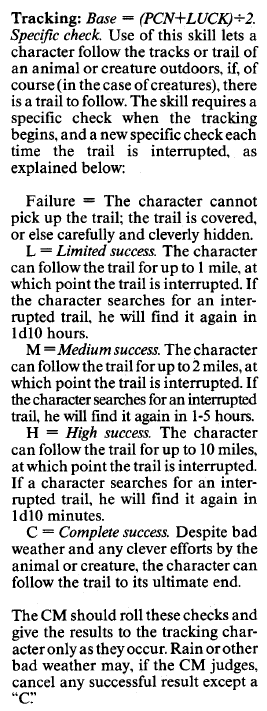
The horror roleplaying game Chill was perhaps the first game I played in which degrees of success were actually spelled out in the rules, rather than being left to the referee's judgement. How well the character rolls determines not only if the character succeeds or not, but how well, as seen in the example of the Tracking skill at right.

Flashing Blades combat rules include something like this. To hit, the player must roll 1D20 under a target number based on their character's attributes and expertise; if the player rolls less than half the target number, then the wound is serious and causes an additional 1D6 damage. A roll of 1 always hits, and bypasses any protection from armor the target of the attack may have. A roll of 20, on the other hand, is a fumble, and may result in anything from loss of actions to injury.

The rules for non-martial skills in FB state, "A roll equal to or less than the attribute indicates that the skill was used successfully," but I can't think of a single referee with whom I've played who didn't carry over the degrees of success from combat to skill rolls as well. In my own campaign, rolling between the target number and half the target number is simple success, rolling less than half the target number is a more significant success, and rolling a one means achieving Master-level success; conversely, rolling between the target number and half the range to twenty is a simple failure, rolling between half the range to twenty and twenty incurs some consequence for failing, and twenty is complete failure, likely with a dangerous consequence as well.

To use OG's example of attempting to jump onto a horse and knock off the rider, an Acrobatics roll is required to leap up behind the saddle. Let's say the character needs a fifteen or less to succeed: on a roll of 9-15, our swashbuckler manages to mount the horse behind the rider, and in the next round a successful grappling roll is required to knock the other rider off; on a roll of 2-8, I'd allow the grappling roll in the same round, and on a 1, the rider must make an immediate Dexterity check or tumble off on his own. On a roll of 16-18, however, our erstwhile swashbuckler is unable to gain a purchase on the rider or saddle and simply slides off the horse on the opposite side - make failure interesting, or at least a bit comical, remember? - on a roll of 19, he slides over the horse and catches his lace cuff on the saddle, trapping his arm until a succesful Dexterity roll works it loose, and on a twenty, the swashbuckler does indeed end up under the horse's hooves for an immediate trampling attack, if the rider should wish it - hey, it ain't all pratfalls. All of these results are likely to incur a Horsemanship check at some point as well.

There are circumstances in which outright failure is indeed an option, but playing about with the margins can be much more fun, both for the referee and the players. One of the most important aspects of refereeing, in my experience, is training my mind to improvise exactly these sorts of results quickly. I've found there's no substitute for being well-versed in genre tropes when it comes to making these calls in actual play, and that's the main reason I devote so many blog posts to books and movies and art; Cinematic and Wednesday Wyeth and The Pen and the Sword aren't filler - they're my conditioning program for the heavy-lifting of refereeing.

Tuesday, January 22, 2013

Immersion

Preface: I posted this on theRPGsite about four-an-a-half years ago, and stumbled across it while searching for something else - which is kinda ironic, considering the subject matter. It's meta in that it's not about cape-and-sword roleplaying specifically, but I'm re-posting it here so that I can reference it in the future.

In the fall of 1996 I attended a search manager's training class at Furnace Creek in Death Valley National Park. The students consisted of sheriff's deputies and park rangers who worked in search-and-rescue operations.

The first day was spent on lecture and a case study; we divided into teams and ran through a scenario involving a lost hunter. Each group functioned as the planning team for the search, so we were busy with establishing a command post, allocating resources, identifying search areas, calculating probabilities of search and detection, and applying our knowledge of lost person behavior. The instructors responded to our requests for information, told us when we found clues, resolved our requests for additional resources, responded to our interviews with witnesses and family members, and so on and so forth. The instructors used slides to show us what the terrain and vegetation cover looked like, as well as the condition of clues we found.

In due time we located the missing hunter, conducted a debriefing on the incident, and called it a day.

The next morning was a short lecture and our second search scenario, two hikers missing in Rocky Mountain National Park. The complexity of the search increased: more challenging terrain, more resources to manage (searches in national parks tend to resemble the circus coming to town), lost persons with less experience than our outdoorsman from the previous day, tougher calculations. I have to say our group did very well; we quickly identified the highest priority areas to search based on lost person behavior, and after awhile the instructors announced we'd found one of the two hikers, the girlfriend.

The slide on the screen was the body of a woman partially covered with snow.

The room got very quiet.

The lead instructor then announced that we located the second hiker as well, further down the drainage where we concentrated our searchers. Another slide of a body in the snow, this time a man.

The room went pin-drop silent.

The lead instructor looked around the room at the assembled deputies and rangers. "Don't look like that," he said. "You did your job."

I remember the sharp feeling of failure, tinged with anger and sadness, when I saw those slides, and I remember distinctly the expressions on the faces around the room mirroring much of what I felt in the moment.

Everyone one of us in that room was an experienced searcher, and I don't doubt for a moment that most of us encountered death in the field before that day. That preceding summer I'd participated in a search-and-recovery for a backpacker who slipped off a corniced pass and fell about six hundred feet to his death, and I spent a week on a complex, physically- and emotionally-challenging search for a ranger, one of my colleagues, who went missing in the backcountry. (The Morgensen SAR, and the circumstances surrounding it, would become the subject of an extraordinary book, The Last Season).

We conducted this exercise across a folding table in an air-conditioned auditorium in the Furnace Creek Visitor Center. We debated plans, told war stories, got soft-drinks and snacks, talked about the weather (it would reach 117 degrees Fahrenheit later that week, which is still pretty cool for Death Valley, but then it was October, not August), joked about the obese roadrunner that hung around the entrance to the VC looking for handouts from visitors (I called him 'Butterball'), and marveled at the Czech visitors who were all over the park that week (good exchange rate + off-season = eastern European visitors in droves).

None of this detracted from the very palpable feeling of loss we experienced at the conclusion of the exercise. Lunch took on the feel of an informal CISD as we reflected on our experiences with death in SAR ops, couched in the morbid humor of experienced professional rescuers.

I read a lot of really stupid things about immersion in roleplaying. There are the "true Scotsmen" who insist that anything less than "TOTAL IMMERSION!" isn't really immersive. There are the idiots who ascribe mental illness to immersion, that feelings resulting from imagination are inherently pathological.

In my experience, even more well-meaning and favorably-disposed gamers make out immersion to be something terribly complicated, and while it's not something which can be reproduced like a formula for soda or barbecue sauce, I've found some common features in immersive roleplaying games: a convincing setting, multi-faceted characters with believable responses, consistency of game-world physics, all of which, for me, point toward the ability to encourage and enhance the willing suspension of disbelief as one of the key elements of immersion in roleplaying.

Tuesday, January 8, 2013

Rulings, and Rules

There's a sprawling discussion on Big Purple's d20 ghetto right now dismissing the putative old-school notion of 'rulings, not rules' as A Bad Thing. This is one of those arguments discussions which gets repeated again and again and again and again by gamers.

The truth of it, which may be obscured by shrill rants about 'arbitrary GMs!' and 'thousand-page rule books!' is that roleplaying games typically involve both rules and rulings, and the more interesting questions are, who gets to make rulings? and, what should the rules cover and what should be left to rulings? With respect to the first, most traditional roleplaying games answer the question of WHO DECIDES? by assigning that role to a referee, though other games may spread that role among the players to one degree or another. For now I'm going to assume the former, but when I write 'referee,' understand that I know there are other ways of doing this.

How often, and in what circumstances, the referee is called upon to make a ruling may be largely determined by the answer to the second question: what do the rules attempt to address specifically, and what is left to the discretion of the referee to adjudicate as the need arises?

One of the arguments which resonates with me for hard-coding many of these potential cruxes into the rules is that players can make informed decisions around what their characters are likely, or unlikely, to be able to do. Traditional task-resolution rules may offer a replicable, dependable game-world simulation - if I roll x, I get result y, meaning I can jump so far or hide in shadows this easily or whatever.

But the range of potential character choices is as broad as the imaginations of the players at the table. In the linked big Purple thread, one of the posters talked about knowing the DC of jumping a horse onto a boat without capsizing the craft. Is it reasonable to expect the designers of a roleplaying game to anticipate that choice with a written rule, or for a referee to remember it on the fly during actual play? In my experience, corner cases like this are exactly why rulings are necessary and desirable, because actual play often becomes one corner case after another.

The best rules, then, may be those which provide guidelines for everyone around the table, rather than, say, a rule like, "Jumping a horse onto a boat without capsizing is DC 30 for a raft, DC 40 for a dinghy, DC 25 for a barge,' &c. Of course, the nature of the guidelines becomes the next point of fracture between gamers.

I don't say much about 4e D&D because I've never played it or read it; in fact the only pieces of it I've seen first hand are the table on page 42 titled, "Difficulty Class and Damage by Level," and the section on skill challenges. As luck would have it, those are two of the sections cited in another Big Purple thread which spun off the first, as examples of how 4e makes adjudication easy, particularly for inexperienced gamers. My own feeling is that page 42 may constrain as much as it inspires and the repetitive margins for success can lead to 'flat' encounters, and that skill challenges are just a hot mess, but I can definitely understand the appeal they hold for others - replicable, reliable math is nothing to sneeze at, particularly in games with lots of fiddly bits.

Flashing Blades takes a different approach. Here's the section on how skills are handled.
During the course of an adventure, characters will wish to make constant use of their skills. This is achieved normally by rolling a D20 against one of the character's attributes. A roll equal to or less than the attribute indicates that the skill was used successfully.

The attribute rolled against is usually the base attribute for the skill, but this may vary depending upon the circumstances. For instance, a character with Acrobatics skill might roll against his Dexterity to put on a 'sham' brawl, but would be required to make a roll against his Wit to recognize one if he saw it. The difficulty of most rolls will vary widely, so the Gamemaster should add bonuses or subtract penalties from the needed roll as indicated by the situation. For example, a character with Stealth skill, and a Dexterity of 13 would normally need to roll 13 or less to hide effectively. If there were no shadows and little cover, he might receive a -2 penalty, making his needed roll 11 or less. Likewise, if it were late at night in a thick forest, he might get a +4 bonus, making his required roll a 17 or less. In cases of extreme difficulty, the Gamemaster might require a roll under a given attribute divided by two or three (always round up).

When two characters use their skills in opposition to each other, it becomes a resistance roll. The first character's roll modifies the second's by the difference between his roll and what he needed. Thus, if a character with Stealth and a Dexterity of 12 were running through a forest, he might be required to make a roll against Dexterity to leave a sparse trail for his pursuer. If he rolled an 8, any character tracking him would receive a -4 penalty (8 - 12 = -4). If he missed and rolled a 15, any character tracking him would get a +3 bonus (15 - 12 = 3).

Resistance rolls are used commonly with Cut Purse, Disguise, Forgery, Stealth, Tracking, and Espionage.

In some cases, skills will only modify normal rolls. For instance, if a character were standing on top of a table about to be flipped by an enemy, he might be required to make a roll against Dexterity to jump down in time. Acrobatics skill might give him a +3 bonus.
It's clean and simple - no Disneyland, no live nude girls. Roll against the applicable attribute, or against that attribute divided by two or three, maybe get a modifier, maybe make an opposed roll. Broad guidelines, broadly applicable. The math is reasonably consistent, too, in that a player knows what his attributes are, and the referee simply needs to let the player know what the relative difficulty is - roll under the attribute? roll under half the attribute? - and any applicable modifiers, and perhaps make an opposition roll. The rules also imply, through the combat section, that skill checks may be interpreted as degrees of success.

I don't know if this would satisfy 'jumping a horse onto a boat without capsizing it is DC 30' guy or 'page 42 makes anyone a competent referee' guy, but as a player it lets me have some idea of what it takes to accomplish something and as a referee it provides me with a framework on which to adjudicate the action as the players make their choices. I don't want a folio of rules which try to cover every corner case, like 'horse jump' guy, and I don't need one rule that applies to every possible corner case, like 'page 42' guy.

Friday, January 4, 2013

Gimli of Arabia

I've recounted the story of 'Gimli of Arabia' on different forums over the years; I think this may be one of the first such posts.
I ran a typical hammer-throwing, axe-swinging dwarf fighter in a 1e AD&D game when I was in high school. At one point we found ourselves exploring a pyramid deep in a desert, and in the course of the adventure we found a +3 scimitar. The other fighter player characters in the party had died and the player was waiting to introduce his new character, so my dwarf was the only one in the party able to take advantage of this magical scimitar.

The dwarf was not proficient in the weapon, so he was less accurate when wielding it (and this was before weapon specialization in UA) until he could burn a proficiency slot, but it was a powerful magic weapon and we needed that as we were facing lots of undead in the crypts beneath the pyramid. As he continued to wield this scimitar, I had the character start embracing some of the local lifestyle: his rough woolen cloak was replaced by a silk aba, he sported a turban, he indulged in local jewelry, and so on. By the time our party left the pyramid and moved on to other adventures, he was a sort of "Gimli of Arabia," riding a camel and picking up a desert-dwelling illusionist as a henchman in the process. He was a lot of fun to play.
The character - who's actual name was Khazm, not Gimli - remains one of my favorite characters from any game and any campaign, but he also illustrates a couple of points about roleplaying games which are important to me.

First, Khazm developed not based on a 'character concept' dreamed up before the game started, but in response to the events of actual play.
One of the reasons I stopped enjoying 3e D&D fairly early on is that, in my experience, it worked against this sort of organic character development. I observed that feat chains, prestige classes and their prerequisites, and 1-20 builds made many players reluctant to take something for which they had not planned and run with it. I don't mean to suggest that the rules required this, and I don't believe it's true of all players everywhere, but I saw enough of it as both a player and a dungeon master to find it off-putting.

The idea that treasure should be matched to the characters is another big step away from my experience playing my dwarf fighter character, taking an unusual weapon and allowing the character concept to evolve to accomodate it, rather than giving the dungeon master a slip requesting "a hammer of thunderbolts, 'cause it's integral to my character concept!"
Over the years I've been told - always on gaming message boards, and never by anyone with whom I actually sat around a table - that my develop-in-play approach to characterisation is more suited to skirmish wargames than roleplaying games. 'Real roleplayers,' the unsubtle implication goes, begin with a 'fleshed out' character, and to do otherwise is simply playing some variation of myself. What's usually overlooked in their too-often sneering disdain is that I am not, in fact, a dwarf warrior in a fantastic realm of dungeons and dragons, or a swashbuckling highwaymen chasing a carriage over the moors on my black charger, or a steely-eyed gunfighter standing in bright sunlight on the dusty streets of Abilene, so my characters are already not-me right from the mother-lovin' giddyup.

What's important to me isn't who my character is at the start of the game, but who my character may become through suffering the slings and arrows of actual play. That means creating an involved backstory, or making up connections to non-player characters, or dreaming up funny mannerisms, or coining a catch-phrase, are trivial compared to my character's reaction to the unfolding events of the campaign. Planning for who my character will be in nineteen levels is just as inconsequential as trying to determine who he is before the campaign begins, and burgeoning rules complexity which leads to a lack of flexibility works directly against my style of play. In my experience, games which produce broad character archetypes work best for this; the more fiddly bits a character needs, the more difficult it can be to make changes on the fly. Simpler rules, without mastery traps, work best for this.

Second, with respect to those broad archetypes, Khazm was an otherwise bog-standard fighter, but adopting an atypical weapon and unusual cultural trappings for his race made him effectively unique in the game-world - this was the days before every demihuman race had an ice subrace and a sea subrace and a desert subrace and a jungle subrace, of course. It didn't take class abilities or feats or prestige classes to make him distinctive - the only rules-wise change to Khazm was spending a weapon proficiency slot on the scimitar after he leveled up - but rather I simply roleplayed him in ways, and surrounded him with trappings, which reflected his adopted culture.

Sometimes I hear that playing swashbucklers or gunfighters or gangsters is boring because all the characters are basically the same - guy with a rapier, guy with a Peacemaker, guy with a Tommy gun. There's nothing, they say, to differentiate one 5th level fighter from another without feats et al. Well, Khazm and I beg to differ.

Thursday, January 3, 2013

Playstyles & Pigeonholes

I wonder if Robin Laws' most pervasive impact on roleplaying games is the quiz based on his book.

I see the results posted in gamers' signatures on various forums pretty often, as a sort of identity badge, perhaps - 'I'm a Storyteller 100%, and I want everyone to know it!' I'd taken it before, but I couldn't remember when, so I took it again the other day. Here's what it spit out at me.

You Scored as Tactician

You're probably a military buff who wants to have the chance to think through complex problems. You want the rules, and your GM's interpretation of them, to match up what happens in the real world or at least be consistant. You want challenging yet logical obstacles to overcome.

Tactician
67%
Method Actor
50%
Butt-Kicker
50%
Storyteller
42%
Power Gamer
42%
Specialist
33%
Casual Gamer
17%

A couple of things jumped out at me. First, it's interesting to me that only one of the scores was above 50%, but not terribly surprising, considering the number of 'neither this nor that' answers I chose. In fact, very few of my answers reached either extreme at all; for me, most of the questions were simply too polarised to elicit strong agreement or disagreement.

Second, looking over my results, I'm pretty consistent. With a little searching, I found my answers to this quiz from not quite a year ago - in both cases, Tactician was my highest score and the only answer to break fifty percent, and while there was a bit of jockeying in the rest of the pack, the answers are more or less consistent between the two. The rough consistency between the results - one score breaking away from the field, the rest varying by fairly small margins - suggests the quiz does a reasonable job of sussing out the likes and dislikes of gamers.

Here's the thing, though: as a diagnostic of my own gaming style, the most important result is not the top score, but rather the clump of answers which follow. The quiz proclaims that I'm a Tactician, ". . . a military buff who wants to have the chance to think through complex problems," who wants " . . . the rules, and your GM's interpretation of them, to match up what happens in the real world or at least be consistant," and wants, ". . . challenging yet logical obstacles to overcome." There's a nugget of truth in this: I like thinking through complex problems, and I like overcoming challenging obstacles, especially ones which must be reasoned through. And yes, I do enjoy wargames as well, though calling me a "military buff" is a bit too specific.

The description of the Tactician provided in the quiz results is a paraphrase of the description provided by Mr Laws, however. Here's the full description, as quoted in the linked passages, with bold text highlighting some of the key differences between the quiz and the book.
The Tactician is probably a military buff, who wants chances to think his way through complex, realistic problems, usually those of the battlefield. He wants the rules, and your interpretation of them, to jibe with reality as he knows it, or at least to portray an internally consistent, logical world in which the quality of his choices is the biggest determining factor in his success or failure. He may view issues of characterization as a distraction. He becomes annoyed when other players do things which fit their PCs' personalities, but are tactically unsound. To satisfy him, you must provide challenging yet logical obstacles for his character to overcome.
There's a quite a bit more here than the quiz results suggests, a much narrower interpretation of what a "Tactician" expects from the game, and, for me, the added specificity goes wildly wrong.

As far as "complex, realistic problems" go, I tend to think of 'battlefield complexity' as fun but perhaps the least interesting sort of complexity a roleplaying game may offer. Everything from traps and environmental hazards to mysteries and political intrigues interest me as problems to solve in roleplaying games, and those often far more than combat. I like the "quality" of my choices to skew the probabilities - for good or bad - of the dice, not be the "biggest determining factor" of success or failure.

And the idea that characterisation is a "distraction," or that "tactically unsound" in-character choices are annoying, isn't even in the ballpark.

So does "Tactician 67%" really come close to describing how I like to play a roleplaying game? Is Mr Laws' typology 'two-thirds' correct as it applies to me?

One of the very real problems of trying to divine players' interests, whether it's Mr Laws' game styles, or the Forge's 'Big Model(s),' or Fred Hicks' "secret language of character sheets", is that playstyle pigeonholes rarely provide even a useful fraction of the whole story. Looking at my quiz results, it's not the Tactician result which tells you most about my gaming style, but rather the bunch sprint between Method Actor, Butt-Kicker, Storyteller, and Power Gamer, all in roughly equal measure. I want action and system mastery and deepening characterisation and the opportunity to weave my character into the history of the game-world.

When I think about campaigns in which I've played, it's these qualities against which I judge how much I enjoyed the experience, not whether my character fought a duel on the deck of a burning galleon or if I adequately demonstrated my pike-and-shot tactical acumen. A referee who looks at my quiz score and tries to engage me with the equivalent of a minis skirmish game won't even be close.

Thursday, November 29, 2012

Serious Business

I wonder if the type of play that happens with experienced players, especially DMs as players, is goofier and more about the impression it leaves on each other than it was back in the day when we were learning the game.
Telecanter at Telecanter's Receding Rules poses an interesting question. He offers the following examples.
The type of play I'm talking about is related to carousing tables. It is a kind of play that says "I want to put my character in a pickle because that will be funny. I will make choices I know to be bad for my character because that will make things interesting." The character that drinks from every pool in a world that has magical pools. The player that releases the demon from the iron bottle when they know it is a demon in the bottle.

I'm wondering if this comes about because the games being played are more one-offs (although Flailsnails allows people on G+ to use the same character again and again) so there is less concern for keeping your character alive to see the next session and also a sense of "We need to pack as much fun into these hours as possible. I may never see these guys again"

I'm wondering if it has to do with playing with folks you don't know as well personally and so the meta-joking is harder. When playing with people you've only known as a name on the internet maybe the easiest joking to do is within the game.

Maybe it is just a matter of jadedness; more experienced players have already survived the hardest dungeons, have achieved name level, have run their own domain. There is little fun left in to trying and eke those earning[s] out yet again.
Unpacking this a bit, I definitely noticed the behavior Telecanter describes at one-shots like the SoCal MiniCons, an attitude of, 'Well, this is a one-shot, so let's play with all the levers and buttons and see what happens,' a willingness to take risks secure in the knowledge that there were no long-term consequences related to, say, an on-going campaign and associated character advancement and involvement with the game-world.

I agree that there's a certain amount of bravado in this as well, a sort of one-upsmanship between the players, though I disagree that it comes from being jaded about the experience of playing the game for a long time. Rather, I think it comes from the same impulse which draws players to swashbuckling games. I recall a post in a thread on Big Purple which described the rivalry between two characters in a cape-and-sword campaign. When a fight broke out in the street outside a tavern, the two characters rushed outside - the first character ran out the door, whereas the second jumped through the window. Not to be outdone, the first character rushed back into the tavern, ran upstairs, and jumped out of a second floor window.

And this is where I think Telecanter hits one of the challenges of roleplaying swashbucklers on the nose.
As I type this I'm also wondering if this is related to one of the trickiest parts of our game; how it tells you to survive on one hand and calls you a coward if you don't try to open doors or chests. It is the whole courage versus caution problem- why even go into this dread place if we know a vampire is there. A kind of nonchalance seems to be a very sophisticated way to handle this problem by sidestepping it and placing on the character's shoulders: "Of course we might die, but Rutherford of the Top Hat is too dumb to realize it."
Nonchalance toward danger is a hallmark of swashbucklers. Doing something with panache can be as important as doing the thing itself, or even moreso. By their nature, swashbucklers are risk-takers.

I've found this important genre conceit can be a real conceptual hurdle for some players, as Telecanter notes. The innate caution bred into many gamers may block or limit the desire to take chances, to show off. This leads to advice like that of Robin Laws, for game writers and referees to blunt the actual hazard to characters as a way to encourage theatrics, but in my experience this risks turning the genre and the game into opera buffa.

Running Flashing Blades as written means that the player characters in my campaign face death and dismemberment by the ill-luck of the die - there are no 'drama points' to rescue them from the fickle finger of Fate, no 'plot immunity' which protects them from an inglorious end, yet the genre conceits remain the same - laughing in the face of danger, the swashbuckler prefers death before dishonor, even when death is just a missed parry or a flubbed Acrobatics check away.

I don't know if I'd go so far as to call it the conventional wisdom, but in discussions of character death among roleplayers, one of the arguments often advanced goes something along the lines of, 'Well, if my character can die on a bad die roll, then why should I take risks? It's a disincentive to roleplay the genre.' It's this line of thought which, in my opinion, leads to Robin Laws' 'swashbuckling with safety rails' approach, but for me, embracing the risk of failure is a big part of what makes cape-and-sword games so much fun.

Telecanter's right - this is one of the "trickiest parts of our game," the desire to succeed with panache against the risk of failing ignominiously, without the benefit of a safety net, particularly in what would be considered a long-term, "serious" campaign in which the players are deeply invested. Cracking wise and taking chances with a pre-gen at an annual game-day one-shot is a lot of fun, but the willingness to do it game-day after game-day, as part of a regular campaign, with a favorite character, may require another mindset altogether. Roleplaying a swashbuckler in a game which holds the player characters in no special regard with respect to failure can be a challenge, but in the immortal words of baseball legend Jimmy Dugan, "It's supposed to be hard. If it wasn't hard, everyone would do it. The hard it what makes it great."

Wednesday, February 29, 2012

A Swashbuckler's Sandbox, Part 4

In part 3, I described using a list of genre influences - an Appendix N - as a guide for creating encounters and non-player characters for a swashbuckling sandbox. Genre tropes in a sandbox may provide a measure of familiarity to players which in turn increases their confidence in their decisions pertaining to their characters, encouraging them to drive the action, which is the goal in a sandbox setting.

This may be perhaps the most obvious and least useful advice ever, but from reading blogs and intreweb forums, sometimes that which seems so obvious to me is a complete mystery to others, so I'm not taking anything for granted.

One of the fundamental differences between the sandbox settings most familiar to fantasy or science fiction gamers, is that the cape-and-sword sandbox less likely to be organized around places - the keep, the Caves of Chaos, and the Mound of the Lizard Men, for example, or Hefry, Ruie, and Forboldn in Regina subsector. Rather, the swashbuckler's sandbox is organized around people.

The non-player characters in the swashbuckler's sandbox form a web of relationships, a web which is in some ways analagous to a traditional dungeon. Think of each person as a 'room,' and the relationships between them as the 'corridors' by which they are connected.

To take that social-relationships-as-dungeon analogy a little further, the social world of the swashbuckler contains some of the hazards associated with old school dungeon crawls. Many of the relationships/'corridors' between characters are hidden behind 'secret doors,' for example, and must be discovered by the adventurers - in our Flashing Blades campaign, for example, one of the player characters' close allies is secretly connected to one of the princes of the blood, but the adventurers are unaware of this relationship at the moment. There are also 'chutes' which in the traditional dungeon drop players from upper levels to the more dangerous lower levels, and in the context of the swashbuckler's sandbox connect a less powerful npc to a more powerful one - in our campaign, the player characters found such a chute when one of them challenged a romantic rival to a duel and belatedly discovered that the rival's uncle is a lieutenant in the Cardinal's Guard.

A swashbuckler explores this web of relationships like a dungeoneer crawls through a lich's tomb, and for the same reasons - as the dungeoneer finds risks and rewards in the crypts of that dusty necropolis, it's the non-player characters populating a cape-and-sword game-world who provide danger, riches, and a chance at glory for the adventurers.

That said, I must allow for 'the piracy exception' - the sandbox for a pirates campaign may closely resemble that of more traditional roleplaying sandboxes, with pirates seeking out galleons and ports and lost temples to plunder in the style of their dungeoneering peers in a fantasy campaign.

The piracy exception aside, in the swashbuckler's sandbox non-player characters are the gateway to rewards and hazards - a jeweled ring is more likely to make its way into a swashbuckler's hand as a token of thanks from a grateful queen than it is from a locked chest guarded by a black pudding. Relationships with npcs are often rewards and hazards in and of themselves, particularly in games and campaigns where increased social status is one of the rewards offered to player characters. Non-player characters may offer an adventurer wealth, influence, sex, membership in an organization, and access to new skills - Lagardère seeking an introduction to the duc de Nevers in order to learn the botte de Nevers is a classic example - as well as danger, in the forms of duels, intrigue, manipulation, and loss of reputation.

To this end, the referee running a swashbuckler's sandbox should devote the same imagination and effort to creating engaging, challenging, mysterious non-player characters as other referees do a megadungeon or an alien world, and those non-player characters should be woven into a complex web of relationships, known and secret, for the adventurers to explore.

Once again, this is probably boilerplate to many - it gets covered in some manner in most referees' sections of game-books and in numerous articles in gaming rags and blog posts. Tips like, "Give each npc two secrets!" are as ubiquitous as rules for initiative or experience. So how is this different with respect to a swashbuckler's sandbox? With the possible exception of the some of the really extensive published city settings, the number and reach of the non-player characters in a cape-and-sword campaign are greater than that of more familiar settings. Consider the extent of the social network of a duke and peer who is a courtier to the king, a soldier in time of war and an extraordinary ambassador in peace, and the lord of a large estate. This one non-player character could have a web of immediate contacts, within a single degree of separation - family, servants, courtiers, and clients - comparable to all of the named npcs is the village of Hommlet and the keep on the Borderlands and then some, and many of those npcs may have considerable networks of their own . . .

Now, very few referees prepare anything other than a relatively small sandbox by attempting to detail every single person anymore than they describe every structure in a large city or every hovel in a marcher barony. What a sandbox referee does prepare are a few key locations in varying depth with the expection of improvising additional details as the need arises. The non-player characters in a swashbuckler's sandbox are handled the same way; to use an example from my campaign, I created a number of families in different parts of France who are given considerable detail - to continue to use the dungeon analogy offered earlier, these families can be thought of as 'levels' or 'sublevels' in the dungeon, and they in turn may be connected to other 'levels,' such as a gentleman's club, the King's Musketeers, or a bishop's curia.

In a traditional sandbox, the adventurers are expected to utilize their wits and resources to learn more about the game-world and set goals for themselves to pursue. The players and their characters may hear rumors or legends, or find an old map or a strange atrifact, offering clues to where rewards may be found. The same is true in a swashbuckler's sandbox, but rather than the legend of the old moathouse overheard in the tavern, the rumors and such concern the non-player characters in the setting. For example, one of the families I rendered in some detail for my Flashing Blades sandbox is that of the vicomte de Praz-de-Lys, a Savoyard nobleman who relocated his household to Paris in order to pursue closer ties to the French noblity. The player characters heard a rumor that the vicomtesse needed to fill a number of positions in her household - a tutor for her children, a fencing instructor for her sons, a banker to manage her finances, and so on - giving the adventurers an entrée into the lives of the Praz-de-Lys', their network of relationships in Paris, and the schemes in which various family members engage.

That last point bears noting - while specific cape-and-sword tropes may vary in different campaigns, one should be present in every swashbuckler's sandbox, and that is that the whole thing is awash in intrigue. "Give each npc two secrets!" should really only scratch the surface of the potential rivalries, dalliances, and alliances connecting the non-player characters. Political rivalries, ancient vendettas, and forbidden romance are the stuff of adventure in this game-world, and these agendas should permeate the relationships between npcs.

In addition to rumors for drawing the adventurers into the web of non-player characters who make up my sandbox, I also lean heavily on random encounters, many featuring named npcs, an idea borrowed from Chaosium's Thieves World box set and TSR's Boot Hill adventures. To borrow the dungeon analogy one last time, using named non-player characters in random encounters produces something like falling through the roof into a chamber of a lost shrine, the 'dungeon' presenting itself to the adventurers! The player characters in my campaign, for example, rescued the duchesse de Chevreuse and her lover, Lord Holland, from bravos in a Paris alley, then snuck the pair back into the Louvre, earning the powerful and dangerous noblewoman's gratitude - this was a random encounter generated as a disguised nobleman and a gang of thieves using the generic tables in the Flashing Blades core rules. Another random encounter - the aftermath of a murderous duel - earned one of the adventurers an enemy whom the players believe has tried twice now to assassinate their characters.

And that last touches on my final point, that the sandbox must react to the actions of the adventurers. The player characters' actions - and sometimes their failures to act - carry consequences. My simple rule is this: if the adventurers are winning, someone else is losing, and that someone may choose to do something about it. This is where the dungeon analogy breaks down a bit for me, for in these instances, the 'rooms' of the 'dungeon' may actually seek out the adventurers! Earning a friend may mean making that friend's enemies the adventurers' own as well, and if that holds true, then the enemies of their enemies may offer alliances as well. A swashbuckler's sandbox is marked by a dynamic tension as the adventurers tug, os simply brush against, the web of relationships they encounter in the game-world.

Swashbucklers may travel the world, but what defines their adventures are the people they meet and engage in their travels, and a swashbuckler's sandbox should emphasize this.

Monday, February 20, 2012

A Swashbuckler's Sandbox, Part 3

After a quick detour to cover a bit about how a sandbox setting works during actual play in part 2, now I want to get into how I run a sandbox cape-and-sword campaign.

First, compile an Appendix N for your sandbox which lays out the genre influences for the campaign.

Roleplaying games are traditionally composed from a farrago of sources and influences, and so are their settings, both explicit and implied. A discrete list of books, comic books, movies, artwork, and other media provides a focus for preparing elements of the sandbox which fit the genre. A sandbox which reflects its genre influences may provide the players an immediate familiarity with and an intuitive feel for the game-world.

The less familiar and more remote the genre influences, on the other hand, the more the players must learn about the sandbox before being confidant in acting on their understanding of the game-world. This is why clichés and archetypes abound in roleplaying games and other media - they paint a vivid picture in the imagination which short circuits the need for lengthy exposition. Increasing the ease with which players can choose a reasonable course of action for their characters helps facilitate sandbox play.

The significance of a sandbox's genre influences also holds for genre-mashups; if the mashup involves two immediately accessible genres - swashbucklers versus Cthulhoid horrors in Revolutionary France! - then the players may gain the same benefits of familiarity as a single genre. On the other hand, a burgeoning excess of hetergeneity may result in incongruity, an invidious sense of mission creep - I still hear players complain about the big setting reveal in 7th Sea, for example.

Now cape-and-sword genre tropes are far from universal - a subject I will get into at length in future posts - so choosing the sandbox's Appendix N helps narrow the field a bit. A setting appropriate to The Princess Bride may be may look very different from one appropriate to Captain Alatriste. The specific genre influences particular to a given sandbox help to give it a shape more readily recognizible to the players.

The Appendix N for my Flashing Blades campaign lists my main sources of inspiration. The story which first prompted me to run Flashing Blades was Robert E. Howard's "The Shadow of the Vulture," set at the 1529 siege of Vienna; I subsequently drew from - naturally - REH's pirate stories, "Swords of the Red Brotherhood" and "Black Vulmea's Vengeance," as well. The other sources that make up my Appendix N build on this.

Melodramas like The Prisoner of Zenda and Swordspoint are absent from my sandbox's Appendix N, though I really like both stories and their sequels. Comic movies like Swashbuckler and the unintentionally funny The Musketeer are missing as well, as most of the humor in the campaign is found, not deliberate or satirical.

Having a firm grasp of the genre and associated tropes gives me a framework on which to build the setting elements of my swashbuckling sandbox. The pulp tales and related sources which inspire my campaign contain rough, flawed anti-heroes and cruel, complex antagonists, and the non-player characters populating my sandbox reflect this - rock-jawed champions and mustache-twirling villains need not apply - as do their agendas, which mostly revolve around the pursuit of fortune and glory and the power that comes with both.

Random encounters play a very important role in my sandboxes. They represent the living setting, a nexus between the travels and actions of the adventurers and in media res events which in some instances follow from the agendas of significant non-player characters in the campaign. Many of my random encounters feature named npcs for this reason; they provide an opportunity for the adventurers to meet and interact with these characters, to build a relationship - for better or worse - with the movers and shakers of the setting. From my Appendix N sources, I can draw ideas for the kinds of encounters representing the genre tropes in those stories. For example, the adventurers in my sandbox aren't likely to hear of a merchant looking to hire caravan guards, but they may be approached by a gambler or a moneylender looking for swordsmen to help recover a debt.

Now that gambler or moneylender will rarely exist in isolation, and in part 4 - part 4?! - I'll get into social relationships as a setting map in my swashbuckler's sandbox.

Friday, February 17, 2012

A Swashbuckler's Sandbox, Part 2

In part 1, I laid the groundwork for what I consider to be a sandbox playstyle. I'd planned on getting into how to work cape-and-sword tropes into a sandbox, but as I started writing it, I found I was introducing all sorts of other baggage regarding how sandboxes work in actual play, so I want play porter for a moment and clear those bags out of the way first.

There are a number of features common to sandbox settings, and, judging from the many discussions in which I've participated on various gaming forums over the years, it seems that every one of them comes with some misunderstandings attached.

First, a sandbox game-world is not tailored, to use the 3e D&D DMG parlance, to the adventurers. In the game-world, there are hazards and challenges that will be easy for the adventurers to handle, some that carry a measure of risk to the adventurers, and some which the adventurers are unlikely to overcome unless they are extremely clever and insanely lucky. Sandboxes include a wide range of degrees of difficulty in challenges, hazards, and encounters, and the adventurers may face them at any time, with or without warning - in fact, one of the important elements of game-play is gathering intelligence on the nature of hazards which exist in the game-world, to reduce the risk of an unexpected, overwhelming encounter.

Second, a sandbox typically contains a number of adventure sites - a ruined castle, a creepy abbey, a dark forest, a maze of caverns, a keep on the borderlands, and so on. Scattered throughout the game-world are clues - rumors picked up from travellers in taverns, books found in dusty libraries, a map found in a dead bandit's pocket, a murak painted on the wall of a monk's cell, et cetera - which point the adventurers in the direction of these locations. These locations typically receive more attention than other places in the game-world during the referee's prep, and are often intended to have an element of replayability about them - each supports multiple visits by the adventurers. Clues are enticements to the adventurers, tempting them with the means to achieve their goals, or even satisfying a goal itself.

Third, a sandbox offers the opportunity for the adventurers to explore at their own pace and in a direction of their choosing. Hexcrawls - exploration hex by hex across a map - are strongly associated with this, appearing early in the hobby in published settings like Blackmoor, the Wilderlands, and the Spinward Marches. This sometimes implies that sandboxes need to be extensive, but that isn't necessarily the case (qv, Keep on the Borderlands).

Fourth and last, a sandbox should be a dynamic game-world. The 3e D&D DMG associates the term "status quo" with sandbox adventuring, implying a sort of stasis state which is only broken by the presence of the adventurers. A sandbox, however, usually contains non-player characters with agendas they pursue independently of the adventurers, unless or until the adventurers choose to become involved or are swept up as a consequence of an npc agenda coming to fruition. In a well-run sandbox, there are also large-scale events which occur in the setting, such as wars, plagues, and so forth, which again exist independently of the adventurers.

Okay, with those trunks and valises stowed, now I can move on to the swashbuckling in part 3.

Tuesday, February 14, 2012

A Swashbuckler's Sandbox, Part I

Once upon a time, there were no sandboxes.

There were only game-worlds, with ten-by-ten rooms to explore and orcs to kill and pies to take. An adventure was "a session of play" (1e AD&D Dungeon Masters Guide, "The Campaign," p. 86) and a succession of such adventures made a campaign. Whatever the players and their characters did last Saturday night was 'the adventure.'

That simple time was surprisingly brief in the history of the roleplaying hobby, however. Modules, many originally drawn from tournament games offered at conventions, soon defined an adventure. Early modules were most often organized around a location - a cavern, a moat house, a pyramid on a cloud-shrouded world, an alien starship. Some modules included the machinations of the denizens of a location, giving these adventures the semblance of a plot.

As roleplaying games reached their first, and arguably highest, peak of popularity in the early Eighties, the significance of these machinations grew to the point where adventures were less about exploring a location and more about interacting with a series of events based on these machinations. These events increasingly took on the structure of fiction. Adventures were expected to have a actual plot, with rising and falling action, reveals and reversals, and a climax. Many were - and are - organized in terms of chapters, or acts and scenes.

The idea that an adventure was simply, 'last Saturday's game,' all but disappeared, from rule books, from published adventures, from advice articles in the various gaming rags, and, most importantly, from the expectations of gamers who never really knew any other way to play. Those expecations brought with them baggage concerning the nature of the player character and the experience of actual play, and that baggage would profoundly affect many design tenets.

The release of 3e D&D, the tabletop roleplaying industry's flagship product, included the marketing tagline, "Back to the Dungeon." There was a conscious effort to tap into the experiences of roots-gamers, such as how adventures and settings were discussed in the rule books. The 3e Dungeon Master's Guide includes a discussion of "status quo" motivations for adventurers, in which a feature of the game-world exists and the adventurers are free to explore it or not as they wish. The 3e DMG also offers an explicit distinction between "site-based" and "linear" adventures.

The intrewebs allowed roots-gamers to talk with one another as well as with with the larger population of gamers generally. Some roots-gamers never stopped playing the early games of the hobby while others - myself included - grew increasingly dissatisfied with contemporary roleplaying games. Through gaming forums and the burgeoning blogosphere we talked about how we approached running and playing roleplaying games, of save-or-die and wandering monsters and random treasures and hexcrawls and, perhaps most significantly, the promotion of player choice and the absence of linear adventures.

And that playstyle received a name.

Sandbox is co-opted from computer games, and depending on exactly which definition is used, it probably isn't the best fit to describe this playstyle, which incorporates elements of open worlds and nonlinear adventuring as well. Nonetheless, sandbox has come to describe a playstyle in which the players and their characters are presented with a game-world and given the freedom to explore it as they please, without the expectation of an unfolding plot prepared in advance by the referee or the goal of producing a traditionally structured story through play.

So while I'm not wild about the term sandbox, it's what we have.

Now that I hope we have some common ground on what I mean by sandbox, in part 2, I'll discuss how I threw swashbucklers into mine.

Wednesday, January 25, 2012

Taking the Reins

Al at Beyond the Black Gate recently blogged about the player driven campaign.

The best groups I've played with or DM'd have not just been the games that were run the best, or offered the best adventures or settings, they were the games wherein the players were just as interested in developing the game as the DM. . . . It seems like having a way to briefly describe the players' role in the development of the best campaigns would be a good thing - just as important as providing a good setting, good adventures, and the best suited ruleset.

My best experiences with roleplaying games include players contributing to the development of the campaign as well, and thinking back on those campaigns, here's what stands out for me.

Setting and managing expectations: Proactive players rarely just happen. Many players expect a campaign to be prix fixe, and if you're serving à la carte, it's important to put it in their heads from the giddyup so they don't go hungry. Players should be encouraged to see themselves as more than mere consumers of a campaign, and in my experience this begins before character generation takes place.

Harness the rules: Some games make this very explicit - World Burning in Burning Empires comes to mind. The players are active participants in the process of creating the setting and the conflicts which arise from it, so at least some measure of campaign development is hard-coded into the rules. More traditional roleplaying games proceed from the assumption that the referee is responsible for creating the setting in which the game takes place and the conflicts which drive the action; in some systems, some player development of the campaign may take place through their characters, often through rules like GURPS' Advantages and Disadvantages or even through the 'stronghold-building' aspect of name-level 1e AD&D characters

In Flashing Blades, characters have Advantages and Secrets, some of which introduce conflict through established relationships, such as Sworn Enemy, Secret Loyalty, or Favor, while others create connections to institutions in the game-world, such as Member of an Order.

I should note that while I believe using the rules to establish initial connections to the setting may help, they are not a substitute for developing those connections through actual play.

Reinforce the genre: The game genre offers clues to what characters in the campaign are expected to do. For example, cape-and-sword suggests roguish characters who spend time carousing, wenching, gambling, and dueling. It also includes romance, intrigue, a struggle for honor, and advancing one's station in society.

In my experience, the memes conveyed by genre encourage the players' freedom to improvise by handing them a lever with which to move the setting in actual play.

Dangle carrots: The game's rewards system drives player choices.

Let me say that again.

The game's rewards system drives player choices. If a player wants her character to get better at swinging a sword, and the way to get better at swinging a sword is to engage in duels, then the player is more likely to pick fights.

If the game rewards in-character behaviors which serve to develop the campaign, then the players are more likely to pursue them. In Flashing Blades, for example, the career rules offer the adventurers the chance to improve their Social Rank, whereby they gain access to wealth and influence. As the campaign progresses, increased Social Ranks puts them in a position to exert meaningful changes to the setting in actual play.

Provide a dynamic world: In my experience, the more the game-world feels like a living place, the more the players and their characters will feel like they can effect change. The classic example of this is 'clearing the dungeon' - if the adventurers return to town after defeating the cultists in the ruined moat house and discover that there's no room at the inn because merchants are passing through again, and there's new construction to accomodate families moving to the area thanks to its safe reputation, then the players will feel the effects of change even if they didn't set out to cause those changes directly.

So that's how I do that.