The Musketeers premiers on BBC America Sunday, 22 June.
Hopefully this fares better than Queen of Swords or Young Blades.

Showing posts with label swashbuckling. Show all posts
Showing posts with label swashbuckling. Show all posts
Friday, June 6, 2014

Thursday, March 13, 2014
Fate and The Princess Bride
There's a thread on Big Purple right now about using Fate to model the duel between Westley and Inigo atop the Cliffs of Insanity.
It makes Fate sound as much fun as doing my taxes.
Ever see something out of the corner of your eye that grabs your attention, but when you look straight at it, it's nothing like what you thought you saw? That's Fate for me. It's a game I really want to like, but whenever I read the rules, or an actual play report, all I hear in my head is gears grinding.
It makes Fate sound as much fun as doing my taxes.
Ever see something out of the corner of your eye that grabs your attention, but when you look straight at it, it's nothing like what you thought you saw? That's Fate for me. It's a game I really want to like, but whenever I read the rules, or an actual play report, all I hear in my head is gears grinding.
Monday, October 7, 2013
There Is Nothing Extraneous in the Players Handbook
On my lengthy list of things to do is a post about why 1e Advanced Dungeons & Dragons is a good game for running a swashbuckling campaign.
But Zak got the gist of it already, so go read his post instead.
But Zak got the gist of it already, so go read his post instead.
Monday, August 26, 2013
Swordswomen of the Silver Screen
Any website with Natalie Dormer and Maureen O'Hara on the masthead automatically gets my attention.
The site includes a list of movies and television shows featuring swordswomen as well as forums for clips, art, and stories - the last three require permission from the administrator to access, however, so be patient.
And did I mention Natalie Dormer?
The site includes a list of movies and television shows featuring swordswomen as well as forums for clips, art, and stories - the last three require permission from the administrator to access, however, so be patient.
And did I mention Natalie Dormer?
Tuesday, March 5, 2013
Anything Goes!
Me: . . . [I]f you sat down to play a game of, say, swashbuckling adventure, why did you create a character who desires neither swashbuckling nor adventure?There are things I don't write about because I know that can't do them justice.
TheBigDice: What if I want to play a Jesuit priest? Someone completely genre-appropriate. But that doesn't own a sword, has never had any training in swinging from chandeliers and has no intentions of ever personally killing a man. Of course, he's got political acumen, contacts and social skills. He's a completely functional character for the setting. He just needs a reason to adventure, a push out of the door.
Me: Then he's not genre-appropriate as a swashbuckling adventurer. He's suitable as a period-appropriate npc, not a player character.
TheBigDice: See, now we're getting somewhere. What you're actually saying is, in a swashbuckling adventure, everyone must play a swashbuckling adventurer, or the campaign isn't about what you as the GM wants it to be about. So we're not actually in a true sandbox here. It's probably got aspects in common with a sandbox, but given that you're saying no to a primarily social character in favour of action oriented ones, I wouldn't say that the "open world" ethos is really on the table. If you're unwilling to accommodate a character that talks his way out of situations rather than fights his way out of them, and aren't prepared to give what [Mike 'Old Geezer' Mornard] described as an unwilling adventurer the push the character needs, then are you really giving your players the freedom that a sandbox seems to demand?
I like forum discussions because they give me a chance to discuss games and gaming styles that I don't really understand, that are too far removed from my interests or experience for me to say anything I consider meaningful about them. While blogging as a medium works well for developing an idea, forums are a great place for asking questions.
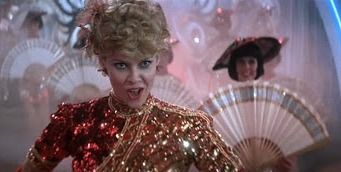
Put simply, a sandbox game-world isn't the same thing as a kitchen-sink setting.
When I pitch my campaign, I believe I'm very clear about what it is and what it isn't: "Le Ballet de l'Acier – The Dance of Steel – is a swashbuckling adventure campaign set in 17th century France for the Flashing Blades roleplaying game. This is the age of D'Artagnan and Diego Alatriste, Gil de Berault and Percy Blakeney, Cyrano de Bergerac and the marquis de Bardelys, Lady Clarick de Winter and Madeleine de Maupin, an age of honor and intrigue, where a stout heart, a strong wrist, and cold steel could bring fortune or death."
In fact, I outlined the campaign premise before I settled on using Flashing Blades; one of the reasons I chose FB is that the chargen rules produce swashbuckling characters. It is a core conceit of the game. Sure, you can play a Jesuit priest if you like, but it's a game designed for you to play Aramis, not Fray Felipe, and that's one of the reasons I picked that particular game over the many other choices available to me.
The campaign I choose to run - the campaign I offer to interested players - is one of swashbuckling adventurers. It's a campaign which celebrates the genre; it doesn't attempt to deconstruct it. Within that core conceit, there is wide latitude. You can play a priest like Aramis, as noted above, or a courtier and saloniste in the mode of Francisco de Quevedo, or a doctor and surgeon in the style of Captain Blood or Doctor Livesey. You can play a character who is witty and attempts to use persuasion and guile to achieve his ends.
But if your first inclination on being invited to play in a game about swashbucklers is to make a character who is not a swashbuckler, then really, how engaged are you with the campaign?
A sandbox game-world isn't a featureless plain of sand. It has boundaries. It has conceits. And one of the referee's jobs is to sell those to his players, and one of the players' jobs is to accept them. There may be negotiation by all parties around those boundaries and conceits. Showing up with a character who ignores those conceits, however, and expecting the referee to acquiesce 'because SANDBOX!' reflects a fundamental lack of understanding about the way a sandbox game-world is prepared and run.
And if, as a general rule, you don't like something, you're probably not the best person to talk about how it's supposed to work.
Thursday, February 7, 2013
Annoying Habits of Duelists
Roll 1D20 -
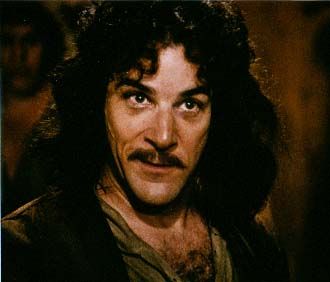 1. Repeats, "You killed my father! Prepare to die!" even though you've never met his father.
2. Insists on a small glass of claret between every pass.
3. Arrives without a sword; asks to borrow yours.
4. Whistles the same two bars of a song over and over again.
5. Repeatedly calls a halt to adjust her ill-fitting mask.
6. Reeks likes the bilge-water in a fishing boat, bringing tears to your eyes.
7. Throws whatever's at hand at you: seat cushions, sticks, silverware, small rocks, pieces of bread, &c.
8. Refuses to cross blades until a priest is present to provide the sacrament of extreme unction.
9. Shrill incessant laughter.
10. Demands that wine corks be placed on the tips of the blades.
11. Offers to flip a coin instead.
12. Refuses to acknowledge touches, even while bleeding profusely from multiple wounds: "That's a wine stain! Have at you!"
13. Brings a pistol to a sword fight.
14. Sneezes and coughs on you throughout the duel; will refuse any delay, insisting that he's getting better.
15. Attempts witty repartee, manages only schoolyard taunts.
16. Stops every few passes to change swords from a long leather bag and confer with his second on tactics.
17. Insists on a postponement: the ground is too soft, the sun is too low, the air is too damp, &c.
18. Interrupted by a stream of messengers with papers to sign, questions to answer, &c: "Sorry, this will only take a moment . . ."
19. Attempts to slash his initials into your clothing, succeeds only in tearing up your coat and vest.
20. Roll twice - this one's really annoying.
2. Insists on a small glass of claret between every pass.
3. Arrives without a sword; asks to borrow yours.
4. Whistles the same two bars of a song over and over again.
5. Repeatedly calls a halt to adjust her ill-fitting mask.
6. Reeks likes the bilge-water in a fishing boat, bringing tears to your eyes.
7. Throws whatever's at hand at you: seat cushions, sticks, silverware, small rocks, pieces of bread, &c.
8. Refuses to cross blades until a priest is present to provide the sacrament of extreme unction.
9. Shrill incessant laughter.
10. Demands that wine corks be placed on the tips of the blades.
11. Offers to flip a coin instead.
12. Refuses to acknowledge touches, even while bleeding profusely from multiple wounds: "That's a wine stain! Have at you!"
13. Brings a pistol to a sword fight.
14. Sneezes and coughs on you throughout the duel; will refuse any delay, insisting that he's getting better.
15. Attempts witty repartee, manages only schoolyard taunts.
16. Stops every few passes to change swords from a long leather bag and confer with his second on tactics.
17. Insists on a postponement: the ground is too soft, the sun is too low, the air is too damp, &c.
18. Interrupted by a stream of messengers with papers to sign, questions to answer, &c: "Sorry, this will only take a moment . . ."
19. Attempts to slash his initials into your clothing, succeeds only in tearing up your coat and vest.
20. Roll twice - this one's really annoying.
Monday, January 21, 2013
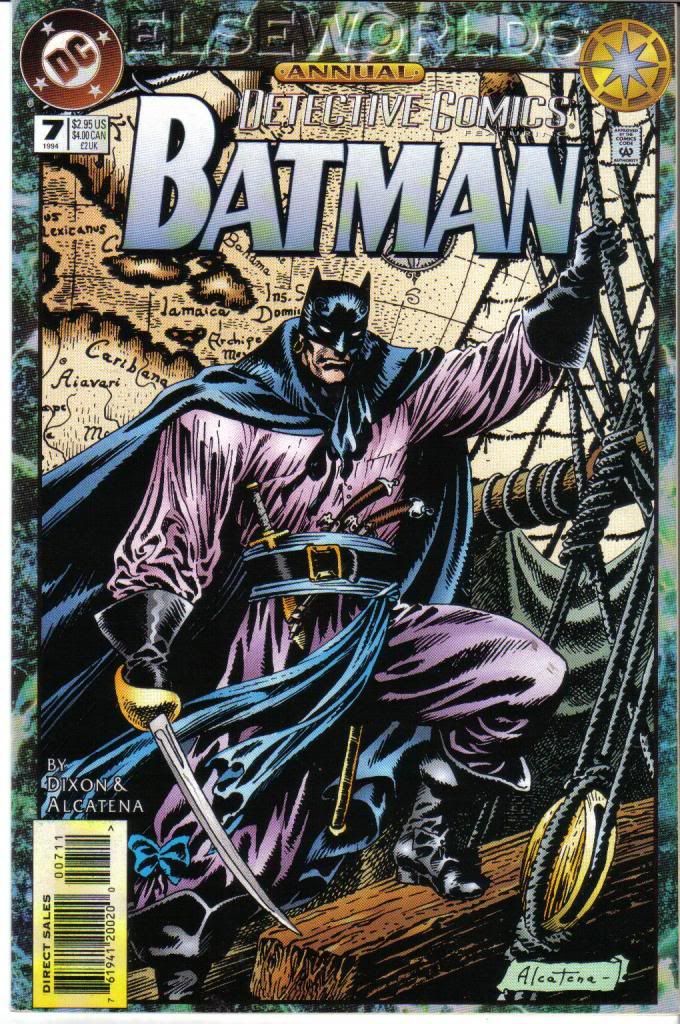
Graphic Novels Challenge: Detective Comics Annual No. 7
I read comics when I was a kid - Daredevil, Silver Surfer, and G.I. Combat, picked from the spinner at our local 7-11, purchased with change earned by scavenging empty soda bottles and turning them in for their deposits. Yes, I'm that old.
Roleplaying games actually supplanted my interest in comics - my comic book money went to buying lead minis instead, and I didn't really pay them much attention until I was working in a bookstore after high school and discovered Frank Miller's Batman: The Dark Knight Returns. It was, for me, a revelation, like I imagine it was for many people, and it piqued my interest in comics once again. It also spurred me to pick up TSR's Marvel Super Heroes roleplaying game, which I ran for the next few years.
The success of Gotham by Gaslight spawned the Elseworlds stories - in fact, GbG would later be retconned as the 'first' Elseworlds title. The Elseworld titles offer the writers and artists a chance to play with canon characters in asynchronous settings and circumstances, like Superman raised in the Soviet Union instead of Heartland America, or Bruce Wayne as the Green Lantern.
This roundabout introduction brings me to Detective Comics Annual no. 7, an Elseworlds title featuring the Batman as a 17th century privateer named Captain Leatherwing, the English scourge of the Spanish Main. The comic also features other iconic characters including Alfredo, Leatherwing's mate, Robin Redblade, a street urchin who plays a Jim Hawkins-like role in the tale, and Capitana Felina, a Spanish noblewoman both entranced and repulsed by Leatherwing. My favorite character, however, is the Laughing Man - the Joker in late 17th-century court dress is the highlight of the book for me. Indeed, it's really the only depiction of the main characters in the book which I liked - the rest of the main character's costumes seemed far too on-the-nose, lacking any of the nuance or period feel which the best Elseworlds books feature - though the book does give penciler and inker Enrique Alcatena an excuse to show Selina in a bodice-hugging gown for several pages. Too-literal costumes aside, the rest of the artwork in the book is quite good.
Chuck Dixon's story itself is utterly pedestrian, bringing nothing new or exciting to any of the characters. It features none of the Batman's strengths - his deductive acumen, his 'wonderful toys' - which define the character for me. The whole thing seemed like a hugely missed opportunity.
This guy really loves it, though, so if the premise interests you, you may want to hunt around for some other opinions.
A sequel, "The Bride of Leatherwing," was published in Batman Chronicles no. 11.
Thursday, November 29, 2012
Serious Business
I wonder if the type of play that happens with experienced players, especially DMs as players, is goofier and more about the impression it leaves on each other than it was back in the day when we were learning the game.Telecanter at Telecanter's Receding Rules poses an interesting question. He offers the following examples.
The type of play I'm talking about is related to carousing tables. It is a kind of play that says "I want to put my character in a pickle because that will be funny. I will make choices I know to be bad for my character because that will make things interesting." The character that drinks from every pool in a world that has magical pools. The player that releases the demon from the iron bottle when they know it is a demon in the bottle.Unpacking this a bit, I definitely noticed the behavior Telecanter describes at one-shots like the SoCal MiniCons, an attitude of, 'Well, this is a one-shot, so let's play with all the levers and buttons and see what happens,' a willingness to take risks secure in the knowledge that there were no long-term consequences related to, say, an on-going campaign and associated character advancement and involvement with the game-world.
I'm wondering if this comes about because the games being played are more one-offs (although Flailsnails allows people on G+ to use the same character again and again) so there is less concern for keeping your character alive to see the next session and also a sense of "We need to pack as much fun into these hours as possible. I may never see these guys again"
I'm wondering if it has to do with playing with folks you don't know as well personally and so the meta-joking is harder. When playing with people you've only known as a name on the internet maybe the easiest joking to do is within the game.
Maybe it is just a matter of jadedness; more experienced players have already survived the hardest dungeons, have achieved name level, have run their own domain. There is little fun left in to trying and eke those earning[s] out yet again.
I agree that there's a certain amount of bravado in this as well, a sort of one-upsmanship between the players, though I disagree that it comes from being jaded about the experience of playing the game for a long time. Rather, I think it comes from the same impulse which draws players to swashbuckling games. I recall a post in a thread on Big Purple which described the rivalry between two characters in a cape-and-sword campaign. When a fight broke out in the street outside a tavern, the two characters rushed outside - the first character ran out the door, whereas the second jumped through the window. Not to be outdone, the first character rushed back into the tavern, ran upstairs, and jumped out of a second floor window.
And this is where I think Telecanter hits one of the challenges of roleplaying swashbucklers on the nose.
As I type this I'm also wondering if this is related to one of the trickiest parts of our game; how it tells you to survive on one hand and calls you a coward if you don't try to open doors or chests. It is the whole courage versus caution problem- why even go into this dread place if we know a vampire is there. A kind of nonchalance seems to be a very sophisticated way to handle this problem by sidestepping it and placing on the character's shoulders: "Of course we might die, but Rutherford of the Top Hat is too dumb to realize it."Nonchalance toward danger is a hallmark of swashbucklers. Doing something with panache can be as important as doing the thing itself, or even moreso. By their nature, swashbucklers are risk-takers.
I've found this important genre conceit can be a real conceptual hurdle for some players, as Telecanter notes. The innate caution bred into many gamers may block or limit the desire to take chances, to show off. This leads to advice like that of Robin Laws, for game writers and referees to blunt the actual hazard to characters as a way to encourage theatrics, but in my experience this risks turning the genre and the game into opera buffa.
Running Flashing Blades as written means that the player characters in my campaign face death and dismemberment by the ill-luck of the die - there are no 'drama points' to rescue them from the fickle finger of Fate, no 'plot immunity' which protects them from an inglorious end, yet the genre conceits remain the same - laughing in the face of danger, the swashbuckler prefers death before dishonor, even when death is just a missed parry or a flubbed Acrobatics check away.
I don't know if I'd go so far as to call it the conventional wisdom, but in discussions of character death among roleplayers, one of the arguments often advanced goes something along the lines of, 'Well, if my character can die on a bad die roll, then why should I take risks? It's a disincentive to roleplay the genre.' It's this line of thought which, in my opinion, leads to Robin Laws' 'swashbuckling with safety rails' approach, but for me, embracing the risk of failure is a big part of what makes cape-and-sword games so much fun.
Telecanter's right - this is one of the "trickiest parts of our game," the desire to succeed with panache against the risk of failing ignominiously, without the benefit of a safety net, particularly in what would be considered a long-term, "serious" campaign in which the players are deeply invested. Cracking wise and taking chances with a pre-gen at an annual game-day one-shot is a lot of fun, but the willingness to do it game-day after game-day, as part of a regular campaign, with a favorite character, may require another mindset altogether. Roleplaying a swashbuckler in a game which holds the player characters in no special regard with respect to failure can be a challenge, but in the immortal words of baseball legend Jimmy Dugan, "It's supposed to be hard. If it wasn't hard, everyone would do it. The hard it what makes it great."
Monday, November 19, 2012
Hook Hand and Peg Leg
"It's all fun and games until someone loses an eye. And a hand." - Vecna's momOne of the potential consequences of losing a fight in Flashing Blades is the prospect of suffering a debilitating wound. If a character is reduced to exactly zero hit points, the location of the final wound is used as the basis for determining if the character is temporarily or permanently disabled in some way. A character reduced to zero hit points by a wound on the head, frex, may lose a nose or an ear - both of which reduce the character's Charm attribute score - or receive a scar on a cheek - which increases the Charm attribute score! A wound to the chest may cause permanent internal injuries, reducing a character's Endurance attribute score, while a wound to a limb may result in a broken bone, which takes weeks to heal.
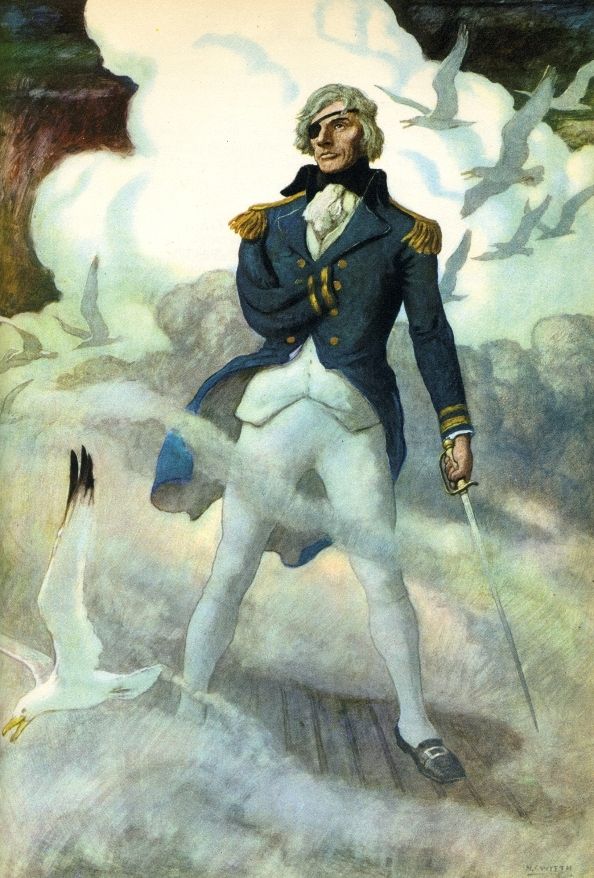
The popular image of the swashbuckler, particularly the pirate, with en eye-patch, a wooden leg, or a hook for a hand, is pretty common, but while it has a basis in history, such as Admiral Lord Nelson, it's surprisingly rare in cape-and-sword literature. Prosthetics such as wooden legs, hooks, and false eyes are well-documented in medical literature from the late Renaissance and Early Modern period, though as described in the writings of the famous French surgeon Ambroise Paré, they were often more elaborate than simple peg legs or hooks, shaped to resemble the actual missing limb and fitted with joints to provides some measure of use to the wearer. Paré even mentions a spring-equipped prosthetic hand, though it's unlikely that it was ever actually manufactured. That peg legs and hooks are so prevalent in pirate lore may reflect that the expertise required to create more life-like prosthetics was absent among most ship-board surgeons, resulting in the cruder examples with which most of us are familiar.
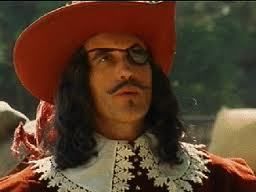
The inclusion of lost eyes and limbs in Flashing Blades, then, appears to reflect the overt influence of cape-and-sword movies on the game's implied setting; it's an interesting design choice in light of the fact that so much of the game draws its inspiration from swashbuckling novels. While this wasn't unique to Flashing Blades - even 1e AD&D suggested that a character reduced to zero hit points "loses a limb, [or] is blinded in one eye" as an alternative to death - it presents players with the prospect of characters suffering a permanent disability while providing the specific rules for determining if and how that occurs and the effect on the character.
Over the years I've noticed a couple of schools of thought among players about character disability arising during play, as distinct from those players who choose disabilities during character creation as a means of gaining advantages elsewhere. One school asserts that 'death is boring,' that disability is a 'more interesting' alternative to losing one's character altogether. The other school claims that it's better that their characters die than be 'gimped' by the loss of attribute points or abilities. (There is also a school which wants neither, but I'm not going to give them any further consideration than to say, they're among us.)
My feeling is, let's have both. One of the reasons I like Flashing Blades is that both death and disability are on the table. They add the frisson of uncertainty when blades or guns are drawn to the experience of playing the game, and because they exist in the back of the players' minds, I think it adds to the characterisation which arises from actual play. One of the inherent tensions of the cape-and-sword genre comes from balancing the demands of honor with reckless violence - the decision to draw swords is, and in my opinion should be, a perilous one, and the risk of death or disability draws a big fat black line under that for me.
Tuesday, October 30, 2012
Mundane Horror
Horror in roleplaying games most often involves elements of the supernatural, from vampires and vengeful spirits to unkillable boogeymen and tentacled creatures from another dimension.
Relatively less common, in my experience, are mundane, non-supernatural horrors appropriate to modern or historical roleplaying games.
The serial killer
Serial killers are well-represented in both fact and fiction, from Jack the Ripper, Elizabeth Báthory, the marquise de Brinvilliers, and Burke and Hare to Hannibal Lecktor, Sweeny Todd, and Norman Bates, but my impression is that this is less common in roleplaying games, perhaps because the squick factor is too high - dealing with a fantastic monster like a werewolf is less disturbing than a killer inspired by the likes of Ed Gein.
Other examples of the serial killer could include mad scientists, such as a vivisectionist, or cultists practicing ritual sacrifice, such as the Aztecs or the Celts - the latter could include those who practice cannibalism as part of ritual life, or even those driven to it in extremis.
Note that a serial killer isn't necessarily mentally ill.
The maneater
The stories of the beast of Gévaudan and the lions of Tsavo open up all sorts of interesting possibilities for encounters with animals which are both monstrous and mundane. They could be wild animals running amok, trained pets (as in "The Murders in the Rue Morgue"), or 'lost' species.
The megalomaniac
The megalomaniac suffers from a range of mental illnesses which manifest as feelings of omnipotence and delusions of grandeur. Mister Kurtz and the Phantom of the Opera are fictional examples of what I have in mind here.
The mountebank
The mountebank uses horror as a means of covering up his (usually criminal) activities. He is Cosgoode Creeps or Asa Shanks, posing as a ghost to scare off the nosy townsfolk or bilk his relatives out of their inheritance.
I have a few traces of horror in my cape-and-sword campaign, particularly around Auvergne, which I tend to think of as the 'scary Appalachia' of my game-world's France.
Relatively less common, in my experience, are mundane, non-supernatural horrors appropriate to modern or historical roleplaying games.
The serial killer
Serial killers are well-represented in both fact and fiction, from Jack the Ripper, Elizabeth Báthory, the marquise de Brinvilliers, and Burke and Hare to Hannibal Lecktor, Sweeny Todd, and Norman Bates, but my impression is that this is less common in roleplaying games, perhaps because the squick factor is too high - dealing with a fantastic monster like a werewolf is less disturbing than a killer inspired by the likes of Ed Gein.
Other examples of the serial killer could include mad scientists, such as a vivisectionist, or cultists practicing ritual sacrifice, such as the Aztecs or the Celts - the latter could include those who practice cannibalism as part of ritual life, or even those driven to it in extremis.
Note that a serial killer isn't necessarily mentally ill.
The maneater
The stories of the beast of Gévaudan and the lions of Tsavo open up all sorts of interesting possibilities for encounters with animals which are both monstrous and mundane. They could be wild animals running amok, trained pets (as in "The Murders in the Rue Morgue"), or 'lost' species.
The megalomaniac
The megalomaniac suffers from a range of mental illnesses which manifest as feelings of omnipotence and delusions of grandeur. Mister Kurtz and the Phantom of the Opera are fictional examples of what I have in mind here.
The mountebank
The mountebank uses horror as a means of covering up his (usually criminal) activities. He is Cosgoode Creeps or Asa Shanks, posing as a ghost to scare off the nosy townsfolk or bilk his relatives out of their inheritance.
I have a few traces of horror in my cape-and-sword campaign, particularly around Auvergne, which I tend to think of as the 'scary Appalachia' of my game-world's France.
Friday, August 24, 2012
Another Perspective on the Lightly Armored Fighter
Eric Treasure at The Dragon's Flagon discusses the lightly armed adventurer and the perceived need to make the maille-clad warrior and the swashbuckler 'equal' under the combat rules of many roleplaying games.
Indirectly, the question posed by the knight and the swashbuckler is, should characters in a roleplaying game be balanced to one another, and if so, to what degree? It's a question which generates a strong opinions, in my experience, regardless of the answer.
Indirectly, the question posed by the knight and the swashbuckler is, should characters in a roleplaying game be balanced to one another, and if so, to what degree? It's a question which generates a strong opinions, in my experience, regardless of the answer.
Monday, August 13, 2012
Lightly Armored Fighter
In the swashbuckling era, no swordsman worthy of the name would think of sullying the fine, graceful line of his body in motion with the use of anything so gauche as armor. Helmets and breatplates are for lowly guards and comically cowardly pirates, not gallant heroes or suave villains. Your DM should give you some free armor protection to compensate for the unforgiving treatment that D&D rules mete out to unarmored combatants.So says Robin Laws, writing about "swashbuckling essentials" in Dragon magazine.
It is an article of faith - a received truth - among many gamers that the lightly armored Renaissance swordsman is the equal of the medieval knight by virtue of being quick on his feet and wielding a lighter blade. The lightly armored fighter archetype appears in fantasy literature as such, and to fail to represent this puts anyone who wants to play a swashbuckler in a world of plate mail and tower shields at an unfair disadvantage.
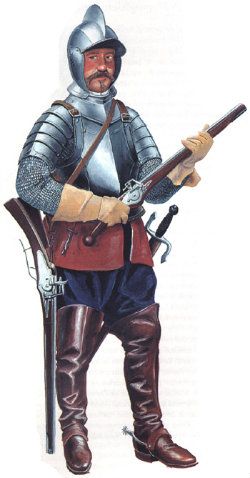
Armor didn't disappear from battlefields because swords got thinner or swordsmen more agile - armor disappeared because firearms rendered it ineffective.
But what about fencing techniques? Surely the great masters of the fifteenth, sixteenth, and seventeenth centries changed the nature of swords and swordplay? In fact, fashion, not fighting, dictated a change in blades, with swords growing thinner and shorter in response to the needs of courtiers, not soldiers, and the techniques of the swordmasters changed in response.
Well, so what, right? D&D's FANTASY, ain't it? Who cares what soldiers wore in the seventeenth century? After all, most fantasy worlds don't even have guns, so why can't a swashbuckler be just as good as a mail-clad warrior?
Fair enough. So how does D&D represent fighting skill? The ability to hit an opponent is tied to class and level, expressed, for example, on an attack matrix in 1e AD&D or basic attack bonus in 3.x D&D. As your character increases in level, so does her ability to hit things. So far, so good.
Defense is handed a bit differently. In 1e and 3e - and I'll keep referencing those two editions from here on out, as they are the ones with which I'm most familiar - a character's primary protection comes from armor, and thus we get to the "unforgiving treatment that D&D rules mete out to unarmored combatants," for which Robin Laws suggests the solution is "some free armor protection to compensate."
But armor isn't the only form of defense available to characters. First, characters can parry - in 1e, a parry subtracts the defender's Strength bonus to hit from the attacker's die roll, and in 3e, "fighting defensively" nets you a -4 on attacks but a +2 dodge bonus to armor class - or dodge - 3e feats and class ability which improve armor class. Second, characters get a bonus to their armor class - called defensive adjustement in 1e, Dexterity bonus in 3e - through having a high Dexterity ability score.
Defensive skill, however, is represented in D&D another way: hit points.
If I could go back in time and send a message to Gary Gygax as he was preparing the little brown books, it would be, 'Come up with a different names for hit points.' Intuitively most gamers associate hit points with the ability to withstand physical damage, and this association sowed untold confusion ever since. 1e defines hit points thus:
Because these reflect both the actual physical ability of the character to withstand damage - as indicated by constitution bonuses- and a commensurate increase in such areas as skill in combat and similar life-or-death situations, the "sixth sense" whith warns the individual of some otherwise unforeseen events, sheer luck, and the fantastic provisions of magical protections and/or divine protection (emphasis added).3e, in the SRD, is much more succinct: "Hit points mean two things in the game world: the ability to take physical punishment and keep going, and the ability to turn a serious blow into a less serious one" (emphasis added again).
But Robin Laws isn't satisfied to allow hit points to be what hit points are: martial skill, the ability to turn aside a deadly blow. And unfortunately he's not the only one.
The original Duelist for 1e was written by Arthur Collins and published in May 1983 as a 'non-player character class' in Dragon 73. The class description includes some forgettable fluff, but the mechanics are what interest me. First, as one expects of the lightly armored fighter, the duelist is restricted to leather armor; somewhat surprisingly - and certainly comically for a character based on the swashbuckler - the duelist cannot use a shield. However, the role of hit points as combat skill - the presumed forte of the lightly armored fighter - is underscored by giving the character a d12 hit die. The author, Mr Collins, goes to some length to explain this design choice, writing, "Giving the duelist 12-sided hit dice is not intended to convey the impression that duelists are monstrous hulks . . ." and calling out the same passge in the 1e DMG quoted previously. Mr Collins concludes, "A 10th-level duelist will average more hit points than a 10th-level fighter, thus giving the former an appropriate edge in one-on-one combat; the duelist can outlast and wear out an opponent who is less skilful than he" (emphasis added once more).
To me, this is an adroit application of an elegant rule. Hit points were designed to emulate the give-and-take of swashbuckling swordplay from the very beginning, and the duelist takes that conceit and runs with it.
However, Mr Collins isn't content to stop there. Not only is the duelist given a higher hit die, representing his martial ability, he's also harder to hit, receiving "free armor protection" in the form of an armor class bonus every three levels; moreover, the duelist receives additional to-hit and damage bonuses as well, so that 10th-level fighter is at a further disadvantage against the 10th-level duelist.
It's a shame that some game designers just don't know when to let off the gas. The duelist and his d12 hit die does exactly what one expects of the swashbuckling fighter, to skillfully land the killing blow when his opponent runs out of tricks of his own; adding an armor class bonus gilds the lily.
The 3e Duelist prestige class is another take on the lightly armored fighter. Feats and skills ramp up the notion of the 'wily' fighter - as opposed to what other kind of fighter, one wonders? are other types of fighters less skilled somehow? - with feats like Dodge, Mobility, and Weapon Finesse which are the prerequisites for the prestige class. The Duelist's class abilities pile on, adding an armor class bonus for Intelligence bonuses, a precisely located strike for extra damage, even the ability to deflect arrows; as with so much about 3e, it takes the archetype and turns it up to eleven. Note that I don't think this is objectively bad for any reason; I do think it reinforces a parody trope of swashbuckling, but at the end of the day, it's simply not my cuppa.
So where am I going with all this?
Last week, Beedo at Dreams in the Lich House posed the question, "For purposes of D&D, what's the difference between a Norman knight, a viking, a samurai, a Roman centurion? What if we throw a muskeeter in the mix, a Mongolian horse archer, and a Hospitaler?"
It's a great question. Beedo continues:
I love this question with regards to the fighter, because the convergence of technology and tactics has created great variations in the fighting men of world history, and the differences are so easy for us to visualize. The evolution of D&D from its original vision has involved a long line of add-ons and extensions to create mechanical differentiation among character classes - new classes and sub-classes, secondary skills, kits, feats, prestige classes, and so on.I couldn't agree more. one of the strengths of the fighter class is that it embraces so many archetypes.
It's a topical question for me - I'm thinking over what a game in an Oriental Adventures setting would look like using a BX style of rules, and I have a pretty good idea how I'd handle archetypes like the samurai, the bushi, the kensai, the warrior monk: you're all fighters. You wear different armor, use different weapons, but at the end of the day, you all get paid to slug it out with the other guy. My work here is done.
I also have some pratical experience with this approach. As I noted in the comments to Beedo's post, many years ago I ran a 1e fighter with a high Dexterity. An ex-pit fighter who escaped the arena, he was all about quickness, from his 12" movement rate in leather armor to his weapons speed factor 3 short sword to win initiative ties - this is why you use speed factors, boys and girls - to his spiked buckler which could be used for both offense and defense to his d10 hit dice which made him a more skilled combatant.
But where does that leave the poor swashbuckler, the duelist with his sword and dagger and no armor in a game filled with deadly warriors in iron suits? Well, I imagine it leaves them lighter on their feet and more likely to take a hit, like their counterparts in Melee, as Fenway5 at Sword and Shield reminds us.
Look, I completely understand the impulse to impose some sort of rules-parity between the lightly armored swashbuckling fighter and the plate mail-clad knight in a fantasy campaign, but I don't share that impulse.
Unlike some fantasy fans, I think history is instructive on this point. Real-life duelists fought without armor at a time when armor was the norm on the battlefield. Why would a duelist forego armor in a fantasy setting? Because of social taboos associated with honor, or because wearing armor around town is an incitement to violence that the authorities won't countenance, or because climbing a trellis into your lover's window is too noisy in chain maille and a great helm. Let the adventurers climb out of their tin cans once in awhile - give all the fighters a reason to be lightly armored.
Just not when a dragon's bearing down on them.
Friday, June 15, 2012
Taunts, Feints, and Threats for Flashing Blades
Preface: The following was originally posted at rpg.net a couple of years ago.
While it’s perfectly feasible and reasonable to leave the effects of mockery, trickery, and intimidation during a duel to the discretion of the Gamemaster, other games offer a number of rules options for this.
Coda: To date these house rules remain more of a thought experiment as I've never actually implemented them in my campaign. Rather than making a formal house rule out of taunts and threats, I continue to make spot rulings, though my resolution remains similar to this. As far as feints go, I think I'd rather that a feint be used to get an defender to waste a parry attempt.
He knew that Saldaña was as placid as an ox in all matters but those concerning his wife. Then passion blinded him. Any jokes about how she had got him the post in exchange for favors granted to third parties – as malicious tongues would have it – quickened his pulse and clouded his reason. “With any luck,” thought Alatriste, “this will help me resolve the matter quickly.” He adjusted his grip, parried a thrust, withdrew a little to draw his opponent in, and, when their blades clashed again, he noticed that Saldaña already seemed less confident. He decided to return to the attack.Taunts, feints, and threats are as much of part of swashbuckling as thrusts and ripostes for many fans of the genre. Flashing Blades, the roleplaying game of high adventure in 17th century France, includes an excellent system of fencing rules, but while it includes character attributes such as Wit and Charm, it doesn’t bring the two together in terms of the rules for combat.
“I imagine she’ll be inconsolable,” he said, striking again. “She’ll doubtless wear deepest mourning.”
Saldaña did not reply, but he was breathing hard and muttered a curse when the furious barrage he had just unleashed slashed only thin air, sliding off the captain’s blade.
“Cuckold,” said Alatriste calmly, then waited.
Now he had him. He sensed him coming toward him in the dark, or rather he knew it from the gleam of steel from his sword, the sound of frantic footsteps, and the rancorous roar Saldaña let out as he attacked blindly.
- Arturo Pérez-Reverte, The Cavalier in the Yellow Doublet
While it’s perfectly feasible and reasonable to leave the effects of mockery, trickery, and intimidation during a duel to the discretion of the Gamemaster, other games offer a number of rules options for this.
- d20: The Bluff and Intimidate skills may be used to gain advantages in combat. Bluff is used to feint: on a successful Bluff check opposed by Sense Motive plus the base attack bonus, the opponent loses its Dexterity bonus to armor class against the next melee attack. Intimidate may be used to demoralize an opponent: on a successful check Bluff check opposed by the opponent’s level or hit dice plus Wisdom bonus, the opponent takes a -2 penalty on attack rolls, ability checks, and saving throws for one round.
- Savage Worlds Pirates of the Spanish Main: Characters may institute a “Test of Wills” using the Taunt and Intimidate skills. On successful Taunt and Intimidate skill checks opposed by Smarts and Spirit respectively, the attacker gains a +2 bonus to the attacker’s next action, and a raise on the roll makes the opponent Shaken as well.
- 7th Sea: The Repartee System allows characters to Charm, Intimidate, and Taunt their opponents. These are opposed checks using the Wits, Resolve, and Panache attributes, respectively. A successful Charm check allows a character to influence another’s point of view. A successful Intimidate check costs the opponent one die from his die pool, plus one additional die for each Raise by the character. A successful Taunt requires the opponent to match the character’s Raises.
- Taunt: A Taunt is a normal action. A Taunt is an opposed check between the attacker’s Charm and the defender’s Wit; the attacker gains a +2 bonus for possessing the Oratory skill. On a successful check, the defender may not select a defense action in the next turn; the defender may choose either normal or long actions, usually either an attack and counter or a lunge. The defender also suffers an additional -2 penalty to his reaction parry attempt. If the attempt to taunt is unsuccessful, then any subsequent attempt is made using the attacker’s Charm/2 for the duration of the combat or until a success is achieved.
- Feint: A Feint is a normal action. A Feint is an opposed check between the Expertise of the attacker and defender respectively using the weapons in hand. On a successful check, the attacker may add a +2 bonus to the attacker’s next attack or parry roll (player’s choice). If the check is unsuccessful, the opponent may add +1 to his next attack or parry roll.
- Threat: A Threat is a normal action. A Threat is an opposed check between the attacker’s Charm and the defender’s Wit; the attacker gains a +2 bonus for possessing the Captaincy skill. On a successful check, the defender either loses his remaining action, if any, or loses one action in the following turn.. If the attempt to intimidate via a Threat is unsuccessful, then any subsequent attempt is made using the attacker’s Charm/2 for the duration of the combat or until a success is achieved.
Coda: To date these house rules remain more of a thought experiment as I've never actually implemented them in my campaign. Rather than making a formal house rule out of taunts and threats, I continue to make spot rulings, though my resolution remains similar to this. As far as feints go, I think I'd rather that a feint be used to get an defender to waste a parry attempt.
Tuesday, May 1, 2012
"You are using Bonetti's Defense against me, ah?"
Need to up your character's dueling cred? Try peppering your repartee with a few of these moves.
Roll 1D20.
1. Giganti's Balestra
2. Dancie's Riposte
3. Agrippa's Passata-soto
4. Sevestini's Reprise
5. Sainct-Didier's Trompement
6. Von Gunterrodt's Zornhau
7. Desbourdes' Attaque au Fer
8. Saint-Pierre's Coulé
9. Thibault's Flèche
10. Cavalcabo's Moulinet
11. Di Grassi's Parry
12. Marozzo's Slash
13. Narvaez's Beat-Parry
14. Palladini's Bind
15. Heredia's Coup d'arrêt
16. Docciolini's Lunge
17. Capo Ferro's Insistence
18. Swetnam's Neuvieme
19. Hale's Prise de Fer
20. Silver's Invitation
Inspired by a Jeff Rients post.
Roll 1D20.
1. Giganti's Balestra
2. Dancie's Riposte
3. Agrippa's Passata-soto
4. Sevestini's Reprise
5. Sainct-Didier's Trompement
6. Von Gunterrodt's Zornhau
7. Desbourdes' Attaque au Fer
8. Saint-Pierre's Coulé
9. Thibault's Flèche
10. Cavalcabo's Moulinet
11. Di Grassi's Parry
12. Marozzo's Slash
13. Narvaez's Beat-Parry
14. Palladini's Bind
15. Heredia's Coup d'arrêt
16. Docciolini's Lunge
17. Capo Ferro's Insistence
18. Swetnam's Neuvieme
19. Hale's Prise de Fer
20. Silver's Invitation
Inspired by a Jeff Rients post.
Tuesday, April 24, 2012
U is for Unbuilt
For the July 2000 issue of Dragon magazine, Robin Laws wrote an article entitled "Swashbuckling Essentials," containing, ". . . twelve tips for the prospective swashbuckler," aimed at referees and players of Dungeons and Dragons specifically, and other games generally. Mr Laws' tips include such nuggets as "Panache Your Middle Name," "Chivalry to the Point of Idiocy," "Gentlemen Prefer Rapiers," and, "Armor is for the Weak."
Mr Laws then advises how to integrate these tips into the rules of the game. Here's a sample.
But "Swashbuckling Essentials" also falls into the familiar trap of failing to understand its sources, and as a result it ends up defining the genre as parody. He also gets some things flat wrong; for example, Mr Laws writes, "If your campaign draws inspiration from The Three Musketeers, don't expect to find treasure all over the place. . . . They get their equipment from the king's armory, their horses from his livery, and so on," whereas M. Dumas devotes whole chapters in his tale to the Musketeers figuring out how to pay for their equipment before going on campaign.
TV Tropes, that inestimable trove of "devices and conventions that a writer can reasonably rely on as being present in the audience members' minds and expectations," includes a page on swashbuckling. Among the "devices and conventions" associated with the cape-and-sword genre is the Unbuilt Trope.
The Unbuilt Trope "is a work that seems like a Deconstruction but is actually the Trope Maker itself. This is often because later appearances of the trope have decayed compared to the original, defining appearance." As TV Tropes explains, this can happen for a number of reasons, from conscious choice to lack of understanding to just plain hackery by later writers. In fact, TV Tropes specifically calls out Alexandre Dumas' The Three Musketeers and Anthony Hope's The Prisoner of Zenda as examples of the Unbuilt Trope in swashbuckling.
In the case of the cape-and-sword genre, I expect that the tropes decayed with the transition of swashbuckling stories to the medium of film. Many fans of the various movie versions of The Three Musketeers might be quite surprised by M Dumas' concise treatment of d'Artagnan's duels in his books. The Alatriste novels by Arturo Pérez-Reverte, written at the tail-end of the twentieth century, are in fact much closer in feel to the works by M Dumas and Mr Hope than they are Rafael Sabatini or Johnston McCulley.
Overemphasizing comically light-hearted action, as I feel Mr Laws does in "Swashbuckling Essentials," limits the range of experiences available through cape-and-sword roleplaying. Showering a player with bonuses that make using improvised weapons better than the sword is one way to encourage swashbuckling action; another is to make fights desperate enough that there is a pressing need for creative solutions, such that using an cleaver unbalanced for throwing to slow down a rush of attackers is preferable to relying on the sword alone, even if it entails a penalty to perform successfully.
When I set out to develop my own cape-and-sword campaign, Le Ballet de l'Acier, I knew I wanted the action in actual play to feel more like the Musketeers and Alatriste novels. I hadn't heard of the Unbuilt Trope at the time; I just knew that I wanted a game that felt more like the Richard Lester Musketeers movies and less like The Crimson Pirate. Swashbuckling can be a dirty business as well as a funny one, and focusing on the latter at the expense of the former, as "Swashbuckling Essentials" does, would result in a much shallower roleplaying experience.
Mr Laws then advises how to integrate these tips into the rules of the game. Here's a sample.
So when you're in a tight spot, when the bloodthirsty pirates have you cornered in the colonial governor's kitchen, look around for items that are waiting to help you. In swashbuckler mode, a found item almost always makes as effective a weapon as the cutlass in your scabbard or the dagger in your boot. Expect your [dungeon master] to assign you a big bonus for flinging a handy meat cleaver at the lead pirate. Expect an even bigger one for lifting a roasting boar from its spit and hurling it at him.And another.
Wit is crucial component of your Charisma-based arsenal. It is not enough to defeat an opponent - you must prove yourself his master in the fine art of the cutting remark. Swashbuckling villains stand united in their reslolute lack of a sense of humor, especially regarding their own faults. Your DM should reward you for wittiness above and beyond the call of duty. For example, each time you successfully infuriate a foe with a cutting remark, your DM might reward you [experience points] equal to 10% of amount you'd get for defeating him outright.Advice like Mr Laws' is pretty common for cape-and-sword roleplaying games, reflecting perhaps the most widely held perceptions of what swashbuckling adventure is all about. There's a lot to like here, particularly about the importance of romance and honor.
But "Swashbuckling Essentials" also falls into the familiar trap of failing to understand its sources, and as a result it ends up defining the genre as parody. He also gets some things flat wrong; for example, Mr Laws writes, "If your campaign draws inspiration from The Three Musketeers, don't expect to find treasure all over the place. . . . They get their equipment from the king's armory, their horses from his livery, and so on," whereas M. Dumas devotes whole chapters in his tale to the Musketeers figuring out how to pay for their equipment before going on campaign.
TV Tropes, that inestimable trove of "devices and conventions that a writer can reasonably rely on as being present in the audience members' minds and expectations," includes a page on swashbuckling. Among the "devices and conventions" associated with the cape-and-sword genre is the Unbuilt Trope.
The Unbuilt Trope "is a work that seems like a Deconstruction but is actually the Trope Maker itself. This is often because later appearances of the trope have decayed compared to the original, defining appearance." As TV Tropes explains, this can happen for a number of reasons, from conscious choice to lack of understanding to just plain hackery by later writers. In fact, TV Tropes specifically calls out Alexandre Dumas' The Three Musketeers and Anthony Hope's The Prisoner of Zenda as examples of the Unbuilt Trope in swashbuckling.
In the case of the cape-and-sword genre, I expect that the tropes decayed with the transition of swashbuckling stories to the medium of film. Many fans of the various movie versions of The Three Musketeers might be quite surprised by M Dumas' concise treatment of d'Artagnan's duels in his books. The Alatriste novels by Arturo Pérez-Reverte, written at the tail-end of the twentieth century, are in fact much closer in feel to the works by M Dumas and Mr Hope than they are Rafael Sabatini or Johnston McCulley.
Overemphasizing comically light-hearted action, as I feel Mr Laws does in "Swashbuckling Essentials," limits the range of experiences available through cape-and-sword roleplaying. Showering a player with bonuses that make using improvised weapons better than the sword is one way to encourage swashbuckling action; another is to make fights desperate enough that there is a pressing need for creative solutions, such that using an cleaver unbalanced for throwing to slow down a rush of attackers is preferable to relying on the sword alone, even if it entails a penalty to perform successfully.
When I set out to develop my own cape-and-sword campaign, Le Ballet de l'Acier, I knew I wanted the action in actual play to feel more like the Musketeers and Alatriste novels. I hadn't heard of the Unbuilt Trope at the time; I just knew that I wanted a game that felt more like the Richard Lester Musketeers movies and less like The Crimson Pirate. Swashbuckling can be a dirty business as well as a funny one, and focusing on the latter at the expense of the former, as "Swashbuckling Essentials" does, would result in a much shallower roleplaying experience.
Monday, April 9, 2012
H is for Honor
Swashbucklers may be may be daredevil duelists and dashing romantics. They may be hard-bitten men and troubled souls. They may be wizened veterans or callow youths. They may be all of these things in the course of their lifetimes, and more.
But perhaps the most important characteristic common to swashbucklers is a personal code of honor.
That sense of honor should not be confused with behaving honorably. A swashbuckler need not be a paragon of virtue — in fact they may be quite the opposite. Diego Alatriste is a hired assassin. Percy Blakeney accepts money to kindnap a burgher’s daughter, then swindles the burgher into paying Blakeney to ‘rescue’ her. D’Artagnan date-rapes Milady de Winter by posing as the comte de Wardes and sneaking into her bedroom under cover of darkness. To satisfy a bet, the marquis de Bardelys assumes the identity of a dead man in order to trick the daughter of the vicomte de Lavedan into marrying him. A swashbuckler’s deeds may define him as hero or villain, but his honor demands that he accept his due no matter what, without equivocation.
Maintaining one’s reputation and preserving one’s honor may lead a swashbuckler down several paths. For example, some may choose to fight anyone and everyone who offers them cause, however slight; this is the classic duelist. Others may emphasize courtesy and etiquette to avoid giving or taking offense, minimizing slights and reserving the sword as the final recourse for the most grave slanders.
Players in cape-and-sword roleplaying game campaigns may choose to give some thought to how their characters express their honor before the campaign begins, but even if they don't, how the player characters conduct themselves in actual play will reflect a de facto personal code by which others may take the character's measure.
But perhaps the most important characteristic common to swashbucklers is a personal code of honor.
‘Never submit quietly to the slightest indignity, except it proceed from the cardinal or the king. It is by his courage — mark this well — it is by his courage alone, that a gentleman makes his way nowadays. Whoever hesitates one moment, lets perhaps that chance escape him, which fortune, for that moment alone, has offered him.’To the swashbuckler it is better to risk death than dishonor. One’s reputation is, in the end, all one truly possesses — power and fortunes come and go, but honor can only be given away, never taken.
— Alexandre Dumas, The Three Musketeers
He took his place without a word. I read in his drawn white face that he had made his mind up to the worst, and his courage so won my admiration that I would gladfully and thankfully have set one of the lookers-on — any of the lookers-on — in his place; but that could not be. So I thought of Zaton’s closed to me, of Pombal’s insult, of the sneers and slights I had long kept at sword point; and, pressing him suddenly in a heat of affected anger, I thrust strongly over his guard, which had grown feeble, and ran him through the chest.
— Stanley Weyman, Under the Red Robe
Alatriste shook his head thoughtfully, then looked at his sword and his dagger. “We are what we are,” he thought. “My reputation is all, and I have no other.”
— Arturo Pérez-Reverte, The Cavalier in the Yellow Doublet
That sense of honor should not be confused with behaving honorably. A swashbuckler need not be a paragon of virtue — in fact they may be quite the opposite. Diego Alatriste is a hired assassin. Percy Blakeney accepts money to kindnap a burgher’s daughter, then swindles the burgher into paying Blakeney to ‘rescue’ her. D’Artagnan date-rapes Milady de Winter by posing as the comte de Wardes and sneaking into her bedroom under cover of darkness. To satisfy a bet, the marquis de Bardelys assumes the identity of a dead man in order to trick the daughter of the vicomte de Lavedan into marrying him. A swashbuckler’s deeds may define him as hero or villain, but his honor demands that he accept his due no matter what, without equivocation.
Maintaining one’s reputation and preserving one’s honor may lead a swashbuckler down several paths. For example, some may choose to fight anyone and everyone who offers them cause, however slight; this is the classic duelist. Others may emphasize courtesy and etiquette to avoid giving or taking offense, minimizing slights and reserving the sword as the final recourse for the most grave slanders.
Players in cape-and-sword roleplaying game campaigns may choose to give some thought to how their characters express their honor before the campaign begins, but even if they don't, how the player characters conduct themselves in actual play will reflect a de facto personal code by which others may take the character's measure.
Monday, April 2, 2012
B is for Buckler
The buckler was a small, maneuverable, hand-held shield for deflecting and punching blows. It was usually round and made of metal but occasionally of hardened leather or layers of wood. Bucklers were typically round and frequently between 8 to 16 inches in diameter, but octagonal, square, and trapezoidal versions were also known.As described in an informative essay published by the Association of Renaissance Martial Arts, the buckler was introduced in the 13th century and remained popular with both soldiers and swordsmen for around three hundred years before finally falling into disuse in the 17th century.
The versatility of the sword and buckler as a method of fighting can be said to lay in its simplicity. As a two-weapon combination, it is simultaneously defensive and offensive. It offered some protection against missile weapons and was convenient for facing heavier weapons such as polearms and axes. Yet, its small size made it agile and quick. Combined with a good shearing sword or tapering cut-and-thrust blade, it could deflect attacks, strike blows of its own, and yet still allow the user’s own sword to cut around in any direction. Another advantage of metal bucklers was that unlike wooden shields, the point of an opponent’s weapon would not get stuck in the face of the buckler nor would the edge of a blade damage the rim (although, when this occurred it could be used to the shield man’s advantage). In many of the historical images of sword and buckler combat the familiar fighting postures found in longsword fencing manuals can be easily discerned, such as the wards of: high, middle, low, back, and hanging.
The practice of striking one's buckler with a sword as a means of issuing a challenge or as a distraction, like stamping one's foot on the piste, while fighting gives us the word swashbuckler.
Thomas Fuller in his 1662, The History of the Worthies of England (Everyman Edition) described “swashblucker” as coming from the action of “swashing and making a noise on the buckler.” Apparently they would strike on their own bucklers with their swords during fighting. Similarly, Baret’s Alvearie of 1573 mentioned “to swash or to make a noise with swordes against tergats” while Ben Johnson in his early 17th century play, Staple of News, included the line, “I do confess a swashing blow”. Shakespeare in Romeo and Juliet also has the Capulet serving man Gregory make his “swashing blow” (i.e., a wide cut). John Florio also mentions, “A bravo, a swashbuckler, one that for money and good cheere will follow any man to defend him; but if any danger come, he runs away the first, and leaves him in the lurch.” And yet, in 1602 William Bass wrote a religious study that metaphorically referred faith to the confidence found in the “Sword & Buckler” as “The Serving Man’s Defence.”As the rapier replaced earlier swords, so did the dagger and main-gauche replace the buckler, though rapier and buckler continues to appear in fencing manuals of the 17th century.
Characters in the Flashing Blades roleplaying game trained in the Italian and French fencing styles may carry bucklers as an off-hand parrying weapon. One of the advantages of the buckler in the FB fencing rules is that it's stronger than most blades, increasing the chance of breaking an opponent's sword. One of the characters in our campaign likes to carry a buckler as well as a swordbreaker.
The rules in Flashing Blades are intended to facilitate playing over a fairly lengthy period, covering the reigns of kings Henri IV, Louis XIII, and Louis XIV. This involves some necessary abstractions, of course, some of which I've addressed through house rules to capture more of the feel of the 1620s, when our campaign is set.
One of the abstractions in the game is that fighting styles and weapons remain consistent between 1589 and 1715. For my campaign, however, I want to capture the changes which occurred over the 17th century - rapiers and off-hand weapons should slowly be supplanted by the single smallsword as the weapon of choice among gentilhommes. Indeed, fighting with a buckler in the grand age of the swashbuckler should become increasingly rare.
I can handle this ebb and flow of time and fashion in the campaign a couple of ways. Frex, I can introduce house rules which change the styles and weapons available to the characters - after about 1650, a new fencing style, the 'smallsword' or 'court' style, with an emphasis on point-work - thrusts and lunges - will become available to the characters. As far as the existing fencing styles go, I could also simply say they're no longer available, but that's a bit too heavy-handed for me - rather they will simply fade into disuse among the non-player characters in the setting, making them an anachronism by the latter years of the Sun King's reign.
The buckler-wielding King's Musketeer in our campaign will start to experience this soon. His buckler brands him as a 'low' fighter, a barodeur, particularly among gentlemen, and they may comment upon it, dismissively perhaps - at their own peril, of course, for if Riordan O'Neill takes offense, they may well find themselves getting a first-hand demonstration of the buckler in action!
I prefer this to simply ruling weapons like bucklers or fencing styles out of the campaign. It gives the players the opportunity to make interesting choice about their characters, of finding their place in the game-world. Perhaps Riordan's player will embrace the image of a street-tough, or maybe he will conform to the social mores of the period and stop carrying the buckler. Either way, we both learn something about the character in actual play.
The referee controls the setting in a roleplaying game, but that control stops at the player's characters. Giving the players intriguing choices, and resolving the consequences of those choices in a way consistent with the game-world, is the referee's role.
Friday, March 30, 2012
You Never Forget Your First
My father took me to see The Three Musketeers when I was nine years old.
It was the Richard Lester film, with Michael York, Oliver Reed, et al., still perhaps the most faithful movie version of the tale. During the first duel, in the convent amid the laundry drying on the lines, I was literally on the edge of my seat. I take my love of reading from both my parents, but my love of movies comes very much from my dad. He introduced me to The Adventures of Robin Hood, Quentin Durward, and The Crimson Pirate during Saturday afternoon matinees on our black-and-white Sears television. Seeing swashbucklers on the big screen - in Technicolor! - was utterly breathtaking.
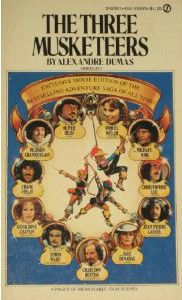 We used to visit our local bookstore in downtown Montrose regularly - every other Friday, on mom's payday, I could purchase two Hardy Boys books, which I would usually end up finishing by Sunday night. Prowling the stacks one Friday evening, I spotted The Three Musketeers on the shelf. It was the Signet movie tie-in, an abridged version of the original tale, and my parents let me get it along with my bi-weekly Franklin W. Dixon fix. Up to that point, Treasure Island was my favorite story, but that abridged TTM soon sat on the shelf beside it. I read it again and again.
The following year, browsing the Revell and Monogram model kits at Michael's Toy Store in the Glendale Galleria, I discovered wargames - Tobruk, from Avalon Hill, was the first, and with each birthday and Christmas - and any payday I could wheedle a parent successfully - my collection of games, then metal miniatures, expanded.
And at the tail end of 1977, I was introduced to roleplaying games.
Like many gamers, I started with D&D and its pseudo-medieval fantasy of knights in chainmail and wizards in pointy hats. From my pervious incarnation as a tabletop warlord, the tactics the game rewarded seemed intuitive. I backed up my characters with men-at-arms wielding polearms effective against both charging horses and evil warriors in plate mail - yes, I'm one of those rare gamers who used the weapons versus armor class modifiers - and archers to harry magic-users. My tactical acumen would make William Marshall proud.
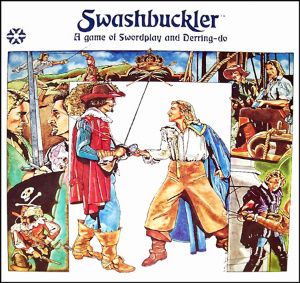 I still enjoyed board games as well, of course, and in 1980 I found an unusual game, Swashbuckler. Whereas Avalon Hill had its 'bookcase games,' Yaquinto Publishing offered its own line of 'album games,' roughly the same size and shape as the cardboard slipcovers of vinyl LPs. Billed as "a game of Swordplay and Derring-Do," it offered me the chance to play the pirates and musketeers who captured my imagination as a young boy on the living room couch and in a darkened theatre with my dad.
Swashbuckler's fidelity to the genre remains remarkable to me. Sharing written orders like those of En Garde! the players choose not only to attack or parry with rapier or cutlass, but to kick, shove, throw a dagger or sword, flip a table, toss a chair, throw a mug of beer - and slip on the drink and get cut by the broken shards - yank a carpet, jump from a balcony or poop deck, swing on a chandelier or a rigging line, and wave a plumed hat in an opponent's face.
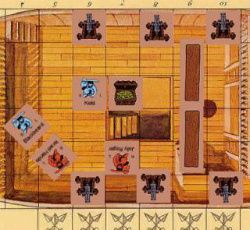 Players could choose cutlass-armed pirates or rapier-wielding musketeers for their characters in the game - my friend John and I played mostly musketeer games in the tavern half of the game-board, but perhaps our most epic games were the ones which began with a fight in the tavern and then spilled onto one of the pirate ships to claim a treasure chest or two.
The game includes rules for the players' swashbucklers to improve with experience, and we soon had our stables of characters. Mortality would claim them periodically, but one of my characters, a musketeer named André, came to outlast them all, surviving tavern brawls and boardings at sea, against rapier and cutlass and dagger and beer mug. André became nigh unstoppable - in fact, he never lost a fight in three years of dueling. His prowess legendary, I decided he needed his own character portrait, and I found the perfect picture for him, which I sketched freehand onto a custom character record, reversing the image to put the sword in his right hand where it belonged.
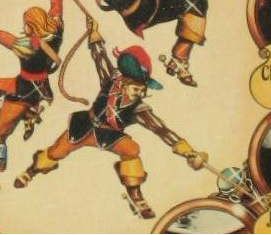 I took the image from the cover of my abridged paperback movie tie-in of The Three Musketeers.
I graduated high school in 1983, and John and I slowly drifted apart - I don't think I played Swashbuckler more than a couple of times after graduation. But I noticed a change in my roleplaying game tactics. I tended to use improvised weapons more often, tried to distract and befuddle my enemies rather than simply outmaneuver or overpower them. I ran a high Dexterity fighter in an AD&D game with a short sword in one hand and a spiked buckler in the other; my thieves nearly always had a dagger in their off-hands and fought from whatever high ground could be found. I became less William Marshall and more Percy Blakeney.
And in 1984, I saw a new roleplaying game, Flashing Blades, on the shelf at The Gamekeeper in the same mall were I discovered Tobruk.
My inner nine year-old remains thrilled to this day.
It was the Richard Lester film, with Michael York, Oliver Reed, et al., still perhaps the most faithful movie version of the tale. During the first duel, in the convent amid the laundry drying on the lines, I was literally on the edge of my seat. I take my love of reading from both my parents, but my love of movies comes very much from my dad. He introduced me to The Adventures of Robin Hood, Quentin Durward, and The Crimson Pirate during Saturday afternoon matinees on our black-and-white Sears television. Seeing swashbucklers on the big screen - in Technicolor! - was utterly breathtaking.
The following year, browsing the Revell and Monogram model kits at Michael's Toy Store in the Glendale Galleria, I discovered wargames - Tobruk, from Avalon Hill, was the first, and with each birthday and Christmas - and any payday I could wheedle a parent successfully - my collection of games, then metal miniatures, expanded.
And at the tail end of 1977, I was introduced to roleplaying games.
Like many gamers, I started with D&D and its pseudo-medieval fantasy of knights in chainmail and wizards in pointy hats. From my pervious incarnation as a tabletop warlord, the tactics the game rewarded seemed intuitive. I backed up my characters with men-at-arms wielding polearms effective against both charging horses and evil warriors in plate mail - yes, I'm one of those rare gamers who used the weapons versus armor class modifiers - and archers to harry magic-users. My tactical acumen would make William Marshall proud.
Swashbuckler's fidelity to the genre remains remarkable to me. Sharing written orders like those of En Garde! the players choose not only to attack or parry with rapier or cutlass, but to kick, shove, throw a dagger or sword, flip a table, toss a chair, throw a mug of beer - and slip on the drink and get cut by the broken shards - yank a carpet, jump from a balcony or poop deck, swing on a chandelier or a rigging line, and wave a plumed hat in an opponent's face.
The game includes rules for the players' swashbucklers to improve with experience, and we soon had our stables of characters. Mortality would claim them periodically, but one of my characters, a musketeer named André, came to outlast them all, surviving tavern brawls and boardings at sea, against rapier and cutlass and dagger and beer mug. André became nigh unstoppable - in fact, he never lost a fight in three years of dueling. His prowess legendary, I decided he needed his own character portrait, and I found the perfect picture for him, which I sketched freehand onto a custom character record, reversing the image to put the sword in his right hand where it belonged.
I graduated high school in 1983, and John and I slowly drifted apart - I don't think I played Swashbuckler more than a couple of times after graduation. But I noticed a change in my roleplaying game tactics. I tended to use improvised weapons more often, tried to distract and befuddle my enemies rather than simply outmaneuver or overpower them. I ran a high Dexterity fighter in an AD&D game with a short sword in one hand and a spiked buckler in the other; my thieves nearly always had a dagger in their off-hands and fought from whatever high ground could be found. I became less William Marshall and more Percy Blakeney.
And in 1984, I saw a new roleplaying game, Flashing Blades, on the shelf at The Gamekeeper in the same mall were I discovered Tobruk.
My inner nine year-old remains thrilled to this day.
Sunday, March 4, 2012
Swashbuckling the Paizo Way
At What a Horrible Night to Have a Curse . . . , Lord Gwydion posts about adding swashbuckling action - ". . .like swinging from chandeliers, flipping their cloak over the opponent's head, throwing sand in their eyes, or . . . grapple/disarm/trip type stuff" - to classic D&D games using Combat Maneuvers from Pathfinder.
He was even kind and patient enough to explain it to a Pathfinder-illiterate like myself.
He was even kind and patient enough to explain it to a Pathfinder-illiterate like myself.
Wednesday, February 29, 2012
A Swashbuckler's Sandbox, Part 4
In part 3, I described using a list of genre influences - an Appendix N - as a guide for creating encounters and non-player characters for a swashbuckling sandbox. Genre tropes in a sandbox may provide a measure of familiarity to players which in turn increases their confidence in their decisions pertaining to their characters, encouraging them to drive the action, which is the goal in a sandbox setting.
This may be perhaps the most obvious and least useful advice ever, but from reading blogs and intreweb forums, sometimes that which seems so obvious to me is a complete mystery to others, so I'm not taking anything for granted.
One of the fundamental differences between the sandbox settings most familiar to fantasy or science fiction gamers, is that the cape-and-sword sandbox less likely to be organized around places - the keep, the Caves of Chaos, and the Mound of the Lizard Men, for example, or Hefry, Ruie, and Forboldn in Regina subsector. Rather, the swashbuckler's sandbox is organized around people.
The non-player characters in the swashbuckler's sandbox form a web of relationships, a web which is in some ways analagous to a traditional dungeon. Think of each person as a 'room,' and the relationships between them as the 'corridors' by which they are connected.
To take that social-relationships-as-dungeon analogy a little further, the social world of the swashbuckler contains some of the hazards associated with old school dungeon crawls. Many of the relationships/'corridors' between characters are hidden behind 'secret doors,' for example, and must be discovered by the adventurers - in our Flashing Blades campaign, for example, one of the player characters' close allies is secretly connected to one of the princes of the blood, but the adventurers are unaware of this relationship at the moment. There are also 'chutes' which in the traditional dungeon drop players from upper levels to the more dangerous lower levels, and in the context of the swashbuckler's sandbox connect a less powerful npc to a more powerful one - in our campaign, the player characters found such a chute when one of them challenged a romantic rival to a duel and belatedly discovered that the rival's uncle is a lieutenant in the Cardinal's Guard.
A swashbuckler explores this web of relationships like a dungeoneer crawls through a lich's tomb, and for the same reasons - as the dungeoneer finds risks and rewards in the crypts of that dusty necropolis, it's the non-player characters populating a cape-and-sword game-world who provide danger, riches, and a chance at glory for the adventurers.
That said, I must allow for 'the piracy exception' - the sandbox for a pirates campaign may closely resemble that of more traditional roleplaying sandboxes, with pirates seeking out galleons and ports and lost temples to plunder in the style of their dungeoneering peers in a fantasy campaign.
The piracy exception aside, in the swashbuckler's sandbox non-player characters are the gateway to rewards and hazards - a jeweled ring is more likely to make its way into a swashbuckler's hand as a token of thanks from a grateful queen than it is from a locked chest guarded by a black pudding. Relationships with npcs are often rewards and hazards in and of themselves, particularly in games and campaigns where increased social status is one of the rewards offered to player characters. Non-player characters may offer an adventurer wealth, influence, sex, membership in an organization, and access to new skills - Lagardère seeking an introduction to the duc de Nevers in order to learn the botte de Nevers is a classic example - as well as danger, in the forms of duels, intrigue, manipulation, and loss of reputation.
To this end, the referee running a swashbuckler's sandbox should devote the same imagination and effort to creating engaging, challenging, mysterious non-player characters as other referees do a megadungeon or an alien world, and those non-player characters should be woven into a complex web of relationships, known and secret, for the adventurers to explore.
Once again, this is probably boilerplate to many - it gets covered in some manner in most referees' sections of game-books and in numerous articles in gaming rags and blog posts. Tips like, "Give each npc two secrets!" are as ubiquitous as rules for initiative or experience. So how is this different with respect to a swashbuckler's sandbox? With the possible exception of the some of the really extensive published city settings, the number and reach of the non-player characters in a cape-and-sword campaign are greater than that of more familiar settings. Consider the extent of the social network of a duke and peer who is a courtier to the king, a soldier in time of war and an extraordinary ambassador in peace, and the lord of a large estate. This one non-player character could have a web of immediate contacts, within a single degree of separation - family, servants, courtiers, and clients - comparable to all of the named npcs is the village of Hommlet and the keep on the Borderlands and then some, and many of those npcs may have considerable networks of their own . . .
Now, very few referees prepare anything other than a relatively small sandbox by attempting to detail every single person anymore than they describe every structure in a large city or every hovel in a marcher barony. What a sandbox referee does prepare are a few key locations in varying depth with the expection of improvising additional details as the need arises. The non-player characters in a swashbuckler's sandbox are handled the same way; to use an example from my campaign, I created a number of families in different parts of France who are given considerable detail - to continue to use the dungeon analogy offered earlier, these families can be thought of as 'levels' or 'sublevels' in the dungeon, and they in turn may be connected to other 'levels,' such as a gentleman's club, the King's Musketeers, or a bishop's curia.
In a traditional sandbox, the adventurers are expected to utilize their wits and resources to learn more about the game-world and set goals for themselves to pursue. The players and their characters may hear rumors or legends, or find an old map or a strange atrifact, offering clues to where rewards may be found. The same is true in a swashbuckler's sandbox, but rather than the legend of the old moathouse overheard in the tavern, the rumors and such concern the non-player characters in the setting. For example, one of the families I rendered in some detail for my Flashing Blades sandbox is that of the vicomte de Praz-de-Lys, a Savoyard nobleman who relocated his household to Paris in order to pursue closer ties to the French noblity. The player characters heard a rumor that the vicomtesse needed to fill a number of positions in her household - a tutor for her children, a fencing instructor for her sons, a banker to manage her finances, and so on - giving the adventurers an entrée into the lives of the Praz-de-Lys', their network of relationships in Paris, and the schemes in which various family members engage.
That last point bears noting - while specific cape-and-sword tropes may vary in different campaigns, one should be present in every swashbuckler's sandbox, and that is that the whole thing is awash in intrigue. "Give each npc two secrets!" should really only scratch the surface of the potential rivalries, dalliances, and alliances connecting the non-player characters. Political rivalries, ancient vendettas, and forbidden romance are the stuff of adventure in this game-world, and these agendas should permeate the relationships between npcs.
In addition to rumors for drawing the adventurers into the web of non-player characters who make up my sandbox, I also lean heavily on random encounters, many featuring named npcs, an idea borrowed from Chaosium's Thieves World box set and TSR's Boot Hill adventures. To borrow the dungeon analogy one last time, using named non-player characters in random encounters produces something like falling through the roof into a chamber of a lost shrine, the 'dungeon' presenting itself to the adventurers! The player characters in my campaign, for example, rescued the duchesse de Chevreuse and her lover, Lord Holland, from bravos in a Paris alley, then snuck the pair back into the Louvre, earning the powerful and dangerous noblewoman's gratitude - this was a random encounter generated as a disguised nobleman and a gang of thieves using the generic tables in the Flashing Blades core rules. Another random encounter - the aftermath of a murderous duel - earned one of the adventurers an enemy whom the players believe has tried twice now to assassinate their characters.
And that last touches on my final point, that the sandbox must react to the actions of the adventurers. The player characters' actions - and sometimes their failures to act - carry consequences. My simple rule is this: if the adventurers are winning, someone else is losing, and that someone may choose to do something about it. This is where the dungeon analogy breaks down a bit for me, for in these instances, the 'rooms' of the 'dungeon' may actually seek out the adventurers! Earning a friend may mean making that friend's enemies the adventurers' own as well, and if that holds true, then the enemies of their enemies may offer alliances as well. A swashbuckler's sandbox is marked by a dynamic tension as the adventurers tug, os simply brush against, the web of relationships they encounter in the game-world.
Swashbucklers may travel the world, but what defines their adventures are the people they meet and engage in their travels, and a swashbuckler's sandbox should emphasize this.
This may be perhaps the most obvious and least useful advice ever, but from reading blogs and intreweb forums, sometimes that which seems so obvious to me is a complete mystery to others, so I'm not taking anything for granted.
One of the fundamental differences between the sandbox settings most familiar to fantasy or science fiction gamers, is that the cape-and-sword sandbox less likely to be organized around places - the keep, the Caves of Chaos, and the Mound of the Lizard Men, for example, or Hefry, Ruie, and Forboldn in Regina subsector. Rather, the swashbuckler's sandbox is organized around people.
The non-player characters in the swashbuckler's sandbox form a web of relationships, a web which is in some ways analagous to a traditional dungeon. Think of each person as a 'room,' and the relationships between them as the 'corridors' by which they are connected.
To take that social-relationships-as-dungeon analogy a little further, the social world of the swashbuckler contains some of the hazards associated with old school dungeon crawls. Many of the relationships/'corridors' between characters are hidden behind 'secret doors,' for example, and must be discovered by the adventurers - in our Flashing Blades campaign, for example, one of the player characters' close allies is secretly connected to one of the princes of the blood, but the adventurers are unaware of this relationship at the moment. There are also 'chutes' which in the traditional dungeon drop players from upper levels to the more dangerous lower levels, and in the context of the swashbuckler's sandbox connect a less powerful npc to a more powerful one - in our campaign, the player characters found such a chute when one of them challenged a romantic rival to a duel and belatedly discovered that the rival's uncle is a lieutenant in the Cardinal's Guard.
A swashbuckler explores this web of relationships like a dungeoneer crawls through a lich's tomb, and for the same reasons - as the dungeoneer finds risks and rewards in the crypts of that dusty necropolis, it's the non-player characters populating a cape-and-sword game-world who provide danger, riches, and a chance at glory for the adventurers.
That said, I must allow for 'the piracy exception' - the sandbox for a pirates campaign may closely resemble that of more traditional roleplaying sandboxes, with pirates seeking out galleons and ports and lost temples to plunder in the style of their dungeoneering peers in a fantasy campaign.
The piracy exception aside, in the swashbuckler's sandbox non-player characters are the gateway to rewards and hazards - a jeweled ring is more likely to make its way into a swashbuckler's hand as a token of thanks from a grateful queen than it is from a locked chest guarded by a black pudding. Relationships with npcs are often rewards and hazards in and of themselves, particularly in games and campaigns where increased social status is one of the rewards offered to player characters. Non-player characters may offer an adventurer wealth, influence, sex, membership in an organization, and access to new skills - Lagardère seeking an introduction to the duc de Nevers in order to learn the botte de Nevers is a classic example - as well as danger, in the forms of duels, intrigue, manipulation, and loss of reputation.
To this end, the referee running a swashbuckler's sandbox should devote the same imagination and effort to creating engaging, challenging, mysterious non-player characters as other referees do a megadungeon or an alien world, and those non-player characters should be woven into a complex web of relationships, known and secret, for the adventurers to explore.
Once again, this is probably boilerplate to many - it gets covered in some manner in most referees' sections of game-books and in numerous articles in gaming rags and blog posts. Tips like, "Give each npc two secrets!" are as ubiquitous as rules for initiative or experience. So how is this different with respect to a swashbuckler's sandbox? With the possible exception of the some of the really extensive published city settings, the number and reach of the non-player characters in a cape-and-sword campaign are greater than that of more familiar settings. Consider the extent of the social network of a duke and peer who is a courtier to the king, a soldier in time of war and an extraordinary ambassador in peace, and the lord of a large estate. This one non-player character could have a web of immediate contacts, within a single degree of separation - family, servants, courtiers, and clients - comparable to all of the named npcs is the village of Hommlet and the keep on the Borderlands and then some, and many of those npcs may have considerable networks of their own . . .
Now, very few referees prepare anything other than a relatively small sandbox by attempting to detail every single person anymore than they describe every structure in a large city or every hovel in a marcher barony. What a sandbox referee does prepare are a few key locations in varying depth with the expection of improvising additional details as the need arises. The non-player characters in a swashbuckler's sandbox are handled the same way; to use an example from my campaign, I created a number of families in different parts of France who are given considerable detail - to continue to use the dungeon analogy offered earlier, these families can be thought of as 'levels' or 'sublevels' in the dungeon, and they in turn may be connected to other 'levels,' such as a gentleman's club, the King's Musketeers, or a bishop's curia.
In a traditional sandbox, the adventurers are expected to utilize their wits and resources to learn more about the game-world and set goals for themselves to pursue. The players and their characters may hear rumors or legends, or find an old map or a strange atrifact, offering clues to where rewards may be found. The same is true in a swashbuckler's sandbox, but rather than the legend of the old moathouse overheard in the tavern, the rumors and such concern the non-player characters in the setting. For example, one of the families I rendered in some detail for my Flashing Blades sandbox is that of the vicomte de Praz-de-Lys, a Savoyard nobleman who relocated his household to Paris in order to pursue closer ties to the French noblity. The player characters heard a rumor that the vicomtesse needed to fill a number of positions in her household - a tutor for her children, a fencing instructor for her sons, a banker to manage her finances, and so on - giving the adventurers an entrée into the lives of the Praz-de-Lys', their network of relationships in Paris, and the schemes in which various family members engage.
That last point bears noting - while specific cape-and-sword tropes may vary in different campaigns, one should be present in every swashbuckler's sandbox, and that is that the whole thing is awash in intrigue. "Give each npc two secrets!" should really only scratch the surface of the potential rivalries, dalliances, and alliances connecting the non-player characters. Political rivalries, ancient vendettas, and forbidden romance are the stuff of adventure in this game-world, and these agendas should permeate the relationships between npcs.
In addition to rumors for drawing the adventurers into the web of non-player characters who make up my sandbox, I also lean heavily on random encounters, many featuring named npcs, an idea borrowed from Chaosium's Thieves World box set and TSR's Boot Hill adventures. To borrow the dungeon analogy one last time, using named non-player characters in random encounters produces something like falling through the roof into a chamber of a lost shrine, the 'dungeon' presenting itself to the adventurers! The player characters in my campaign, for example, rescued the duchesse de Chevreuse and her lover, Lord Holland, from bravos in a Paris alley, then snuck the pair back into the Louvre, earning the powerful and dangerous noblewoman's gratitude - this was a random encounter generated as a disguised nobleman and a gang of thieves using the generic tables in the Flashing Blades core rules. Another random encounter - the aftermath of a murderous duel - earned one of the adventurers an enemy whom the players believe has tried twice now to assassinate their characters.
And that last touches on my final point, that the sandbox must react to the actions of the adventurers. The player characters' actions - and sometimes their failures to act - carry consequences. My simple rule is this: if the adventurers are winning, someone else is losing, and that someone may choose to do something about it. This is where the dungeon analogy breaks down a bit for me, for in these instances, the 'rooms' of the 'dungeon' may actually seek out the adventurers! Earning a friend may mean making that friend's enemies the adventurers' own as well, and if that holds true, then the enemies of their enemies may offer alliances as well. A swashbuckler's sandbox is marked by a dynamic tension as the adventurers tug, os simply brush against, the web of relationships they encounter in the game-world.
Swashbucklers may travel the world, but what defines their adventures are the people they meet and engage in their travels, and a swashbuckler's sandbox should emphasize this.
Subscribe to:
Posts (Atom)