Showing posts with label Traveller. Show all posts

Tuesday, February 16, 2016

Campaign Turn

 photo wargame_zpsgxbwna2r.jpg
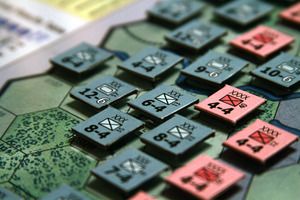
One of the features of wargames to make its way into early roleplaying games is the campaign turn. In wargaming, campaign turns are usually associated with strategic planning and operations, such as moving and staging troops or engaging in subterfuge. For example, Piquet's Theater of War provides rules for linking together one of Piquet's many tactical wargames into an extended campaign. As described by Victor at Operation: Wargaming!
Having picked the time period already, I needed to select the scale of the game. Theater of War (ToW) has three to chose from; Strategic, Grand Tactical and Tactical. The strategic covers an estimated 4000 x 4000 sq. miles and uses the seasons, Spring, Summer, Fall and Winter for the campaign turns. This was too large for what I had in mind.
Grand Tactical covers a smaller area roughly 400 x 400 sq. miles and uses months as a campaign turn. So 12 turns equals a year. This is more in line with what I was thinking.
The tactical covers an area of 50 x 50 miles and the campaign turn is a week and the campaign ends after the 4th week or more.
Allocating a block of time in-game to resolve certain kinds of action wasn't at all uncommon in roleplaying games back in the day. Searching for rumors or a patron is a week-long activity in Traveller. Original, little brown book D&D uses the week as the basic scale of time-keeping, with one day devoted to dungeon exploration and the rest to rest and refitting: "The time for dungeon adventures considers only preparations and a typical, one day descent into the pits." A campaign turn in Boot Hill is a week or a month at the referee's discretion. The knights in Pendragon typically have one adventure per year. En Garde! turns are one week long, and the game also uses the month and the season as units of time in resolving action.

The month also appears in Flashing Blades as a standard measure for resolving campaign-level action. Career commitments are measured in months, as is the time spent for gaining new skills, practicing martial skills, or pursuing minor jobs; frex, a priest's annual commitment to performing his duties is six months, with the other six months available for training, practice, pursuing another career or job, or, most importantly, adventuring. Interestingly, the time commitment for a career is flexible: "Each year, a Priest must spend six months, distributed as he likes, performing his religious duties." This gives many careers the feel of a sinecure rather than a nine-to-five job, but it's not inconsistent with how some offices were administered in l'ancien régime.

There is a significant exception to this flexibility: the military campaign. Soldiers and knights on campaign are committed for six months to action at 'the front,' which is resolved through a fun mini-game which condenses the action into three 'encounters.' These encounters begin with the risk of wounds, then may lead to a special event such as an individual battle with an enemy soldier while defending a strategic position, breaking out after being surrounded, or capturing an enemy's flag. Prisoners may be taken and ransom and booty claimed. Military campaigns are waged over six consecutive months, as determined by a die roll, and adventurers whose units are on campaign must serve. The campaign mini-game draws many FB players to military careers for their characters.

Campaign turns in wargames often condense large swathes of activity, particularly involving strategic movement and logistics. Avalon Hill's Kingmaker was a good example of this, with a player's turn involving moving his faction's nobles and their pretenders until a battle broke out or Parliament was convened, in which case the action changed to tactical level combat between forces or the negotiation and treachery of marshaling votes and declaring a king; The Rise and Fall of the Third Reich, another AH board-and-chit game, begins each turn with allocating basic resource points to simulate the logistics of production and supply, followed by strategic movement, and it's only after these are resolved that combat between fleets and armies may take place.

In a roleplaying game, campaign turns may be an opportunity for a mini-game, such as the aforementioned military campaign for Flashing Blades or the cattle drive mini-game published in Reilly Associates' Variant magazine back in the early Eighties for 2e Boot Hill, or they may be something akin to one or more sorts of montages. One could, for example, imagine a Flashing Blades' priest's six months of "religious duties" as a series of vignettes: collecting alms for the poor, praying in his cell, saying Mass, leading a saint's day procession, hearing confession, and so on.

As a referee, I often find myself asking the players something like, "Tell me what it is you want to accomplish," instead of asking for single, discrete steps - "You want to find out if Baron de Bauchery was in town, so first you'll talk to the innkeeper at the Black Swan, and after that you'll take to the innkeeper at the Roe Deer, then . . . " becomes, "So you want to make the rounds of the local inns to find out if the Baron de Bauchery was staying in town when Princess Pinkflower disappeared? Tell me how you plan to approach this." Do they offer bribes? Do they attempt to intimidate the innkeepers? Do they present themselves as allies of the baron? Smart players will use campaign turns similarly, as an opportunity to pursue long-term character development and engagement with the game-world; perhaps our FB priest will use his six months of pastoral obligation to become acquainted with a seigneur and his family, or to research conflicts between Catholics and heretics from the Wars of Religion in his parish.

Beyond a means of condensing routine, non-'adventuring' action, campaign turns also perform an important pacing function. Rising action isn't rising action with falling action for contrast, and campaign turns serve as an opportunity for the campaign to periodically catch its breath. This can help a game-world feel like a living place, where the adventurers follow seasonal rhythms or discharge their responsibilities as figures in in-game society. My first experience playing in a 3e D&D campaign found our characters climbing multiple levels in mere weeks in-game; coming directly from a 1e AD&D background, with steeper experience point requirements and rules such as required training intervals to gain levels, the effect was disconcerting. In my experience, allowing the campaign to proceed in verisimilar cycles contributes to immersion in the game-world.

Thursday, October 10, 2013

Effective Social Rank: Gloire

Social Rank in Flashing Blades is a significant part of the game's intended reward system; more than a means of 'keeping score,' Social Rank manifests in feedbacks throughout the career system as well as the character's costs of living. In my campaign, it's also an important part of social skill checks in my FB campaign via the following house rule.
. . . I allow the difference in Social Rank between two characters to modify certain Charm-based skill checks, such as Captaincy and Seduction. I did this using the Social Standing attribute score in Traveller years ago, and Thijs Krijger, moderator of the Flashing Blades Yahoo group, used this in his house rules for mistresses (which are sadly absent from his blog). In some cases, a non-player character in the service of another may use their master's Social Rank, frex, a guard on the gate of the château de Bauchery uses the baron's Social Rank of 12 rather than his own rank of 3 in determining if a Captaincy check will persuade him to stand aside.
As noted, I originally conceived of using social position as a skill modifier while running Traveller. As in F;ashing Blades, Traveller's Social Standing is a nominal reward system, but one more closely tied to the game's lifepath chargen rules; there's also a bit of symbiosis here, in that FB's careers drew some inspiration from Traveller. In my Traveller house rule, Social Standing is more about social affinity than 'pole position'; the difference in Social Standings between a player and non-player character was divided by two and rounded down; that value was then used as a negative modifier on the reaction roll table. The effect was a feeling of 'one of us,' as reactions tended to worsen the further one went from one's own social grouping, either up or down; an 'average Joe' with a base Social Standing of 7 would be equally disadvantaged in dealing with someone of Social Standing 4 or Social Standing 9, and it reflected a de facto caste system IMTU - that's 'in my Traveller universe,' for the uninitiated.

For Flashing Blades' 17th century France, however, social status is both highly stratified and extremely competitive, so the difference between Social Rank can be either a positive or negative modifier: those with higher social status are readily and reliably able to manipulate those beneath them, as shown in the rules for influence.

Social Rank in Flashing Blades increases as characters climb the career ladder, with great wealth, and as a reward at the gamemaster's discretion. Without rewards, Social Rank tends to climb somewhat slowly, as promotions occur annually in most careers. The relatively static nature of Social Rank is actually a pretty fair reflection of Early Modern France, but for a game of swashbuckling adventurers, I feel like there should be something more than banging away toward that promotion next year . . . if you roll 9+ on 2D6. Toward that end, I added another house rule, called Effective Social Rank.

A player character's effective Social Rank may increase, as noted, as a reward, at the gamemaster's discretion. These are permanent increases in most case, and therefore basically indistinguishable from other sources of Social Rank bumps. I decided that a character could also receive a temporary increase in Social Rank as well, for some act likely to give the character a favorable reputation. The mechanism for this was simple: any character holding a Gloire point receives a + 1 bump to their Social Rank until all of the character's Gloire points are used up. The increased Social Rank provides a bonus to social skill use, as noted above, as well as entry into an organisation with a minimum Social Rank requirement; however, the character must actually achieve the required Social Rank permanently within one year of entry, or risk losing the position.

This allows player characters to gain an edge by their conduct as well as increasing access to different careers for the characters to pursue if they wish.

Now, if a character can gain a bonus for a favorable reputation, couldn't that same character also earn a penalty for infamy? Of course! Characters may earn a Black Spot, which is the subject of tomorrow's post.

Thursday, August 15, 2013

How to Referee, Part Two

I ran an all-too-brief Traveller campaign about eight years ago, a bog-standard space-merchants-with-a-mortgaged-free-trader-and-a-mountain-of-debt. As part of my prep, I worked on a table of events associated with speculative trading, to use in conjunction with the Actual Value table in the rules for trading.

For those of you unfamiliar with Traveller, merchants can transport other people's goods, but at best that will keep you living on the edge of a potential repo. Speculation - buying your own cargo on one planet and selling it on another- is riskier but offers by far the best potential for profit. The Actual Value table is consulted when buying and selling, and provides a percentage modifier to the base price of the cargo; if the base price of a ton of wheat is 500 ImpCr, and the Actual Value table result is 80%, you can purchase it as 400 ImpCr per ton.

What I wanted for my campaign was an additional table, that provided modifiers to the Actual Value roll, stuff like, 'Market saturated, - 2 ,' or, 'Sudden demand, + 1,' to add flavor to the results. I worked out a d6, d6 table of results, but it still seemed bland to me, so I and showed it to a buddy of mine. He ran his Traveller campaign for something like fifteen or sixteen years at that point, and he regularly had far more players looking for seats around his table then he did chairs to accommodate them. I knew his critique would be helpful.

He looked over the table, then put it aside and grabbed a pair of six-sided dice. 'You have a cargo of cybernetic parts and you're on [planet name], an agricultural world, jump-three from the industrial world of [planet name]' he said, tossing the dice on the kitchen table. A three. 'Fifty percent,' he continued - there was no need for him to look up the Actual Value chart, as he knew it by heart - 'an Oberlindes Lines bulk carrier arrived a week ago, and the market is flooded.' He picked up the dice again, and tossed them once more - a ten. 'One hundred thirty percent. Looks like those LSP robotic harvesters that arrived six months ago are acting up, and the replacement parts haven't arrived yet, so there's a price bump.' Another roll - a twelve. 'One hundred seventy percent. Not only is demand high for parts for those harvesters, your broker just found a loophole in the tariff code.' He tossed the dice a couple more times, each time improvising an event from the memorised table of generic percentages.

'It's already in there,' he finished with a smile.

Wednesday, June 5, 2013

Social Skills and NPC Stats

On Monday, I introduced my approach to social skills in roleplaying games. Now, I'm pivoting to a related topic, that of non-player character stats, in particular ability scores and skills.

Some gamers don't like to bother with stats for npcs, for a number of reasons: too much work for too little return is a pretty common one - 'why should I spend all that time on a npc who may last only five minutes in the game?!' - though *waves hands furiously* comes up with some frequency as well - 'I just make something up in response to what the players do.'

I can definitely relate to the first: the event which lead to my personal 'old school renaissance' began with trying to prepare a supplement of generic non-player characters for d20 Modern - after looking at page after page of two-line characters stat blocs in a copy of 1001 Characters for Traveller, compared to what I was attempting to churn out for d20M, the less complex rules of earlier roleplaying games looked mighty good to me. In my experience, games which make non-player character stats simple to prep and manage in actual play are more likely to encourage often harried referees to actually use them rather than handwaving them.

I'm not fond of handwaving the rules of the game as a general rule. It's one thing to make a ruling based on a situation at hand, to apply or not apply a particular rule based on its applicability in the moment, or to improvise a target number when one isn't readily available; it's another thing altogether to consistently ignore the rules for an approximation of how an encounter with a non-player character 'should go.' As referee, I like to play the game, too, and if I'm just making stuff up that 'sounds right,' then I'm no longer actually participating in the same game as the players. The rules provide a more-or-less objective foundation to the game-world, and by holding myself to that foundation, it makes it easier for me to assume the role of neutral arbiter when the dice hit the tabletop.

Moreover, most players become invested in their characters' abilities as expressed through the rules: trading attribute points, choosing skills, selecting equipment, and so on. Note that this is not the same thing as optimising a character; all of these choices can be made for reasons, such as fulfilling a particular character concept, that have nothing to do with how effective a particular character is with respect to task or conflict resolution in the game. In my opinion, this investment carries with it the reasonable expectation of that objective game-world against which those characters may be tested.

So, my personal preference is to have appropriate stats for non-player characters, and to this end I select games which skew toward the less complex end of the spectrum when it comes to character generation and creation. Note that a game doesn't have to have identical rules for generating or creating player and non-player characters - consider the difference between, say, a 1e D&D player character and a 0-level non-player character - only that they should be comparable in some way through the rules of the game. To make them easy to use in game, I like to create a stable of generic non-player character stat blocs in advance of play - generic barkeep, generic guard, generic bravo, generic gambler, and so on - often using a stripped down subset of the rules for player character creation, with unique characters generated in more-or-less the same way as player characters.

That means that, in the campaigns I run, each non-player character has a set of attributes and skills that relate to the rules for social interactions; as a function of that objective setting, I'm not inclined to simply make up a target number on the fly if there's some other recourse open to me. Now, there are a number of ways in which the rules for social skills can be used to manage social interactions, and in my experience, at least two of them are pretty problematic. Social interaction rules may be simple or complex. Perhaps the simplest is the reaction or loyalty roll, modified by an attribute score or a skill; the Charisma modifier in 1e AD&D or the Liaison skill in Traveller each come to mind as quintessential examples of this. Years of playing with reaction rolls convinces me that, if you use no other social interaction rules in a roleplaying game, then use these, along with morale checks for opponents - it's pretty near bomb-proof as far as rules go.

Another approach is to roll-against-attribute: frex, a roll under the character's Charm attribute score indicates success. This is one of those rules which can be somewhat problematic, however; in essence, the character's attribute score becomes the objective measure of difficulty in performing a task in the game-world. A rope is as difficult to run across as the character's Acrobatics score makes it; a maid in a countess' entourage is as difficult to seduce as one's Seduction score. Static target numbers, such as the DC's for the d20 Diplomacy score, are similarly flawed, a problem exacerbated in those games by feat and class ability bloat resulting in extremely high skill values.

One way to account for this is using objective measures of difficulty to apply as modifiers to an attribute or skill roll. When I ran Traveller, I used the BITS task system for skill check modifiers; I particularly like the correlation between the descriptor and the value of the modifier, as it helps to establish a common, replicable frame of reference for both the referee and the players.

My preferred approach is to manage social interactions through opposed rolls, stat versus stat, such as Charm versus Wit to bluff a guard. For me, it is perhaps the most intuitive method of handling social interactions through dice rolls, as it pits the relative strengths of the characters against one another.

In the rules and published adventures for Flashing Blades, the examples of skill use provide for both direct rolls against an attribute or skill value as well as opposed rolls. I decided to preserve this approach in my own campaign, but I also wanted to avoid the pitfalls of the simple roll-versus-attribute. Toward this end, I developed an additional non-player character stat - Tractability - which serves a similar function to the BITS task system for Traveller. How Tractability works is the subject of my next post.

Friday, September 28, 2012

LoS

Wargame rules often spend a fair number of paragraphs on who can see whom. Line of sight - usually abbreviated LoS - can be a part of everything from firing weapons to charging to a commander changing a unit's orders, so wargames treat it with some care. Fans of the original Squad Leader will remember the dot in the center of each hex used for determining whether a particular hex could be seen from another hex, or the determination of "hull down" for AFVs on ridgelines.

After wargames birthed roleplaying games, the need to determine when something was in view to the characters remained. OD&D, for instance, says that monsters are detected at a distance of 20-80 feet underground or 40-240 yards outdoors unless the party is surprised. It's interesting there's no consideration for individual character proficiency, and when such a differentiation appears, it's associated with classes and skills, not ability scores. Frex, the 1e AD&D Ranger, as a class ability, is more likely to surprise an opponent and less likely to be surprised in turn, while in Traveller, the Tactics and Leader skills and military experience favorably modify surprise for the adventurers.

Boot Hill retains a facing system more like that of the tabletop miniature skirmish game from which it was derived, with characters able to observe a 90-degree arc ahead of them and the ability to observe someone in concealment wholly at referee discretion. I soon added a house rule that a character could spend one movement point to 'look around,' which allowed the character to extend the observation axis by another 90-degrees to the left or right; in this way, a character could run but would be slowed by taking his attention off the direction in which he was moving, which seemed a fair trade-off. Again, the character's attributes played no particular role in determining what could be seen, and in BH, even the dice were removed as a factor, as opposed to D&D or Traveller.

It wasn't too many years before roleplaying games introduced rules for alertness, perception or observation, often associated with a character attribute and/or skill, and this soon became the norm; with some games, such as d20-based systems, a combination of attribute scores, skill points, and feats could produce 'Spot-monkeys' with superhuman powers of observation.

Though I think that later roleplaying games tend to make too big a deal out of things like Spot, Alertness, and so forth, treating all characters as equally perceptive is perhaps a bit too coarse-grained as well, appropriate to small units but not distinct individuals. Accordingly, for my Flashing Blades campaign, I use a blending of the two methods. The core rules make no mention of surprise or observation, but examples in the published adventures point to both the Wit and Luck attributes; in fact, it was this usage of Luck that led me to spell out that in my campaign, Luck is, "rather than a metaphysical force or quality, the insightfulness of the character: it's the ability to notice subtle clues or behaviors, to be in tune with one's surroundings" - a gambler, for which Luck is the associated attribute, isn't so much smiled upon by Fortune as he is able to pick up tells from his fellow gamblers, for example. As such, Luck is often used to represent the power of observation or perception in actual play.

As a modifier to an individual's Luck attribute, I also use the combined surprise and initiative rules for original, 'classic' Traveller - the skills Captaincy and Strategy replace Traveller's Leader and Tactics respectively, and service on a campaign gives the benefit of military experience. If the adventurers are surprised as a group, then individual Luck checks are made at a penalty of Luck/2 or Luck/3 at my discretion. For me this achieves the best of both worlds.