Showing posts with label Disneyland. Show all posts

Thursday, February 28, 2013

Choose Your Own Adventure

A couple of weeks ago I took the Cabin Girl and the Cabin Boy to California Adventure at the Disneyland Resort after school. One of the great things about having annual passes is that it makes short trips of a few hours viable - there's no sense of urgency, of 'We gotta get Space Mountain and Indiana Jones in TODAY!' to the exclusion of everything else the parks have to offer. We can spend an afternoon poking around, say, Tomorrowland, and not worry about missing the rest of Disneyland, since we'll likely be back in a week or two.

Perhaps the best thing about buying the passes is that we can spend lots of time on the playgrounds.

One of the earliest attractions in Disneyland, opened in 1956, Tom Sawyer Island is reached by a short raft trip across the 'Rivers of America.' Originally themed around the adventures of Tom Sawyer, Becky Thatcher, and Huck Finn, it was re-imagineered after the success of the Pirates of the Caribbean movies as Pirates' Lair on Tom Sawyer Island. In either incarnation, the island is a giant playground, one built with the imagination - and budget - of the Walt Disney Corporation. A central ridge is honeycombed with narrow, twisting caves, just wide enough for two kids to pass and just narrow enough for crouching parents to need to find an alcove to let one another scoot by. One cave, Dead Man's Grotto, features the beating heart of Davy Jones in its iron chest, an Audio-Animatronic pirate shackled to a wall with a tale of woe to tell, and a surprise visit by Pintel and Ragetti should a guest try to disturb the pirates' treasure. Other caves feature chests of treasure or locked doors with narrow grates to peek through, and at one end of the ridge the partial remains of a wrecked galleon is haunted by ghostly chains. Atop the ridge, reached through the caves in the interior, is a lookout with telescopes.

Around the island there is a suspension bridge leading to Tom and Becky's treehouse, which the kids can climb and explore, and a pontoon bridge made of barrels for crossing a small cove. Turning a capstan winch pulls a chest of treasure, with a pirate skeleton dangling beneath, from the water, and working a pair of pumps empties out a sunken boat and reveals more treasure, and another pair of skeletons, within. At the far end of the island is Fort Wilderness - the fort was once an actual attraction in which guests could climb the stairs and look out on the island from its log towers, but now it's just a façade - and a huge pile of pirate treasure to climb on.

California Adventure, the theme park built atop the old parking lot of Disneyland, features a playground of its own, Redwood Creek Challenge Trail, in the Grizzly Peak 'land.' RCCT, located directly across from the Grizzly River Run flume ride, takes its inspiration not from fiction but from the real Sierra Nevada. Its winding pathways are filled with animal tracks, and lead guests through the stump of a giant sequoia and forested groves. Fallen trunks of the big trees take the place of caves in RCCT, and the suspension and pontoon bridges are replaced by thick rope cargo nets stretched between a smokejumpers' training tower and a combination ranger station and forest fire lookout, complete with a working Osborne Fire Finder.

There's a rock wall with a pair of traverses - climbing the rocks of Tom Sawyer Island is actually prohibited, as I was informed by a polite white-hatted Disneyland security guard years ago - and a twisting slide set in a jumble of boulders - a 'rock slide,' of course. Two more slides are set inside giant logs. There's a tiny stream which can be crossed by hopping on rocks made of playground rubber-mulch or a short bridge which is subject to sudden inundation. Carved statues of figures from California aborigine stories line a segment of trail, and a small cave allows a guest to learn which animal spirit they most resemble. The one attraction sure to have a line on every visit is the combination tire swing and zip line in the smokejumpers' tower.

On this particular visit, the Cabin Girl and the Cabin Boy spent more than an hour roaming Redwood Creek, figuring out which tracks were left by which animal, climbing up and down the rope ramps and bridges, riding the zip lines, scaling the rock walls, racing each other down the log slides, sighting along the fire finder. With an occasional prompt from me, they would try to figure out from its tracks if an animal was running or walking, and in which direction it was travelling, or identify which animal spirits at the cave were also found among the carvings along the trail, and what legends were associated with each.

Tom Sawyer Island and Redwood Creek Challenge Trail are two of my favorite attractions at the Disneyland Resort - in fact, if I had to make a list, they would certainly be in the top four, and depending on my mood when I made the list, they might even be in the top two spots. The Disney theme parks are perhaps best known for their rides, for the way they create an amazing sensory environment and tell a story, whether it's the recounting of a famous tale or something wholly original. But what I love about the island and the trail is that while the same attention to detail is provided in creating the environment, the story - the adventure - is left to the guests to create.

I'll bet you already know where I'm going with this.

Gamers use the term sandbox to describe 'open worlds' in which characters are free to explore. One of the problems with 'sandbox' as a term of art, in my experience, is that it can leave the impression of a featureless plain - lone and level sands stretching far away. This impression is sometimes invoked by gamers who dislike such game-worlds and the associated playstyle, for one reason or another.

But most 'sandbox' game-worlds are more like playgrounds than true sandboxes, and in my experience, the best examples of these game-worlds rise to the level of playgrounds-by-Disney. These playgrounds are not random collections of furnishings. Rather, they are filled with places and people and institutions of interest, which are meant to attract the players and their characters to interact with them without determining when or how those interactions may unfold. They have themes or motifs which add depth - there are patterns to recognize and apply.

On various forums over the years, one of the recurring critiques of sandbox game-worlds offered is that some players, when confronted with too much freedom of choice, have a deer-in-the-headlights moment; in fact, I've come across it enough times that about a month ago, I started a thread at Big Purple asking gamers to help me understand what induces 'sandbox paralysis.' The answers from those posters who actually experience this were enlightening - those who took the thread as a chance to bash sanbox play, far less so.

For awhile now I held the ideas that putting genre-tropes front and center and offering a familiar setting may help with making sandbox - playground - play more readily accessible to gamers who might otherwise be turned off by the prospect. Tom Sawyer Island and Redwood Creek do both in their 'call to adventure.' Reading the responses to the 'sandbox paralysis' thread, I think that addresses some gamers' issues with the playstyle, but by no means all; some players are truly only happy if they feel they can reliably expect certain experiences from playing the game, experiences which require the referee's active participation in developing, experiences which a sandbox game-world is, in their estimation, unlikely to provide.

And that's okay, of course. Playgrounds aren't for everyone. I feel the same way about more linear, more story-oriented gaming; while I understand its appeal, it's not for me. Horses for courses.

But I do think it would helpful for gamers discussing sandbox game-worlds and playstyle to remember that they are much more than boxes of sand for digging holes and making castles. They are playgrounds as well, and in the really clever ones, the jungle gyms and slides and ladders are disguised as a pirate's lair or a Sierra Nevada forest.

Tuesday, April 10, 2012

I is for Imagineering

In Disney's California Adventure amusement park, there is an attraction called Walt Disney Imagineering Blue Sky Cellar. The attraction provides ". . . a rare preview of upcoming magic through the eyes of Walt Disney Imagineers at Disney California Adventure Park," through illustrations, models, maquettes, and video interviews with the people who create the rides and other attractions of the Disneyland Resort.

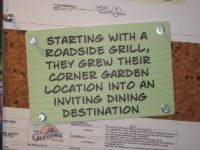
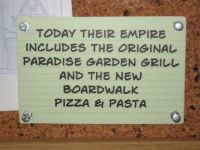
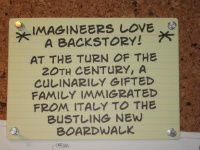
One example of the Imagineering process describes planning a restaurant in California Adventure.

This is where the designers begin. With the backstory. For a restaurant.

Living in southern California means easy access to lots of amusement parks. We purchased annual passes for Disneyland for the last three years, and this year we also bought passes for Universal Studios Hollywood. Both California Adventure and Universal Studios offer river-raft attractions: Grizzly River Run at Disney and Jurassic Park - The Ride at Universal.

GRR (grr . . . like a bear, get it?) simulates a river-rafting trip in northern California; Jurassic Park simulates an attraction in, well, Jurassic Park. Both rides attempt to create a believable environment for visitors, and both attractions offer an thrill ride where the riders are assumed to get soaked to some degree - in fact, both rides go out of their way to make sure you get wet.

After riding both rides numerous times, I've noticed a distinct difference between the two attractions with respect to that last feature. On Jurassic Park, the ride begins with a trip through a dripping rainforest canopy, then passes along an Isla Nubar river; along the way, water squirts from behind bushes or from the mouths of the fringed dinosaurs to get the riders wet. After the final plunge, water mortars shoot a spray of water into the air as the raft reaches the bottom of the drop, pretty much guaranteeing a soaking.

On GRR, however, the riders are sprayed by leaking pipes in an old mill, by a waterfall inside a cave, and by a leaking log flume. There are no water cannons at the bottom of the plunge on GRR; instead you find yourself carried into the path of a geyser which jets water over the raft.

Now here's the thing: in addition to creating an environment and telling a story, both rides do their best to soak their riders, but GRR takes that a step further by making the soaking a natural extension of the ride environment and the story instead of simply adding squirting jets and water cannons to the experience.

Both rides deliver the watery thrills you expect them to, but the Disney attraction seamlessly integrates those thrills with the imaginary environment.

I think about gaming quite often when I'm at Disneyland; I never fail to be blown away by the attraction designers' ability to pull me into the environment.

And where do they begin? With the backstory. Even for something as mundane as a burger joint and a pizza parlor.

I agree with the notion that, all else being equal, a '"pretty" dungeon' - an adventure site which possesses a backstory and an a mix of design aesthetics - is better than one without.

I know some gamers couldn't care less; they're in it for the action, and aesthetics and (most especially) backstory may not enter into that for them. This is where the "all else being equal" enters into the equation; like GRR and Jurassic Park riders want to get wet, roleplaying game players want an environment which lends itself to action. "Pretty" dungeons can't just be pretty - they need to offer that action as well.

I put together a description of a tavern for my Flashing Blades game. The backstory is that the "Sail-Needle" was once a sail loft before being converted into a tavern. The structure has high ceilings, reflecting its earlier use in manufacturing sails for the galleys and roundships of Marseille.

So what, right?

Because those ceilings are so high, the tavern has two large chandeliers to provide light for the guests. This provides the opportunity for a classic staple of cape-and-sword adventure, the chandelier swing, not only from a single chandelier, but rather a pair of them. In this example, the backstory plays directly into creating an environment conducive to action appropriate to the swahbuckling genre.

For some gamers, perhaps many gamers, things like aesthetics and backstory, the stuff that makes an adventure location "pretty," may make little difference, but, in my experience, for the gamers who appreciate them, putting in the effort to make the environment meaningful really enhances the experience of playing the game.