MIB 1625: "Swashbuckling investigators of the paranormal battle aliens, conspiracies, and the Cardinal's Guards in Paris, circa 1625."
This manages to make 7th Sea's metaplot look reasonable.
I followed the link to "Rondak's Portal," hoping to find an actual play log or something, but no joy. Too bad.

Friday, May 3, 2013

Thursday, May 2, 2013
"Building a Stronghold"
Preface: I posted this on theRPGsite about three years ago, and stumbled across it while searching for something else. You may see some hints about where I developed my formulation of the the swashbuckling 'endgame.'"Building a stronghold" is more than the construction of a castle and hiring of mercenaries. It's about becoming a political creature. I think this is what many fantasy games miss, and it's one of the reasons I prefer historical games to fantasy ones.
For this to work, the players must accept that the goals and objectives change as the game transitions from one style of play to another over time. To use a hex-and-counter analogy, it starts off as GDW's The Battle of Agincourt and becomes Avalon Hill's Kingmaker.
From what little I've read of the early days of fantasy rpgs - mostly The First Fantasy Campaign - the players readily understood and embraced this mindset. From my own experience, however, it disappeared pretty quickly among gamers: in our AD&D games in the early Eighties - call it '81 to '83 or thereabouts - building a stronghold was about clearing land and building a castle and hiring mercenaries and attracting followers [and] was followed by fighting off monsters and humanoids who wanted to make that stronghold their next lair and those followers their next meal. The political game remained nebulous to non-existant, in no small part because our strongholds tended to be built beyond the frontier, consciously or subconsciously reflecting the desire to avoid being beholden to a prince and the attendant political maneuvering. Our experience was more like a cavalry outpost in Indian country than the War of the Roses.

Accomplishing this means enmeshing the adventurers in the political world of the setting, which of course means there needs to be a political component to the setting first. I didn't really grasp this until I was in college, so it started appearing in my games in the mid-Eighties; the relationship between a planetary government and the Imperium in my Traveller games began taking on some nuance and balkanized worlds became my favorite planets for adventure, frex.
Kingmaker provided a lot of inspiration for introducing politics into my roleplaying gaming. Power is gained through control of offices of the state and church, not just nobles and men-at-arms in the field; if one's faction does not possess the sole prince, then one needs to crown a pretender and gain seats in the houses of Lords and Commons or one may be quickly isolated and overwhelmed when Parliament is summoned.
The key idea here is that one's ability to exert influence in the setting must extend further than the point on one's sword or lance, so gaining political power means gaining entry to and mastery of the institutions of state. In a fantasy roleplaying game, this means giving the adventurers the opportunity to join something, to climb a hierarchy other than the experience points table, to gain titles other than those of one's class. It could be an order of knighthood, a college of wizards, a religious confraternity, the Thieves' Guild, or whatever; as the adventurers gain personal power, they should have the opportunity to gain influence as well. A career spent as the behind-the-scenes mercenary strike force of the Emperor doesn't get you there.
By the time they reach "name level," or whatever level represents the lower reaches of the game-world's main figures of power, they should be enmeshed in the affairs of state, able to enter the halls of power and reasonably expect to pull some of the levers therein.
The situations they confront there should not be readily resolved with swords or spells - at least not always. One should need allies, and one should be someone who is sought for an alliance. This means the referee needs to create, and run, a convincing court with conflicting factions as well as allies and enemies abroad - and if those allies can sometimes be enemies and vice cersa, so much the better. The adventurers graduate from simple power wielders to power brokers, using those levers of power to exhance or diminish the levers pulled by others. A fighter who is also the grandmaster of an order or knights and the governor of a royal fortress controlling a key pass in the mountains or a cleric who is the ecclesiarch of an important temple and the tutor to the prince's heir possess the leverage to affect events out of scale with their stats and abilities.
Once you reach this point, in my opinion, the "historical scope" of the campaign becomes tangible and meaningful to both the players and the adventurers. Can your character become a Warwick, or a Richelieu?
This doesn't preclude the characters from reaching higher by any means. The adventurers in this game can also aspire to be a Timur or an Othman, but they may find that gaining an empire is not the same as holding it. A prince often discovers that there are levers of power out of reach of the throne, so one better gain, and keep, allies. The idea of legacy may become a powerful motivation here: Othman established a great dynasty, while Timur's empire pretty much died with him.
For this type of play, one where the characters control considerable resources by dint of office or commission, counting gold pieces needs to be abstracted.
To borrow an analogy from another board game, you need something like the BRPs - basic resource points, iirc - of Third Reich, a simple means of representing the resources of a city, a realm, or what-have-you, and a mean of converting them into armies or fortresses or school or temples or estates. The ability to give power as well as the mean of gaining it should be important at this level, such as placing a henchman in a key provincial government or an admiralty; rewards should be more than, "Oh, and here's this +1 sword I don't use anymore."
Wednesday, May 1, 2013
Tuesday, April 30, 2013
Linear Adventures
In the winter of 1625, Riordan O'Neill, a King's Musketeer, and Guillaume Sébastien, a physician, were, at the behest of the duke of Savoy, dispatched to Milan to seek the ransom of the Sabaudian vicomte de Praz-de-Lys, a captive of Don Alvaro de Salamanca, the Spanish governor of the Forte de Fuentes. Along the way, a French diplomat informed them of an important fact - should Don Alvaro, who to this point steadfastly refused to ransom his captive, die, the vicomte's parole would pass to the governor of Milan.
Mission-oriented advetures are a staple of roleplaying games; because they made for convenient tournament contests, many of the earliest roleplaying game adventure modules were of this sort, and as a result of their initial prevalence, the model became deeply ingrained in the expectations of many gamers. Rescue-the-hostage and retrieve-the-mcguffin were - and are - a staple of gaming action, so much so that when a poster at Big Purple referred to this as "trad," I had to agree, my own sandboxy proclivities notwithstanding.
 Adventures of this sort have a somewhat ambiguous reputation among gamers; over time, the influence of would-be writers - [khan] NILES! [/khan] - on adventure design produced modules which increasingly prescribed the scope of player choices for risk of the adventure failing to deliver the anticipated conclusion. Plot-heavy adventures in which the player characters were ushered from scene-to-scene resulted in a backlash against modules, and the referees who ran them, as 'railroads.' Over time, the pendulum swung so hard the other way that a number of gamers took to describe any adventure with 'a plot' as a railroad.
I believe it was 3e D&D that referred to the 'trad' adventure model as 'linear adventures.' Linear adventures are the now-classic scene-scene-scene-climax, or event-event-event-destination, or encounter-encounter-encounter-boss fight, format found in most game books and modules. Despite the linear set-up, they may be experienced in a non-linear fashion, as when the adventurers succeed in bypassing one of the scenes through smart play or dumb luck, such as avoiding a bandit ambush.
Railroading, on the other hand, doesn't allow the adventurers to bypass the encounters the referee or adventure sets in front of them; attempting to do so results in the players being forced into facing the encounter, as when players' characters attempt to take the west road instead of the east road with the bandit ambush the referee has planned, and a massive lightning storm springs up that keeps the adventurers from going west.
Illusionism is railroading's kissin' cousin. In this instance, the players are free to go whatever direction they like, but no matter what they do, the referee springs his encounter on them anyway, as when the bandits attack the adventurers regardless of whether or not they take the east or west (or north or south) roads.
Unfortunately, some suggest that 'railroad' is somehow the opposite of 'sandbox,' ignoring or failing to understand that a referee can just as readily railroad the players and their characters in a sandbox as in more traditional adventures. Railroading and illusionism, are, to me, profoundly dysfunctional ways to play roleplaying games, and conflating all plot-driven adventures as railroads is a serious error.
Moreover, I don't think scene-scene-scene-climax is actually a good approach to defining linear adventure so much as it's the most common way it's presented in roleplaying games. A linear adventure is more about operational progress from a discrete starting point to achieve an explicit goal or end which is frequently external to the player characters, that is, the goal is imposed upon them by someone else. It is often structured as scene-scene-scene-climax in order to ape a story's rising and falling action, conflicts and crises, and conclusion; the problem is that much of the advice to referees for running linear adventures expects or encourages railroading or illusionism in order to maintain that structure. This is poor adventure design, of course, but it doesn't inherently need to be that way.
Rather than structuring a linear adventure as scene-scene-scene-climax, I may prepare a slew of options for how the npcs react depending on what the adventurers do, like in "The Lady of La Rochelle" for Flashing Blades, or set the actions of the npcs against a timeline in which the antagonists are acting and the adventurers are free to respond, like in Operation: Ace of Clubs for Top Secret, or as a series of events to which the adventurers may or may not respond, like in Burned Bush Wells for Boot Hill. Burned Bush Wells is an adventure which takes place in the eponymous town during a hard winter. There is a conflict between two factions, a powerful businessman and his crony marshal and the other business owners of the town. Sequential events in the adventure detail the steps taken by each faction to overcome the other, concluding with one faction or the other winning, depending on the involvement and actions - if any - of the adventurers.
BBW can be viewed as scene-scene-scene-conclusion, but it can also be viewed as a timeline which exists independently of the adventurers; the adventure makes only very general assumptions about how the adventurers will respond, if indeed they respond at all, to the sequence of events. It's entirely possible for the adventurers to bypass all of the events, side with either faction, or progress from starting event to ending event in order.
The events of the adventure unfold linearly - a thief, helping the doc, a shotgun wedding, and so on - moving toward a conclusion. The events are even dropped at the player characters' feet. But what BBW doesn't do is presume the adventurers's responses to the events, and it loads up the referee with enough information to wing it if the adventurers try something completely different, and it even gives advice to the referee on how the events change based on adventurer action and inaction during previous events.
When you get away from trying to structure the actions of the player characters as part of a story, then linear adventures can be constructed in such a way that they still lead from A to E but provide for meaningful player choices instead of ham-fisted transitions between scenes or encounters.
Linear adventures make sense in a sandbox when the player characters submit themselves to some authority - they join the army, they are inducted into an order, they buy an office, they are granted a title, &c. Requiring adventurers to fulfill their responsibilities gives meaning to accepting titles, offices, ranks, and so forth, and linear adventures arising out of those responsiblities may be one logical way for those duties to present themselves to, and impose themselves upon, the player characters. Unfortunately, linear adventures - specifically badly conceived and presented linear adventures - have poisoned the well to some degree, leading some gamers to dismiss them out of hand and even to claim that any attempt to control the actions of the adventurers - especially in a sandbox game-world - is railroading. This does not need to be so, but referees should also take care not make the fear become a reality when introducing linear adventures into their sandboxes.
Mission-oriented advetures are a staple of roleplaying games; because they made for convenient tournament contests, many of the earliest roleplaying game adventure modules were of this sort, and as a result of their initial prevalence, the model became deeply ingrained in the expectations of many gamers. Rescue-the-hostage and retrieve-the-mcguffin were - and are - a staple of gaming action, so much so that when a poster at Big Purple referred to this as "trad," I had to agree, my own sandboxy proclivities notwithstanding.
I believe it was 3e D&D that referred to the 'trad' adventure model as 'linear adventures.' Linear adventures are the now-classic scene-scene-scene-climax, or event-event-event-destination, or encounter-encounter-encounter-boss fight, format found in most game books and modules. Despite the linear set-up, they may be experienced in a non-linear fashion, as when the adventurers succeed in bypassing one of the scenes through smart play or dumb luck, such as avoiding a bandit ambush.
Railroading, on the other hand, doesn't allow the adventurers to bypass the encounters the referee or adventure sets in front of them; attempting to do so results in the players being forced into facing the encounter, as when players' characters attempt to take the west road instead of the east road with the bandit ambush the referee has planned, and a massive lightning storm springs up that keeps the adventurers from going west.
Illusionism is railroading's kissin' cousin. In this instance, the players are free to go whatever direction they like, but no matter what they do, the referee springs his encounter on them anyway, as when the bandits attack the adventurers regardless of whether or not they take the east or west (or north or south) roads.
Unfortunately, some suggest that 'railroad' is somehow the opposite of 'sandbox,' ignoring or failing to understand that a referee can just as readily railroad the players and their characters in a sandbox as in more traditional adventures. Railroading and illusionism, are, to me, profoundly dysfunctional ways to play roleplaying games, and conflating all plot-driven adventures as railroads is a serious error.
Moreover, I don't think scene-scene-scene-climax is actually a good approach to defining linear adventure so much as it's the most common way it's presented in roleplaying games. A linear adventure is more about operational progress from a discrete starting point to achieve an explicit goal or end which is frequently external to the player characters, that is, the goal is imposed upon them by someone else. It is often structured as scene-scene-scene-climax in order to ape a story's rising and falling action, conflicts and crises, and conclusion; the problem is that much of the advice to referees for running linear adventures expects or encourages railroading or illusionism in order to maintain that structure. This is poor adventure design, of course, but it doesn't inherently need to be that way.
Rather than structuring a linear adventure as scene-scene-scene-climax, I may prepare a slew of options for how the npcs react depending on what the adventurers do, like in "The Lady of La Rochelle" for Flashing Blades, or set the actions of the npcs against a timeline in which the antagonists are acting and the adventurers are free to respond, like in Operation: Ace of Clubs for Top Secret, or as a series of events to which the adventurers may or may not respond, like in Burned Bush Wells for Boot Hill. Burned Bush Wells is an adventure which takes place in the eponymous town during a hard winter. There is a conflict between two factions, a powerful businessman and his crony marshal and the other business owners of the town. Sequential events in the adventure detail the steps taken by each faction to overcome the other, concluding with one faction or the other winning, depending on the involvement and actions - if any - of the adventurers.
BBW can be viewed as scene-scene-scene-conclusion, but it can also be viewed as a timeline which exists independently of the adventurers; the adventure makes only very general assumptions about how the adventurers will respond, if indeed they respond at all, to the sequence of events. It's entirely possible for the adventurers to bypass all of the events, side with either faction, or progress from starting event to ending event in order.
The events of the adventure unfold linearly - a thief, helping the doc, a shotgun wedding, and so on - moving toward a conclusion. The events are even dropped at the player characters' feet. But what BBW doesn't do is presume the adventurers's responses to the events, and it loads up the referee with enough information to wing it if the adventurers try something completely different, and it even gives advice to the referee on how the events change based on adventurer action and inaction during previous events.
When you get away from trying to structure the actions of the player characters as part of a story, then linear adventures can be constructed in such a way that they still lead from A to E but provide for meaningful player choices instead of ham-fisted transitions between scenes or encounters.
Linear adventures make sense in a sandbox when the player characters submit themselves to some authority - they join the army, they are inducted into an order, they buy an office, they are granted a title, &c. Requiring adventurers to fulfill their responsibilities gives meaning to accepting titles, offices, ranks, and so forth, and linear adventures arising out of those responsiblities may be one logical way for those duties to present themselves to, and impose themselves upon, the player characters. Unfortunately, linear adventures - specifically badly conceived and presented linear adventures - have poisoned the well to some degree, leading some gamers to dismiss them out of hand and even to claim that any attempt to control the actions of the adventurers - especially in a sandbox game-world - is railroading. This does not need to be so, but referees should also take care not make the fear become a reality when introducing linear adventures into their sandboxes.
Monday, April 29, 2013
DVR Alert
On Thursday, 2 May, TCM airs Moonfleet, starring a dastardly Stewart Granger and George Sanders. In addition to featuring a swashbuckling dungeon crawl, the movie also answers the question, how does a guy with a poleaxe fight a guy with a sword?
Local listings and all that.
Local listings and all that.
Sunday, April 28, 2013
The Pen and the Sword: The Three Musketeers
The hour having come, they went with their four lackeys to a spot behind the Luxembourg given up to the feeding of goats. Athos threw a piece of money to the goatkeeper to withdraw. The lackeys were ordered to act as sentinels.
A silent party soon drew near to the same enclosure, entered, and joined the Musketeers. Then, according to foreign custom, the presentations took place.
The Englishmen were all men of rank; consequently the odd names of their adversaries were for them not only a matter of surprise, but of annoyance.
"But after all," said Lord de Winter, when the three friends had been named, "we do not know who you are. We cannot fight with such names; they are names of shepherds."
 "Therefore your lordship may suppose they are only assumed names," said Athos.
"Which only gives us a greater desire to know the real ones," replied the Englishman.
"You played very willingly with us without knowing our names," said Athos, "by the same token that you won our horses."
"That is true, but we then only risked our pistoles; this time we risk our blood. One plays with anybody; but one fights only with equals."
"And that is but just," said Athos, and he took aside the one of the four Englishmen with whom he was to fight, and communicated his name in a low voice.
Porthos and Aramis did the same.
"Does that satisfy you?" said Athos to his adversary. "Do you find me of sufficient rank to do me the honor of crossing swords with me?"
"Yes, monsieur," said the Englishman, bowing.
"Well! now shall I tell you something?" added Athos, coolly.
"What?" replied the Englishman.
"Why, that is that you would have acted much more wisely if you had not required me to make myself known."
"Why so?"
"Because I am believed to be dead, and have reasons for wishing nobody to know I am living; so that I shall be obliged to kill you to prevent my secret from roaming over the fields."
The Englishman looked at Athos, believing that he jested, but Athos did not jest the least in the world.
A silent party soon drew near to the same enclosure, entered, and joined the Musketeers. Then, according to foreign custom, the presentations took place.
The Englishmen were all men of rank; consequently the odd names of their adversaries were for them not only a matter of surprise, but of annoyance.
"But after all," said Lord de Winter, when the three friends had been named, "we do not know who you are. We cannot fight with such names; they are names of shepherds."
"Which only gives us a greater desire to know the real ones," replied the Englishman.
"You played very willingly with us without knowing our names," said Athos, "by the same token that you won our horses."
"That is true, but we then only risked our pistoles; this time we risk our blood. One plays with anybody; but one fights only with equals."
"And that is but just," said Athos, and he took aside the one of the four Englishmen with whom he was to fight, and communicated his name in a low voice.
Porthos and Aramis did the same.
"Does that satisfy you?" said Athos to his adversary. "Do you find me of sufficient rank to do me the honor of crossing swords with me?"
"Yes, monsieur," said the Englishman, bowing.
"Well! now shall I tell you something?" added Athos, coolly.
"What?" replied the Englishman.
"Why, that is that you would have acted much more wisely if you had not required me to make myself known."
"Why so?"
"Because I am believed to be dead, and have reasons for wishing nobody to know I am living; so that I shall be obliged to kill you to prevent my secret from roaming over the fields."
The Englishman looked at Athos, believing that he jested, but Athos did not jest the least in the world.
Saturday, April 27, 2013
Perfect Getaway: Chapter One
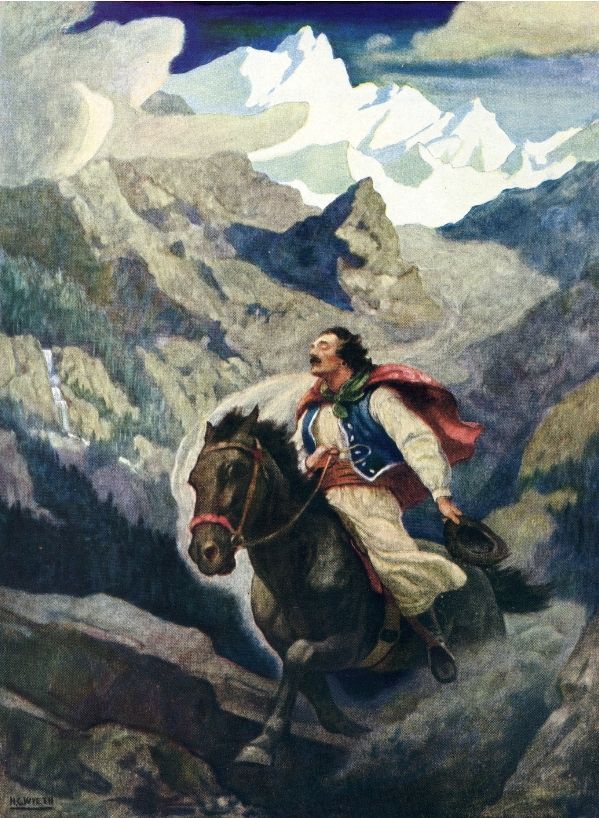
C'mon, tell me that doesn't make you want to run a swashbuckling campaign.
Subscribe to:
Posts (Atom)