Go see this.
Seriously.

Sunday, March 4, 2012

Swashbuckling the Paizo Way
At What a Horrible Night to Have a Curse . . . , Lord Gwydion posts about adding swashbuckling action - ". . .like swinging from chandeliers, flipping their cloak over the opponent's head, throwing sand in their eyes, or . . . grapple/disarm/trip type stuff" - to classic D&D games using Combat Maneuvers from Pathfinder.
He was even kind and patient enough to explain it to a Pathfinder-illiterate like myself.
He was even kind and patient enough to explain it to a Pathfinder-illiterate like myself.
Saturday, March 3, 2012
Carte de Cassini
In a post at Built by Gods Long Forgotten describing a clever approach to designing a megadungeon, Lum includes a link to an interactive version of Giambattista Nolli's 1748 map of Rome.
I've loved maps and charts since I was a kid, pretending for hours that I was navigating my way across the Pacific Ocean or traversing central Asia along the Silk Road. I was a geography major at university and took every cartography course my department offered, and I made resource management maps in my days as a park ranger and resource ecologist, so stuff like this is a gentle caress of my nucleus accumbens.
I make extensive use of historic city maps for my Flashing Blades campaign, but my favorite campaign map by far is an interactive version of the Carte de Cassini.
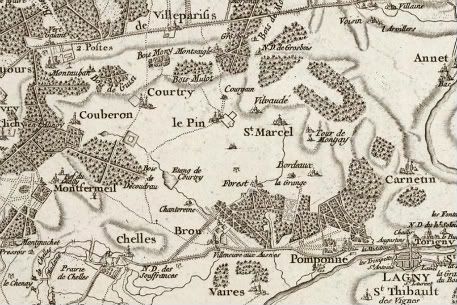
The eponymous map was begun by the Italian astronomer Giovanni Domenico Cassini. Cassini was invited to France by King Louis IV in 1669, where the astronomer became the first director of the Paris Observatory. Developing an interest in the planets, it was here that Cassini would discover the gap in the rings of Saturn which bears his name.
Shortly after his arrival, Cassini - who as a naturalized Frenchman adopted the name Jean-Domenique - began the first topographic survey of an entire country in the 1670s, carefully triangulating distances to produce an accurate map of the Sun King's realm. The project would succeed them both - Cassini's son and grandson would be required to see the surveying and mapping to completion in 1789, when the Carte de Cassini was published.
The map is an amazing record of its time, detailing the names and locations of villages, fortified cities, castles, commanderies of the Knights of Saint John, mills, roads, forests, rivers, marshes and on and on. Pairing it with the contemporary Google map of France allows me to examine land cover in greater detail - the number of features of the current French landscape that can be found in their near identical proportions on the Cassini map is astounding - as well as measure accurate distances between points.
In my experience, there is no fictional roleplaying game map which can hold a candle to it. It is an incredible resource for running a campaign set in 17th or 18th century France, and, if cartophilia's your thing, it's just a kick in the ass to play with.
I've loved maps and charts since I was a kid, pretending for hours that I was navigating my way across the Pacific Ocean or traversing central Asia along the Silk Road. I was a geography major at university and took every cartography course my department offered, and I made resource management maps in my days as a park ranger and resource ecologist, so stuff like this is a gentle caress of my nucleus accumbens.
I make extensive use of historic city maps for my Flashing Blades campaign, but my favorite campaign map by far is an interactive version of the Carte de Cassini.
The eponymous map was begun by the Italian astronomer Giovanni Domenico Cassini. Cassini was invited to France by King Louis IV in 1669, where the astronomer became the first director of the Paris Observatory. Developing an interest in the planets, it was here that Cassini would discover the gap in the rings of Saturn which bears his name.
Shortly after his arrival, Cassini - who as a naturalized Frenchman adopted the name Jean-Domenique - began the first topographic survey of an entire country in the 1670s, carefully triangulating distances to produce an accurate map of the Sun King's realm. The project would succeed them both - Cassini's son and grandson would be required to see the surveying and mapping to completion in 1789, when the Carte de Cassini was published.
The map is an amazing record of its time, detailing the names and locations of villages, fortified cities, castles, commanderies of the Knights of Saint John, mills, roads, forests, rivers, marshes and on and on. Pairing it with the contemporary Google map of France allows me to examine land cover in greater detail - the number of features of the current French landscape that can be found in their near identical proportions on the Cassini map is astounding - as well as measure accurate distances between points.
In my experience, there is no fictional roleplaying game map which can hold a candle to it. It is an incredible resource for running a campaign set in 17th or 18th century France, and, if cartophilia's your thing, it's just a kick in the ass to play with.
Friday, March 2, 2012
Using Mythic Game Master Emulator as a refereeing tool: two actual play examples
A brief note: Being that I have a whole month-and-a-half of blog posts under my belt, to celebrate Old Stuff Day I decided to dig something up I originally posted on Big Purple last year.
I like stochasticity in roleplaying games.
When I'm refereeing a game, I like being surprised and reacting to what's happening in the game at least as much as the players do. Toward this end, I lean on random rolls for many of the events and features of the games I run - random encounters, random reactions, random maps, random treasure, random npcs, random harlots.
Perhaps the most intriguing quarrel in my quiver these days is the Mythic Game Master Emulator. The GME is a collection of subsystems from the Mythic roleplaying game - a game that I think deserves a lot more attention than it gets - designed to facilitate no-preparation play, with or without a referee, with a group of players or solo.
 The heart of the system is the Fate Chart, a cross-indexed table that is used in Mythic to resolve skill tests; it's also designed to provide weighted answers to yes-or-no questions, and it's this feature which is used to run the game, with either the player(s) or the referee interpreting the outcome. The GME also provides a random event system to add twists to the game, and I'm using this as well.
Here are two examples of how I'm using the GME in running our Flashing Blades campaign.
I. THE DUELISTS
While travelling home to his lodgings after a night at the theatre, an adventurer stumbled upon the aftermath of a duel, and I wanted to gauge the reaction of the duelists to begin discovered by a stranger. I rolled for the reaction of one of the duelists, the chevalier de Didonne; as the better swordsman of the pair, I judged Didonne would be the one to initiate combat with the interloper. However, his reaction was positive - not friendly necessarily, but not at all hostile, either. In light of what I knew of Didonne's personality - arrogant, indifferent to others - I decided he simply didn't care that the duel was discovered.
After the game ended, I dug out my copy of the GME, to see what the duelists would do next, if anything. Here are the questions I posed, the odds I gave them, the result, and my interpretation.
Will Didonne seek out Riordan (the adventurer) to intimidate or silence him? (Unlikely.)
NO. I set the likelihood to 'Unlikely' based on the in-game reaction roll, and from the emulator result apparently Didonne really wasn't concerned about being discovered at the bloody scene - and knowing what I knew of the duel, I could understand why: he was the baron de Gras' second and the duel was initiated by the sieur de Gercourt, who was bleeding out on the ground, so he felt he could make a decent case for his own involvement, which coupled with the protection offered by his patron, the chevalier de Vendôme, and his own status as a knight of Saint John meant he was unlikely to face either social or legal complications from the duel.
But what about the baron?
Will the baron de Gras seek out Riordan to intimidate or silence him? (Unsure.)
EXCEPTIONAL YES. An 'exceptional' result is generated by the Fate Chart if the roll is in the upper or lower fifth of the range, so apparently the baron, a courtier and gentleman of the Queen-Mother's bedchamber (an honorary title - he's not bonking Marie de Medici) was very concerned about their discovery at the scene of the duel. Again, this fit well with the facts on the ground: Gras was secretly wearing armor, a mail shirt under his doublet and a secrete (metal skullcap) under his hat, which, while not uncommon among duelists, is still considered thoroughly dishonorable. His reputation is much at stake, for a number of reasons.
Will Gras try to kill Riordan if he gets the chance? (Likely.)
YES. The baron apparently wants no loose ends . . .
Are the baron's agents able to immediately locate Riordan? (Unlikely)
NO. Wanting to find someone, and actually finding them, are two different things. Riordan is a distinctive figure, tall and powerfully built, who works in the Louvre, but he wasn't wearing his Musketeer's tunic and Paris is a big damn city full of men (and a few women) with swords - setting the odds to Unlikely (as opposed to Very Unlikely or No Way) was probably generous to the baron. Still, the identity of the Musketeer remains unknown to the baron.
Will Gras recognize Riordan if he sees him again? (Unsure.)
YES. As I've described elsewhere, many of the named npcs in my campaign appear in random encounters, so there's a chance the baron and the Musketeer may yet run into one another once again.
So that's where things stood after December's game-night; flash forward to last month's game-night, and Riordan runs into the chevalier de Didonne (a random encounter at the Paris horse-market); this prompted a follow-up question.
Does Didonne report on Riordan's identity to the baron? (Unsure.)
YES. At last the baron knows who his quarry is . . .
II. THE AMBUSH
The adventurers believed a duel was about to turn into an ambush by the Cardinal's Guards, and they decided to turn the tables on their ambushers. They concocted a complicated plan which required a lot of things to go right, and instead everything went south almost immediately. The result was a dead guardsman and eight stolen horses. Now they are potentially on the hook for dueling in defiance of royal edicts, horse theft, and murder - capital crimes all.
Immediately after they escaped, the adventurers returned to the hôtel of the musketeers' captain-lieutenant, Tréville, to report on the incident in the hopes that Tréville could smooth things over with the king.
This time I used a flash-based version of the emulator, and it immediately introduced a random event, a "negative alteration." I decided this meant that the Cardinal got to the king first. (Note: the change in format is an artifact of cutting-and-pasting from the flash site.)
Does The Cardinal convince The King that his guards were at the Hôpital St-Louis to arrest O'Neill for dueling? (Likely.)
YES. This is a lie, by the way - they were there because a nephew of a lieutenant of the Cardinal’s Guard challenged one of the adventurers to a duel, and the lieutenant wanted to make sure his sister’s son didn’t get killed.
Is The King inclined to punish the adventurers and musketeers? (Very likely.)
YES. Tréville's task is now more difficult, which means I’ll push the odds against him.
Do the musketeers convince Tréville to intercede with The King on their behalf? (Unsure.)
EXCEPTIONAL YES. Tréville believes that the Cardinal's Guards planned an ambush and has his Musketeers’ backs to the last!
Is The King angry with Tréville? (Likely.)
YES. Again, this pushes the odds out of Tréville’s favor.
Will The King permit Tréville an audience anyway? (Unlikely.)
YES. Despite the odds against, Tréville is able to use his relationship with the king to plead his case.
Does Tréville convince The King that the Cardinal's Guards planned to ambush the musketeers and adventurers, rather than arrest them? (Very Unlikely – the odds are steadily stacking up against the adventurers now.)
NO. The king is still inclined to believe Cardinal Richelieu’s lie.
Does Tréville convince The King to be lenient in punishing the musketeers and adventurers for the guardsman's death? (No Way.)
YES Against steep odds (No Way means there was only a 15% chance of a yes answer), Tréville made a persuasive argument here, and this is where my knowledge of the setting comes into play. How do I get from an angry king to a merciful king, especially Louis 'the Just' (who could be anything but . . .)?
First, Louis wants to save face with the Cardinal, not punish his Musketeers, and Tréville gives him the means to do so: any punishment meted out to the Musketeers must also be meted out to the lieutenant’s nephew, who was party to the duel that started the whole thing. This allows the king to put the Cardinal back on his heels. Second, duelists frequently received pardons, either from a magistrate specifically or from the Church as part of a general amnesty on criminals.
So, assuming the adventurers didn't do anything to dig this hole deeper - no guarantees of that, of course - they faced a six-month banishment from Paris until they could receive a letter of remission or some other form of pardon. Through a friend of Tréville's, they headed for Grenoble to join a company of gentlemen soldiers going to war in Italy.
Will The Cardinal pursue retribution for the death of the guardsman? (Has to Be)
YES. I think it’s significant that the answer is not an ‘exceptional yes’ - clearly the Cardinal will attempt to make the adventurers' lives miserable at some point, but it's not a priority for him, more something to pursue when the opportunity arises.
Now, I know the question some of you are thinking: why bother?
As I said at the outset, the stochasticity of roleplaying games is, for me, one of their main selling points. It's one of the features that I believe makes them distinct from novels and short stories, movies, television shows, and other like media. I like that the unexpected hangs on every die roll, that preconceptions about characters and plots in other media need not apply.
I like not knowing exactly what happens next, on either side of the screen, and increasing random elements in the game adds to that for me. What the GME does is add a discrete system for introducing and managing stochasticity with some interesting switchs and buttons to manipulate - on the surface, it's really no different than saying, 'Okay, roll a six sider: odd means no, even means yes,' but features like the Chaos factor, which is cross-factored with the Odds and changes the range of values for each answer, add another layer of twists to the outcomes. Instead of trying to guess the odds, I simply decide the likelihood of a given outcome and reference the table; the odds are calculated for me, making it fast and efficient to use in actual play.
I like stochasticity in roleplaying games.
When I'm refereeing a game, I like being surprised and reacting to what's happening in the game at least as much as the players do. Toward this end, I lean on random rolls for many of the events and features of the games I run - random encounters, random reactions, random maps, random treasure, random npcs, random harlots.
Perhaps the most intriguing quarrel in my quiver these days is the Mythic Game Master Emulator. The GME is a collection of subsystems from the Mythic roleplaying game - a game that I think deserves a lot more attention than it gets - designed to facilitate no-preparation play, with or without a referee, with a group of players or solo.
Here are two examples of how I'm using the GME in running our Flashing Blades campaign.
I. THE DUELISTS
While travelling home to his lodgings after a night at the theatre, an adventurer stumbled upon the aftermath of a duel, and I wanted to gauge the reaction of the duelists to begin discovered by a stranger. I rolled for the reaction of one of the duelists, the chevalier de Didonne; as the better swordsman of the pair, I judged Didonne would be the one to initiate combat with the interloper. However, his reaction was positive - not friendly necessarily, but not at all hostile, either. In light of what I knew of Didonne's personality - arrogant, indifferent to others - I decided he simply didn't care that the duel was discovered.
After the game ended, I dug out my copy of the GME, to see what the duelists would do next, if anything. Here are the questions I posed, the odds I gave them, the result, and my interpretation.
Will Didonne seek out Riordan (the adventurer) to intimidate or silence him? (Unlikely.)
NO. I set the likelihood to 'Unlikely' based on the in-game reaction roll, and from the emulator result apparently Didonne really wasn't concerned about being discovered at the bloody scene - and knowing what I knew of the duel, I could understand why: he was the baron de Gras' second and the duel was initiated by the sieur de Gercourt, who was bleeding out on the ground, so he felt he could make a decent case for his own involvement, which coupled with the protection offered by his patron, the chevalier de Vendôme, and his own status as a knight of Saint John meant he was unlikely to face either social or legal complications from the duel.
But what about the baron?
Will the baron de Gras seek out Riordan to intimidate or silence him? (Unsure.)
EXCEPTIONAL YES. An 'exceptional' result is generated by the Fate Chart if the roll is in the upper or lower fifth of the range, so apparently the baron, a courtier and gentleman of the Queen-Mother's bedchamber (an honorary title - he's not bonking Marie de Medici) was very concerned about their discovery at the scene of the duel. Again, this fit well with the facts on the ground: Gras was secretly wearing armor, a mail shirt under his doublet and a secrete (metal skullcap) under his hat, which, while not uncommon among duelists, is still considered thoroughly dishonorable. His reputation is much at stake, for a number of reasons.
Will Gras try to kill Riordan if he gets the chance? (Likely.)
YES. The baron apparently wants no loose ends . . .
Are the baron's agents able to immediately locate Riordan? (Unlikely)
NO. Wanting to find someone, and actually finding them, are two different things. Riordan is a distinctive figure, tall and powerfully built, who works in the Louvre, but he wasn't wearing his Musketeer's tunic and Paris is a big damn city full of men (and a few women) with swords - setting the odds to Unlikely (as opposed to Very Unlikely or No Way) was probably generous to the baron. Still, the identity of the Musketeer remains unknown to the baron.
Will Gras recognize Riordan if he sees him again? (Unsure.)
YES. As I've described elsewhere, many of the named npcs in my campaign appear in random encounters, so there's a chance the baron and the Musketeer may yet run into one another once again.
So that's where things stood after December's game-night; flash forward to last month's game-night, and Riordan runs into the chevalier de Didonne (a random encounter at the Paris horse-market); this prompted a follow-up question.
Does Didonne report on Riordan's identity to the baron? (Unsure.)
YES. At last the baron knows who his quarry is . . .
II. THE AMBUSH
The adventurers believed a duel was about to turn into an ambush by the Cardinal's Guards, and they decided to turn the tables on their ambushers. They concocted a complicated plan which required a lot of things to go right, and instead everything went south almost immediately. The result was a dead guardsman and eight stolen horses. Now they are potentially on the hook for dueling in defiance of royal edicts, horse theft, and murder - capital crimes all.
Immediately after they escaped, the adventurers returned to the hôtel of the musketeers' captain-lieutenant, Tréville, to report on the incident in the hopes that Tréville could smooth things over with the king.
This time I used a flash-based version of the emulator, and it immediately introduced a random event, a "negative alteration." I decided this meant that the Cardinal got to the king first. (Note: the change in format is an artifact of cutting-and-pasting from the flash site.)
Does The Cardinal convince The King that his guards were at the Hôpital St-Louis to arrest O'Neill for dueling? (Likely.)
YES. This is a lie, by the way - they were there because a nephew of a lieutenant of the Cardinal’s Guard challenged one of the adventurers to a duel, and the lieutenant wanted to make sure his sister’s son didn’t get killed.
Is The King inclined to punish the adventurers and musketeers? (Very likely.)
YES. Tréville's task is now more difficult, which means I’ll push the odds against him.
Do the musketeers convince Tréville to intercede with The King on their behalf? (Unsure.)
EXCEPTIONAL YES. Tréville believes that the Cardinal's Guards planned an ambush and has his Musketeers’ backs to the last!
Is The King angry with Tréville? (Likely.)
YES. Again, this pushes the odds out of Tréville’s favor.
Will The King permit Tréville an audience anyway? (Unlikely.)
YES. Despite the odds against, Tréville is able to use his relationship with the king to plead his case.
Does Tréville convince The King that the Cardinal's Guards planned to ambush the musketeers and adventurers, rather than arrest them? (Very Unlikely – the odds are steadily stacking up against the adventurers now.)
NO. The king is still inclined to believe Cardinal Richelieu’s lie.
Does Tréville convince The King to be lenient in punishing the musketeers and adventurers for the guardsman's death? (No Way.)
YES Against steep odds (No Way means there was only a 15% chance of a yes answer), Tréville made a persuasive argument here, and this is where my knowledge of the setting comes into play. How do I get from an angry king to a merciful king, especially Louis 'the Just' (who could be anything but . . .)?
First, Louis wants to save face with the Cardinal, not punish his Musketeers, and Tréville gives him the means to do so: any punishment meted out to the Musketeers must also be meted out to the lieutenant’s nephew, who was party to the duel that started the whole thing. This allows the king to put the Cardinal back on his heels. Second, duelists frequently received pardons, either from a magistrate specifically or from the Church as part of a general amnesty on criminals.
So, assuming the adventurers didn't do anything to dig this hole deeper - no guarantees of that, of course - they faced a six-month banishment from Paris until they could receive a letter of remission or some other form of pardon. Through a friend of Tréville's, they headed for Grenoble to join a company of gentlemen soldiers going to war in Italy.
Will The Cardinal pursue retribution for the death of the guardsman? (Has to Be)
YES. I think it’s significant that the answer is not an ‘exceptional yes’ - clearly the Cardinal will attempt to make the adventurers' lives miserable at some point, but it's not a priority for him, more something to pursue when the opportunity arises.
Now, I know the question some of you are thinking: why bother?
As I said at the outset, the stochasticity of roleplaying games is, for me, one of their main selling points. It's one of the features that I believe makes them distinct from novels and short stories, movies, television shows, and other like media. I like that the unexpected hangs on every die roll, that preconceptions about characters and plots in other media need not apply.
I like not knowing exactly what happens next, on either side of the screen, and increasing random elements in the game adds to that for me. What the GME does is add a discrete system for introducing and managing stochasticity with some interesting switchs and buttons to manipulate - on the surface, it's really no different than saying, 'Okay, roll a six sider: odd means no, even means yes,' but features like the Chaos factor, which is cross-factored with the Odds and changes the range of values for each answer, add another layer of twists to the outcomes. Instead of trying to guess the odds, I simply decide the likelihood of a given outcome and reference the table; the odds are calculated for me, making it fast and efficient to use in actual play.
Thursday, March 1, 2012
GMs Day Sale at DriveThruRPG
DriveThruRPG's GM's Day Sale is on now through 7 March. Among the discounted titles are Flashing Blades - already a steal, now even moreso - 7th Sea and Swashbuckling Adventures, Pirates of the Spanish Main, Honor + Intrigue, The Free Musketeers - a product about which I know nothing more than the cover blurb - and The Adventures of Sindbad. It sounds like I have the excuse I needed to pick up H+I, and The Adventures of Sindbad has my attention as well.
Notably not on sale? All for One: Régime Diabolique. Triple Ace Games is apparently quite confidant in the value of their product at its current price-point. I wish them good luck with that, but my own meagre gaming coin goes elsewhere.
Notably not on sale? All for One: Régime Diabolique. Triple Ace Games is apparently quite confidant in the value of their product at its current price-point. I wish them good luck with that, but my own meagre gaming coin goes elsewhere.
Nothing Is Unobtainable to the Sword
"Master," said Morāno, looking at the sapphire now on his own little finger near the top joint, the only stone amongst his row of rings, "you must surely have great wealth."
"Yes," said Rodriguez, slapping the scabbard that held his Castilian blade. And when he saw that Morāno's eyes were staring at the little emeralds that were dotted along the velvet of the scabbard he explained that it was the sword that was his wealth:
"For in the wars," he said, "are all things to be won, and nothing is unobtainable to the sword. For parchment and custom govern all the possessions of man, as they taught me in the college of San Josephus. Yet the sword is at first the founder and discoverer of all possessions; and this my father told me before he gave me this sword, which hath already acquired in the old time fair castles with many a tower."
- Don Rodriguez: Chronicles of Shadow Valley, Lord Dunsany
"Yes," said Rodriguez, slapping the scabbard that held his Castilian blade. And when he saw that Morāno's eyes were staring at the little emeralds that were dotted along the velvet of the scabbard he explained that it was the sword that was his wealth:
"For in the wars," he said, "are all things to be won, and nothing is unobtainable to the sword. For parchment and custom govern all the possessions of man, as they taught me in the college of San Josephus. Yet the sword is at first the founder and discoverer of all possessions; and this my father told me before he gave me this sword, which hath already acquired in the old time fair castles with many a tower."
- Don Rodriguez: Chronicles of Shadow Valley, Lord Dunsany
Subscribe to:
Posts (Atom)