Local listings, yadda yadda

Wednesday, January 30, 2013
DVR Alert
If Monday night's The Adventures of Don Juan whetted your appetite for more Errol Flynn, on Thursday Friday see him in his prime when TCM shows The Adventures of Robin Hood and Captain Blood back-to-back.
Local listings, yadda yadda
Local listings, yadda yadda

Tuesday, January 29, 2013
Pass/Fail
Jumping onto the bad guy's horse and knocking him off is awesome; missing, hitting the ground, and getting trampled isn't. On the other hand, halfassing it, catching one hand in the saddle, and being dragged while you scramble up the horse is best of all.So writes Mike 'Old Geezer' Mornard over at Big Purple.
Part of the referee's role in most trad roleplaying games is to interpret the rolls of the dice in actual play. Often, particularly during combat, the interpretations are pretty simple, yes/no affairs: do I hit? do I parry? Other circumstances, such as some types of skill checks, may lend themselves to more nuanced interpretations, however: if I fail my attempt to seduce the princess, does she simply spurn my advances or does she have me thrown in the moat by the guards?
Referees are often advised, as in OG's example above, to make the results interesting and exciting, or at least not-boring. The approach of 'yes, but . . .' and 'yes, and . . . ' suggests adding complexity to the situation as an alternative to failure. Another approach is to use degrees of success or failure.
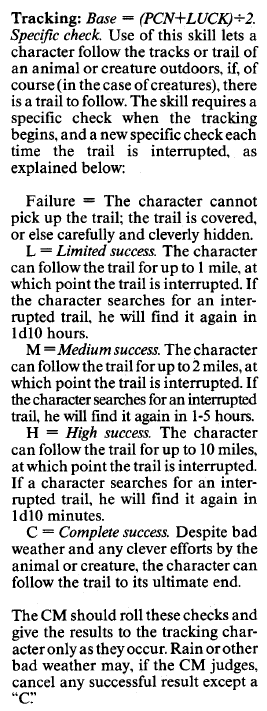
Flashing Blades combat rules include something like this. To hit, the player must roll 1D20 under a target number based on their character's attributes and expertise; if the player rolls less than half the target number, then the wound is serious and causes an additional 1D6 damage. A roll of 1 always hits, and bypasses any protection from armor the target of the attack may have. A roll of 20, on the other hand, is a fumble, and may result in anything from loss of actions to injury.
The rules for non-martial skills in FB state, "A roll equal to or less than the attribute indicates that the skill was used successfully," but I can't think of a single referee with whom I've played who didn't carry over the degrees of success from combat to skill rolls as well. In my own campaign, rolling between the target number and half the target number is simple success, rolling less than half the target number is a more significant success, and rolling a one means achieving Master-level success; conversely, rolling between the target number and half the range to twenty is a simple failure, rolling between half the range to twenty and twenty incurs some consequence for failing, and twenty is complete failure, likely with a dangerous consequence as well.
To use OG's example of attempting to jump onto a horse and knock off the rider, an Acrobatics roll is required to leap up behind the saddle. Let's say the character needs a fifteen or less to succeed: on a roll of 9-15, our swashbuckler manages to mount the horse behind the rider, and in the next round a successful grappling roll is required to knock the other rider off; on a roll of 2-8, I'd allow the grappling roll in the same round, and on a 1, the rider must make an immediate Dexterity check or tumble off on his own. On a roll of 16-18, however, our erstwhile swashbuckler is unable to gain a purchase on the rider or saddle and simply slides off the horse on the opposite side - make failure interesting, or at least a bit comical, remember? - on a roll of 19, he slides over the horse and catches his lace cuff on the saddle, trapping his arm until a succesful Dexterity roll works it loose, and on a twenty, the swashbuckler does indeed end up under the horse's hooves for an immediate trampling attack, if the rider should wish it - hey, it ain't all pratfalls. All of these results are likely to incur a Horsemanship check at some point as well.
There are circumstances in which outright failure is indeed an option, but playing about with the margins can be much more fun, both for the referee and the players. One of the most important aspects of refereeing, in my experience, is training my mind to improvise exactly these sorts of results quickly. I've found there's no substitute for being well-versed in genre tropes when it comes to making these calls in actual play, and that's the main reason I devote so many blog posts to books and movies and art; Cinematic and Wednesday Wyeth and The Pen and the Sword aren't filler - they're my conditioning program for the heavy-lifting of refereeing.
Sunday, January 27, 2013
DVR Alert
Clear some space on the DVR - Monday night's Turner Classic Movies schedule, titled, "Sword Play," features five excellent swashbucklers: Tyrone Power in The Mark of Zorro, Errol Flynn in The Adventures of Don Juan, Jose Ferrer - in a rare Oscar-winning cape-and-sword performance! - in Cyrano de Bergerac, Raiders of the Seven Seas, and Cornel Wilde and Maureen O'Hara - as the daughter of Athos! - in At Sword's Point.
Check your local listings for times, as always - and seriously, isn't it well past time for you to delete Dungeons & Dragons: Book of Vile Darkness?
Check your local listings for times, as always - and seriously, isn't it well past time for you to delete Dungeons & Dragons: Book of Vile Darkness?
The Pen and the Sword: The Shadow of the Vulture
"Damnation!" he muttered. "The accursed ones have ridden ahead of their fire. They've stolen on the village in the dark - come on, girl!"
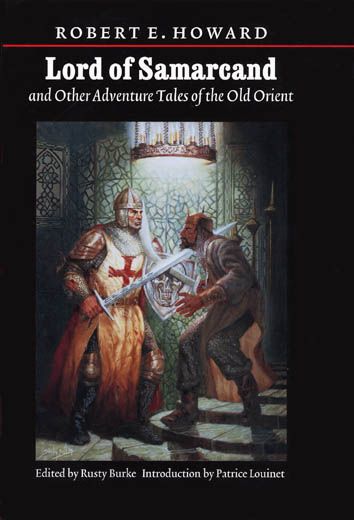 But even as he caught her white wrist to drag her away, and she screamed and fought against him like a wild thing, mad with fear, the mud wall crashed at the point nearest them. It crumpled under the impact of a score of horses, and into the doomed village reined the riders, distinct in the growing light. Huts were flaring up on all hands, screams rising to the dripping clouds as the invaders dragged shrieking women and drunken men from their hovels and cut their throats. Gottfried saw the lean figures of the horsemen, the firelight gleaming on their burnished steel; he saw the vulture wings on the shoulders of the foremost. Even as he recognized Mikhal Oglu, he saw the chief stiffen and point.
"At him, dogs!" yelled the Akinji, his voice no longer soft, but strident as the rasp of a drawn saber. "It is Gombuk! Five hundred aspers to the man who brings me his head!"
With a curse von Kalmbach bounded for the shadows of the nearest hut, dragging the screaming girl with him. Even as he leaped he heard the twang of bowstrings, and the girl sobbed and went limp in his grasp. She sank down at his feet, and in the lurid glare he saw the feathered end of an arrow quivering under her heart. With a low rumble he turned toward his assailants as a fierce bear turns at bay. An instant he stood, head out-thrust truculently, sword gripped in both hands; then, as a bear gives back from the onset of the hunters, he turned and fled about the hut, arrows whistling about him and glancing from the rings of his mail. There were no shots; the ride through that dripping forest had dampened the powder-flasks of the raiders.
Von Kalmbach quartered about the back of the hut, mindful of the fierce yells behind him, and gained the shed behind the hut he had occupied, wherein he stabled his gray stallion. Even as he reached the door, someone snarled like a panther in the semi-dark and cut viciously at him. He parried the stroke with the lifted sword and struck back with all the power of his broad shoulders. The great blade glanced stunningly from the Akinji's polished helmet and rent through the mail links of his hauberk, tearing arm from shoulder. The Muhammadan sank down with a groan, and the German sprang over his prostrate form. The gray stallion, wild with fear and excitement, neighed shrilly and reared as his master sprang on his back. No time for saddle or bridle. Gottfried dug his heels into the quivering flanks and the great steed shot through the door like a thunderbolt, knocking men right and left like tenpins. Across the firelit open space between the burning huts he raced, clearing crumpled corpses in his stride, splashing his rider from heel to head as he thrashed through the puddles.
- "The Shadow of the Vulture," Robert E. Howard
"At him, dogs!" yelled the Akinji, his voice no longer soft, but strident as the rasp of a drawn saber. "It is Gombuk! Five hundred aspers to the man who brings me his head!"
With a curse von Kalmbach bounded for the shadows of the nearest hut, dragging the screaming girl with him. Even as he leaped he heard the twang of bowstrings, and the girl sobbed and went limp in his grasp. She sank down at his feet, and in the lurid glare he saw the feathered end of an arrow quivering under her heart. With a low rumble he turned toward his assailants as a fierce bear turns at bay. An instant he stood, head out-thrust truculently, sword gripped in both hands; then, as a bear gives back from the onset of the hunters, he turned and fled about the hut, arrows whistling about him and glancing from the rings of his mail. There were no shots; the ride through that dripping forest had dampened the powder-flasks of the raiders.
Von Kalmbach quartered about the back of the hut, mindful of the fierce yells behind him, and gained the shed behind the hut he had occupied, wherein he stabled his gray stallion. Even as he reached the door, someone snarled like a panther in the semi-dark and cut viciously at him. He parried the stroke with the lifted sword and struck back with all the power of his broad shoulders. The great blade glanced stunningly from the Akinji's polished helmet and rent through the mail links of his hauberk, tearing arm from shoulder. The Muhammadan sank down with a groan, and the German sprang over his prostrate form. The gray stallion, wild with fear and excitement, neighed shrilly and reared as his master sprang on his back. No time for saddle or bridle. Gottfried dug his heels into the quivering flanks and the great steed shot through the door like a thunderbolt, knocking men right and left like tenpins. Across the firelit open space between the burning huts he raced, clearing crumpled corpses in his stride, splashing his rider from heel to head as he thrashed through the puddles.
- "The Shadow of the Vulture," Robert E. Howard
Friday, January 25, 2013
Random Encounters: Rory's Story Cubes, Revisited
Tim Snider at The Savage AfterWorld rolls some story cubes, gets an artifact, a mutant, a village, and an adventure hook.
Thursday, January 24, 2013
I Didn't Spend All Those Years Playing Boot Hill and Not Learn a Little Something About Bravery
A 2e Boot Hill character's attributes are Speed, Gun Accuracy, Throwing Accuracy, Bravery, Strength, and Experience. Five of the six affect how well your character fights; the sixth, Strength, determines how much damage the character can take.
The five attributes, including Bravery, which affect combat include modifiers to a character's speed and/or accuracy with various weapons. The Bravery attribute score increases or decreases a character's Speed and Accuracy, for example, providing a discrete, quantifiable impact on the character's performance in the game: a character with a high Bravery score is cool under fire, faster and more accurate than his counterpart with a low Bravery attribute value.
Consider a character who is a town marshal with a Coward Bravery rating and no Experience; maybe he got the job through a political connection, or maybe the townsfolk stuck the badge on him because no one else wanted it and he didn't have the guts to say no. Now a gang of bank robbers come to town, and it's the marshal's job to confront them.
Now here's the thing: there's nothing about the attribute itself rules-wise which determines if or how the marshal will confront the robbers; the attribute modifiers only speak to what happens if he tries to fire his gun at them. The attribute and the modifiers influence how successful the character is in a particular task; they say nothing about when or how the character decides to attempt the task.
So the marshal checks his six-shooters, grabs a double-barrel from the rack, and walks into the dusty Main Street to face-down the robbers. His hands shake like he has the palsy, sweat drips off his brow making his eyes sting, and his mouth is as dry as an arroyo in August so that when he shouts, "Throw up yer hands!" it comes out as little more than a hoarse whisper, and that is what is represented by the Bravery attribute modifiers, not the decision to confront the gang - that decision is solely the province of the player.
In thinking this through, I realised that the character's stats are reflected not in what the character does, but in how well he does it. By treating character attributes as a nothing more than a rules interface and not a determinant of personality, roleplaying and character stats exist independently of one another. Put another way, roleplay your character as you like, and let the stats take care of themselves.
Consider another example, this time the loquacious player who uses a 'social stat' like Charisma or Charm as his character's dump stat; whether you're using something as simple as a reaction roll-plus-modifier or something as complex as Duel of Wits, let the player be as charming and as eloquent as he likes, and let the dice handle the actual result. The player of a would-be warlord may deliver a stirring in-character speech, but if his Charisma modifier is in the negatives, however inspiring the player may believe it to be, the warlord isn't persuasive, for this is the limitation imposed by the character's actual ability, in the same way that his Strength or Dexterity may affect his effectiveness at fighting.
If the player wants the character to be better at something, then it's on the player to choose that for the character, by whatever means the system supports, whether that's adding skill points, raising an attribute, or whatever - a would-be Cassanova with a 5 Charisma needs to invest skill points in Bluff or Diplomacy or whatever, or accept that he's only going to get play when he's really, really lucky.)
I've floated this argument on different roleplaying gaming forums over the years, and I found it's one which reliably brings out the self-anointed real roleplayers to tell me I'm doing it oh-so-profoundly wrong, to accuse me of advocating 'roll-play over roleplay,' and on, and on, and on. Perhaps their most compelling - though by no means persuasive - argument is, 'But that's what the books say!' And pretty often they're right. There's a sort of schizophrenia between what some rule books say about attribute scores, and what they mean in actual play. One of the rules-rebuttals offered is the 2e AD&D PHB, in a section subheaded, "What the Numbers Man," which offers examples of interpreting character personality from the attribute scores.
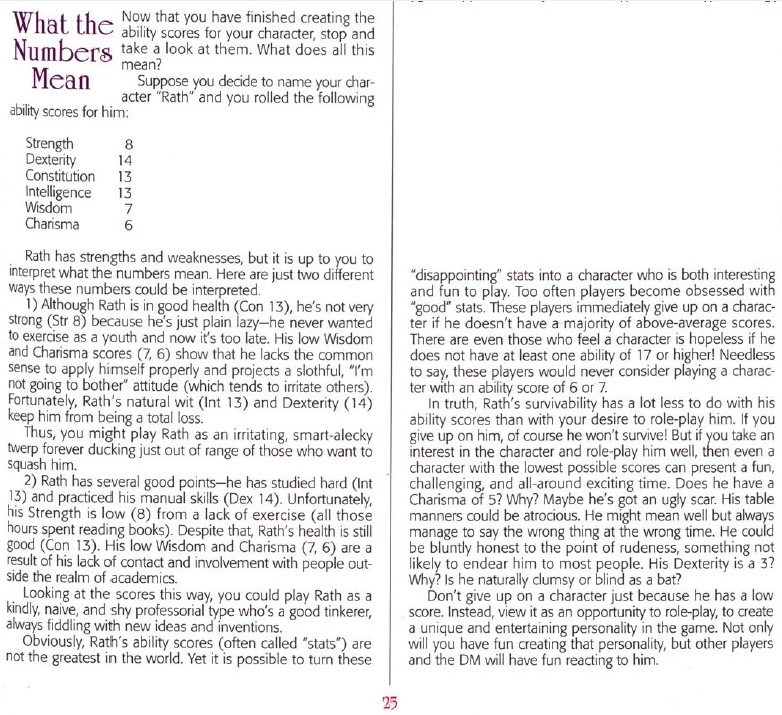
I have two specific issues with this. First, in the case of many roleplaying games but AD&D in particular, the implications of the attribute scores don't relate well to other parts of the game. Take this, frex, from the page above: "His Dexterity is 3? Why? Is he naturally clumsy or blind as a bat?" Well, if he's blind as a bat, is his chance of detecting secret doors lower? Is his outdoor encounter detection range reduced? Or if he's clumsy, is his movement reduced when he runs? Does it affect his melee attacks? Interpreting the stats this way has knock-on effects through other parts of the game with which Dex 3 simply doesn't interact. In 1e AD&D, Dex 3 means the character must be a cleric, that she cannot be a half-elf, elf or halfling, and that she suffers penalties to her reaction time, missle attacks, armor class, and certain saves. And that's it. Neither "blind as a bat" nor "naturally clumsy" fit because of the way attribute scores relate to the rest of the rules.
Second, insisting that attribute scores define personality may limit the range of potential characterisations to 'playing to type.' For example, maybe Rath, again from the 2e example, is a thief who really wants to be the leader of a gang, so he's forever trying to recruit cutpurses and bandits. But of course he's not a natural leader at all, no matter how hard he tries - I know this because his reaction rolls and loyalty scores suck when he tries to lead. The fun thing is, his rare successes simply reinforce his perception of himself, or offer him hope, so he keeps trying.
Playing against type can make for memorable characters. I have a great example of this from my Flashing Blades campaign, Riordan O'Neill, King's Musketeer, would-be Casanova with (originally) Charm 11. Most of his attempts at courtship and seduction are an uphill struggle, and luck is a huge factor in his successes. It's his repeated attempts at being the great lover in spite of lacking the natural acuity reflected by his Charm score that make him so much fun in actual play.
Or how 'bout the lily-livered Boot Hill town marshal I wrote about earlier? Maybe he took the job of marshal out of a sense of responsibility to his community, and he's determined to overcome his shakes when faced with the bank robbers. Or maybe he's a braggart and a bully who likes lording the position of marshal over the rest of the townsfolk, but like most bullies, deep-down he's gutless - he goes to face the bank robbers because he knows if he doesn't, he'll be exposed as yellow.
There's nothing wrong with playing to type, of course, but by unhooking personality from ability, a broader range of characterisations becomes available to the players.
'But what about immersion?' the real-roleplayers complain. 'An Int 6 barbarian shouldn't solve puzzles as well as an Int 18 magic-user!' There are a couple of weaknesses to this rebuttal as well. I don't mean to keep picking on D&D here, but since this argument comes up so often with respect to The World's Most Popular Roleplaying Game™, D&D examples provide a convenient gamer lingua franca. First, let's look again at what the rules say Intelligence actually provides to the character. In 1e AD&D, frex, Intelligence covers the number of possible languages spoken, the minimum and maximum number of spells a magic-user may know by level, the chance to learn a given spell, and the minimum score required to learn spells of a particular level; in 3e, Intelligence covers languages again, skill points, and the modifier for a number of skills. There is no mention of puzzle solving in there at all, and referees who 'slip clues' to players running characters with a high Intelligence score are adding something to the game that simply doesn't exist to compensate for this.
Looking more closely at the rules, what Intelligence, Wit, &c often provide in roleplaying games are resources, not abilities. Perhaps the player of the Int 6 barbarian solves sudokus in his sleep, but he's not solving a puzzle in a language his character doesn't understand until or unless someone translates it for him. Skills may also be gatekeepers, in that a character must learn a certain skill simply to be able to perform a given task. A player who's a master at pike-and-shot wargames is still limited to making brilliant maneuvers in Flashing Blades by first taking the Strategy skill and then rolling under one-third of his character's Wit. In each case, the player's ability is constrained by the character's resources.
In truth, I admit I couldn't care less if a player isn't roleplaying her character's Wit 6. Maybe it comes from starting with D&D way back when, but honestly, I expect players to metagame, to rely on their resourcefulness and experience, and I design my challenges accordingly. I never expected players to pretend their characters didn't know, say, that fire kills trolls; if I wanted them to face an unexpected challenge, then I would simply change things up on them, like trolls which are killed with salt instead of fire. One of the characters in my Flashing Blades campaign nearly died because his player ignored a clue - a case of Anjou wine - which came straight out of The Three Musketeers novel. Easter eggs from books or movies aren't there out of laziness or to try to be clever - they're there because they're fun for the players, and I fully expect them to take advantage of them, or I wouldn't include them in the first place. We're playing a game, and the experience should reward smart play.
Second, because attribute scores are often disconnected from other rules, what tends to snap my suspenders of disbelief isn't an Int 6 barbarian is solving puzzles, but rather roleplaying him as the same stupid lunk at 10th level as he is a 1st level. The barbarian's explored ancient ruins, fought men and monsters, survived poisoning, travelled across trackless wastes, seen priests drive off and destroy undead with a word, felt the power of magic, raised a horde and sacked an evil temple, maybe even been turned to stone and restored to flesh, and yet a few gamers would have that Int 6 trump all of the actual play experiences of the character - and no, that's not hyperbole.
There are roleplaying games out there which integrate both who a character is and how that does what she does - Pendragon is one of my favorite examples of 'personality mechanics' in a roleplaying game. Ability scores, however, are not personality rules, in my experience, and unfortunately even the rule books themselves sometimes confuse this.
The five attributes, including Bravery, which affect combat include modifiers to a character's speed and/or accuracy with various weapons. The Bravery attribute score increases or decreases a character's Speed and Accuracy, for example, providing a discrete, quantifiable impact on the character's performance in the game: a character with a high Bravery score is cool under fire, faster and more accurate than his counterpart with a low Bravery attribute value.
Consider a character who is a town marshal with a Coward Bravery rating and no Experience; maybe he got the job through a political connection, or maybe the townsfolk stuck the badge on him because no one else wanted it and he didn't have the guts to say no. Now a gang of bank robbers come to town, and it's the marshal's job to confront them.
Now here's the thing: there's nothing about the attribute itself rules-wise which determines if or how the marshal will confront the robbers; the attribute modifiers only speak to what happens if he tries to fire his gun at them. The attribute and the modifiers influence how successful the character is in a particular task; they say nothing about when or how the character decides to attempt the task.
So the marshal checks his six-shooters, grabs a double-barrel from the rack, and walks into the dusty Main Street to face-down the robbers. His hands shake like he has the palsy, sweat drips off his brow making his eyes sting, and his mouth is as dry as an arroyo in August so that when he shouts, "Throw up yer hands!" it comes out as little more than a hoarse whisper, and that is what is represented by the Bravery attribute modifiers, not the decision to confront the gang - that decision is solely the province of the player.
In thinking this through, I realised that the character's stats are reflected not in what the character does, but in how well he does it. By treating character attributes as a nothing more than a rules interface and not a determinant of personality, roleplaying and character stats exist independently of one another. Put another way, roleplay your character as you like, and let the stats take care of themselves.
Consider another example, this time the loquacious player who uses a 'social stat' like Charisma or Charm as his character's dump stat; whether you're using something as simple as a reaction roll-plus-modifier or something as complex as Duel of Wits, let the player be as charming and as eloquent as he likes, and let the dice handle the actual result. The player of a would-be warlord may deliver a stirring in-character speech, but if his Charisma modifier is in the negatives, however inspiring the player may believe it to be, the warlord isn't persuasive, for this is the limitation imposed by the character's actual ability, in the same way that his Strength or Dexterity may affect his effectiveness at fighting.
If the player wants the character to be better at something, then it's on the player to choose that for the character, by whatever means the system supports, whether that's adding skill points, raising an attribute, or whatever - a would-be Cassanova with a 5 Charisma needs to invest skill points in Bluff or Diplomacy or whatever, or accept that he's only going to get play when he's really, really lucky.)
I've floated this argument on different roleplaying gaming forums over the years, and I found it's one which reliably brings out the self-anointed real roleplayers to tell me I'm doing it oh-so-profoundly wrong, to accuse me of advocating 'roll-play over roleplay,' and on, and on, and on. Perhaps their most compelling - though by no means persuasive - argument is, 'But that's what the books say!' And pretty often they're right. There's a sort of schizophrenia between what some rule books say about attribute scores, and what they mean in actual play. One of the rules-rebuttals offered is the 2e AD&D PHB, in a section subheaded, "What the Numbers Man," which offers examples of interpreting character personality from the attribute scores.
I have two specific issues with this. First, in the case of many roleplaying games but AD&D in particular, the implications of the attribute scores don't relate well to other parts of the game. Take this, frex, from the page above: "His Dexterity is 3? Why? Is he naturally clumsy or blind as a bat?" Well, if he's blind as a bat, is his chance of detecting secret doors lower? Is his outdoor encounter detection range reduced? Or if he's clumsy, is his movement reduced when he runs? Does it affect his melee attacks? Interpreting the stats this way has knock-on effects through other parts of the game with which Dex 3 simply doesn't interact. In 1e AD&D, Dex 3 means the character must be a cleric, that she cannot be a half-elf, elf or halfling, and that she suffers penalties to her reaction time, missle attacks, armor class, and certain saves. And that's it. Neither "blind as a bat" nor "naturally clumsy" fit because of the way attribute scores relate to the rest of the rules.
Second, insisting that attribute scores define personality may limit the range of potential characterisations to 'playing to type.' For example, maybe Rath, again from the 2e example, is a thief who really wants to be the leader of a gang, so he's forever trying to recruit cutpurses and bandits. But of course he's not a natural leader at all, no matter how hard he tries - I know this because his reaction rolls and loyalty scores suck when he tries to lead. The fun thing is, his rare successes simply reinforce his perception of himself, or offer him hope, so he keeps trying.
Playing against type can make for memorable characters. I have a great example of this from my Flashing Blades campaign, Riordan O'Neill, King's Musketeer, would-be Casanova with (originally) Charm 11. Most of his attempts at courtship and seduction are an uphill struggle, and luck is a huge factor in his successes. It's his repeated attempts at being the great lover in spite of lacking the natural acuity reflected by his Charm score that make him so much fun in actual play.
Or how 'bout the lily-livered Boot Hill town marshal I wrote about earlier? Maybe he took the job of marshal out of a sense of responsibility to his community, and he's determined to overcome his shakes when faced with the bank robbers. Or maybe he's a braggart and a bully who likes lording the position of marshal over the rest of the townsfolk, but like most bullies, deep-down he's gutless - he goes to face the bank robbers because he knows if he doesn't, he'll be exposed as yellow.
There's nothing wrong with playing to type, of course, but by unhooking personality from ability, a broader range of characterisations becomes available to the players.
'But what about immersion?' the real-roleplayers complain. 'An Int 6 barbarian shouldn't solve puzzles as well as an Int 18 magic-user!' There are a couple of weaknesses to this rebuttal as well. I don't mean to keep picking on D&D here, but since this argument comes up so often with respect to The World's Most Popular Roleplaying Game™, D&D examples provide a convenient gamer lingua franca. First, let's look again at what the rules say Intelligence actually provides to the character. In 1e AD&D, frex, Intelligence covers the number of possible languages spoken, the minimum and maximum number of spells a magic-user may know by level, the chance to learn a given spell, and the minimum score required to learn spells of a particular level; in 3e, Intelligence covers languages again, skill points, and the modifier for a number of skills. There is no mention of puzzle solving in there at all, and referees who 'slip clues' to players running characters with a high Intelligence score are adding something to the game that simply doesn't exist to compensate for this.
Looking more closely at the rules, what Intelligence, Wit, &c often provide in roleplaying games are resources, not abilities. Perhaps the player of the Int 6 barbarian solves sudokus in his sleep, but he's not solving a puzzle in a language his character doesn't understand until or unless someone translates it for him. Skills may also be gatekeepers, in that a character must learn a certain skill simply to be able to perform a given task. A player who's a master at pike-and-shot wargames is still limited to making brilliant maneuvers in Flashing Blades by first taking the Strategy skill and then rolling under one-third of his character's Wit. In each case, the player's ability is constrained by the character's resources.
In truth, I admit I couldn't care less if a player isn't roleplaying her character's Wit 6. Maybe it comes from starting with D&D way back when, but honestly, I expect players to metagame, to rely on their resourcefulness and experience, and I design my challenges accordingly. I never expected players to pretend their characters didn't know, say, that fire kills trolls; if I wanted them to face an unexpected challenge, then I would simply change things up on them, like trolls which are killed with salt instead of fire. One of the characters in my Flashing Blades campaign nearly died because his player ignored a clue - a case of Anjou wine - which came straight out of The Three Musketeers novel. Easter eggs from books or movies aren't there out of laziness or to try to be clever - they're there because they're fun for the players, and I fully expect them to take advantage of them, or I wouldn't include them in the first place. We're playing a game, and the experience should reward smart play.
Second, because attribute scores are often disconnected from other rules, what tends to snap my suspenders of disbelief isn't an Int 6 barbarian is solving puzzles, but rather roleplaying him as the same stupid lunk at 10th level as he is a 1st level. The barbarian's explored ancient ruins, fought men and monsters, survived poisoning, travelled across trackless wastes, seen priests drive off and destroy undead with a word, felt the power of magic, raised a horde and sacked an evil temple, maybe even been turned to stone and restored to flesh, and yet a few gamers would have that Int 6 trump all of the actual play experiences of the character - and no, that's not hyperbole.
There are roleplaying games out there which integrate both who a character is and how that does what she does - Pendragon is one of my favorite examples of 'personality mechanics' in a roleplaying game. Ability scores, however, are not personality rules, in my experience, and unfortunately even the rule books themselves sometimes confuse this.
Subscribe to:
Posts (Atom)