Tuesday, January 8, 2013

Rulings, and Rules

There's a sprawling discussion on Big Purple's d20 ghetto right now dismissing the putative old-school notion of 'rulings, not rules' as A Bad Thing. This is one of those arguments discussions which gets repeated again and again and again and again by gamers.

The truth of it, which may be obscured by shrill rants about 'arbitrary GMs!' and 'thousand-page rule books!' is that roleplaying games typically involve both rules and rulings, and the more interesting questions are, who gets to make rulings? and, what should the rules cover and what should be left to rulings? With respect to the first, most traditional roleplaying games answer the question of WHO DECIDES? by assigning that role to a referee, though other games may spread that role among the players to one degree or another. For now I'm going to assume the former, but when I write 'referee,' understand that I know there are other ways of doing this.

How often, and in what circumstances, the referee is called upon to make a ruling may be largely determined by the answer to the second question: what do the rules attempt to address specifically, and what is left to the discretion of the referee to adjudicate as the need arises?

One of the arguments which resonates with me for hard-coding many of these potential cruxes into the rules is that players can make informed decisions around what their characters are likely, or unlikely, to be able to do. Traditional task-resolution rules may offer a replicable, dependable game-world simulation - if I roll x, I get result y, meaning I can jump so far or hide in shadows this easily or whatever.

But the range of potential character choices is as broad as the imaginations of the players at the table. In the linked big Purple thread, one of the posters talked about knowing the DC of jumping a horse onto a boat without capsizing the craft. Is it reasonable to expect the designers of a roleplaying game to anticipate that choice with a written rule, or for a referee to remember it on the fly during actual play? In my experience, corner cases like this are exactly why rulings are necessary and desirable, because actual play often becomes one corner case after another.

The best rules, then, may be those which provide guidelines for everyone around the table, rather than, say, a rule like, "Jumping a horse onto a boat without capsizing is DC 30 for a raft, DC 40 for a dinghy, DC 25 for a barge,' &c. Of course, the nature of the guidelines becomes the next point of fracture between gamers.

I don't say much about 4e D&D because I've never played it or read it; in fact the only pieces of it I've seen first hand are the table on page 42 titled, "Difficulty Class and Damage by Level," and the section on skill challenges. As luck would have it, those are two of the sections cited in another Big Purple thread which spun off the first, as examples of how 4e makes adjudication easy, particularly for inexperienced gamers. My own feeling is that page 42 may constrain as much as it inspires and the repetitive margins for success can lead to 'flat' encounters, and that skill challenges are just a hot mess, but I can definitely understand the appeal they hold for others - replicable, reliable math is nothing to sneeze at, particularly in games with lots of fiddly bits.

Flashing Blades takes a different approach. Here's the section on how skills are handled.
During the course of an adventure, characters will wish to make constant use of their skills. This is achieved normally by rolling a D20 against one of the character's attributes. A roll equal to or less than the attribute indicates that the skill was used successfully.

The attribute rolled against is usually the base attribute for the skill, but this may vary depending upon the circumstances. For instance, a character with Acrobatics skill might roll against his Dexterity to put on a 'sham' brawl, but would be required to make a roll against his Wit to recognize one if he saw it. The difficulty of most rolls will vary widely, so the Gamemaster should add bonuses or subtract penalties from the needed roll as indicated by the situation. For example, a character with Stealth skill, and a Dexterity of 13 would normally need to roll 13 or less to hide effectively. If there were no shadows and little cover, he might receive a -2 penalty, making his needed roll 11 or less. Likewise, if it were late at night in a thick forest, he might get a +4 bonus, making his required roll a 17 or less. In cases of extreme difficulty, the Gamemaster might require a roll under a given attribute divided by two or three (always round up).

When two characters use their skills in opposition to each other, it becomes a resistance roll. The first character's roll modifies the second's by the difference between his roll and what he needed. Thus, if a character with Stealth and a Dexterity of 12 were running through a forest, he might be required to make a roll against Dexterity to leave a sparse trail for his pursuer. If he rolled an 8, any character tracking him would receive a -4 penalty (8 - 12 = -4). If he missed and rolled a 15, any character tracking him would get a +3 bonus (15 - 12 = 3).

Resistance rolls are used commonly with Cut Purse, Disguise, Forgery, Stealth, Tracking, and Espionage.

In some cases, skills will only modify normal rolls. For instance, if a character were standing on top of a table about to be flipped by an enemy, he might be required to make a roll against Dexterity to jump down in time. Acrobatics skill might give him a +3 bonus.
It's clean and simple - no Disneyland, no live nude girls. Roll against the applicable attribute, or against that attribute divided by two or three, maybe get a modifier, maybe make an opposed roll. Broad guidelines, broadly applicable. The math is reasonably consistent, too, in that a player knows what his attributes are, and the referee simply needs to let the player know what the relative difficulty is - roll under the attribute? roll under half the attribute? - and any applicable modifiers, and perhaps make an opposition roll. The rules also imply, through the combat section, that skill checks may be interpreted as degrees of success.

I don't know if this would satisfy 'jumping a horse onto a boat without capsizing it is DC 30' guy or 'page 42 makes anyone a competent referee' guy, but as a player it lets me have some idea of what it takes to accomplish something and as a referee it provides me with a framework on which to adjudicate the action as the players make their choices. I don't want a folio of rules which try to cover every corner case, like 'horse jump' guy, and I don't need one rule that applies to every possible corner case, like 'page 42' guy.

Monday, January 7, 2013

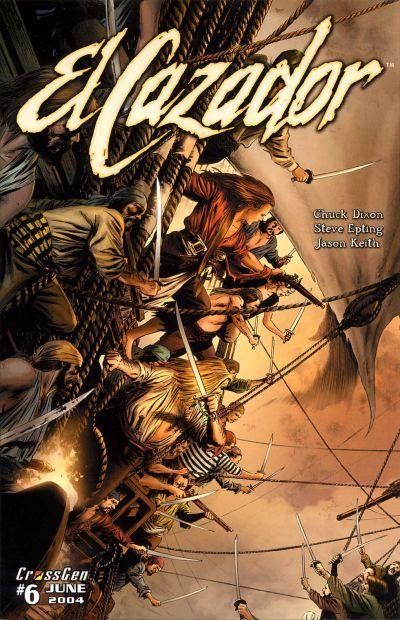
Graphic Novels Challenge: El Cazador


Let me make something clear right now - I suck at writing reviews.

If you're looking for a discussion of the writers' and artists' body of work and where this fits into their oeuvre, you'll need to look elsewhere - all I'd be doing is parroting someone else's insights. If you're looking for details about the plot and the characters, then you'll be disappointed - I can't stand reviews full of spoilers. I'm not going to waste my time or yours on a lengthy publishing history.

Okay, still with me?

El Cazador is a rare jewel, a pirate comic book that doesn't involve the undead, witchcraft, or mystical relics. The tale is set in 1687, and when I say that, I mean deeply embedded. Snippets of French, Spanish, Italian and Dutch pepper the dialog, reflecting the polyglot pirate crews of Blackjack Tom, Redhand Harry, and Lady Sin, the Spanish noblewoman turned pirate and captain of the eponymous ship, El Cazador (The Hunter). The whole thing is awash in period detail, in both the art and the writing, yet it never loses sight of what it is, a classic high seas cape-and-sword romance. There's mutiny and marooning, fireships and duels, a example of, and a tribute to, the kind of pirate story one might find flowing from the pen of Rafael Sabatini nearly a century ago.

And on top of all that, the artwork is breathtaking. There are a dozen panels at least that I would gladly blow up to poster size, starting with the opening pages featuring a view from the sea floor of fish swimming amidst the wreckage and corpses of an capsized galleon floating above.

El Corazon, written by Chuck Dixon and penciled by Steve Epting, first appeared in 2003 and ran for six issues until the publisher, CrossGen, went belly up the next year, bringing the series, and Lady Sin's quest for revenge against Blackjack Tom, to an abrupt and unwelcome halt. The six issues were collected and published as a graphic novel by Hyperion Paperbacks in 2007, and if my copy is at all representative, they did a pretty crap job of it - my pages are near to falling out as the spine crackles and snaps every time I gently thumb through the book.

It's a real shame this story never found its way to completion - Lady Sin would appear in Sigil in 2011, after Marvel acquired GrossGen's rights, but in a new storyline - but there is a lot of solid inspiration for cape-and-sword campaigns found between the covers of El Cazador.

Sunday, January 6, 2013

The Pen and the Sword: Don Rodriguez: Chronicles of Shadow Valley

Preface: For the new year, Cinematic is giving way to a new Sunday 'feature,' The Pen and the Sword, featuring excerpts from cape-and-sword books and stories.

I ran the following piece last April, but it's just so good I really wanted to include it in this series. I hope you enjoy this as much as I do. - BV

"A vile song, señor, and a vile tune with it," said a voice quite close.

However much the words hurt his pride in his mandolin Rodriguez recognised in the voice the hidalgo's accent and knew that it was an equal that now approached him in the moonlight round a corner of the house with the balcony; and he knew that the request he courteously made would be as courteously granted.

"Señor," he said, "I pray you to permit me to lean my mandolin against the wall securely before we speak of my song."

"Most surely, señor," the stranger replied, "for their is no fault with the mandolin."

"Señor," Rodriguez said, "I thank you profoundly." And he bowed to the gallant, whom he now perceived to be young, a youth tall and lithe like himself, one whom we might have chosen for these chronicles had we not found Rodriguez.

Then Rodriguez stepped back a short way and placed his kerchief upon the ground; and upon this he put his mandolin and leaned it against the wall. When the mandolin was safe from dust or accident he approached the stranger and drew his sword.

"Señor," he said, "we will now discuss music."

- Don Rodriguez: Chronicles of Shadow Valley, Lord Dunsany

Friday, January 4, 2013

Gimli of Arabia

I've recounted the story of 'Gimli of Arabia' on different forums over the years; I think this may be one of the first such posts.
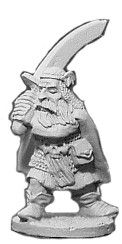
I ran a typical hammer-throwing, axe-swinging dwarf fighter in a 1e AD&D game when I was in high school. At one point we found ourselves exploring a pyramid deep in a desert, and in the course of the adventure we found a +3 scimitar. The other fighter player characters in the party had died and the player was waiting to introduce his new character, so my dwarf was the only one in the party able to take advantage of this magical scimitar.

The dwarf was not proficient in the weapon, so he was less accurate when wielding it (and this was before weapon specialization in UA) until he could burn a proficiency slot, but it was a powerful magic weapon and we needed that as we were facing lots of undead in the crypts beneath the pyramid. As he continued to wield this scimitar, I had the character start embracing some of the local lifestyle: his rough woolen cloak was replaced by a silk aba, he sported a turban, he indulged in local jewelry, and so on. By the time our party left the pyramid and moved on to other adventures, he was a sort of "Gimli of Arabia," riding a camel and picking up a desert-dwelling illusionist as a henchman in the process. He was a lot of fun to play.
The character - who's actual name was Khazm, not Gimli - remains one of my favorite characters from any game and any campaign, but he also illustrates a couple of points about roleplaying games which are important to me.

First, Khazm developed not based on a 'character concept' dreamed up before the game started, but in response to the events of actual play.
One of the reasons I stopped enjoying 3e D&D fairly early on is that, in my experience, it worked against this sort of organic character development. I observed that feat chains, prestige classes and their prerequisites, and 1-20 builds made many players reluctant to take something for which they had not planned and run with it. I don't mean to suggest that the rules required this, and I don't believe it's true of all players everywhere, but I saw enough of it as both a player and a dungeon master to find it off-putting.

The idea that treasure should be matched to the characters is another big step away from my experience playing my dwarf fighter character, taking an unusual weapon and allowing the character concept to evolve to accomodate it, rather than giving the dungeon master a slip requesting "a hammer of thunderbolts, 'cause it's integral to my character concept!"
Over the years I've been told - always on gaming message boards, and never by anyone with whom I actually sat around a table - that my develop-in-play approach to characterisation is more suited to skirmish wargames than roleplaying games. 'Real roleplayers,' the unsubtle implication goes, begin with a 'fleshed out' character, and to do otherwise is simply playing some variation of myself. What's usually overlooked in their too-often sneering disdain is that I am not, in fact, a dwarf warrior in a fantastic realm of dungeons and dragons, or a swashbuckling highwaymen chasing a carriage over the moors on my black charger, or a steely-eyed gunfighter standing in bright sunlight on the dusty streets of Abilene, so my characters are already not-me right from the mother-lovin' giddyup.

What's important to me isn't who my character is at the start of the game, but who my character may become through suffering the slings and arrows of actual play. That means creating an involved backstory, or making up connections to non-player characters, or dreaming up funny mannerisms, or coining a catch-phrase, are trivial compared to my character's reaction to the unfolding events of the campaign. Planning for who my character will be in nineteen levels is just as inconsequential as trying to determine who he is before the campaign begins, and burgeoning rules complexity which leads to a lack of flexibility works directly against my style of play. In my experience, games which produce broad character archetypes work best for this; the more fiddly bits a character needs, the more difficult it can be to make changes on the fly. Simpler rules, without mastery traps, work best for this.

Second, with respect to those broad archetypes, Khazm was an otherwise bog-standard fighter, but adopting an atypical weapon and unusual cultural trappings for his race made him effectively unique in the game-world - this was the days before every demihuman race had an ice subrace and a sea subrace and a desert subrace and a jungle subrace, of course. It didn't take class abilities or feats or prestige classes to make him distinctive - the only rules-wise change to Khazm was spending a weapon proficiency slot on the scimitar after he leveled up - but rather I simply roleplayed him in ways, and surrounded him with trappings, which reflected his adopted culture.

Sometimes I hear that playing swashbucklers or gunfighters or gangsters is boring because all the characters are basically the same - guy with a rapier, guy with a Peacemaker, guy with a Tommy gun. There's nothing, they say, to differentiate one 5th level fighter from another without feats et al. Well, Khazm and I beg to differ.

Thursday, January 3, 2013

Playstyles & Pigeonholes

I wonder if Robin Laws' most pervasive impact on roleplaying games is the quiz based on his book.

I see the results posted in gamers' signatures on various forums pretty often, as a sort of identity badge, perhaps - 'I'm a Storyteller 100%, and I want everyone to know it!' I'd taken it before, but I couldn't remember when, so I took it again the other day. Here's what it spit out at me.

You Scored as Tactician

You're probably a military buff who wants to have the chance to think through complex problems. You want the rules, and your GM's interpretation of them, to match up what happens in the real world or at least be consistant. You want challenging yet logical obstacles to overcome.

Tactician
67%
Method Actor
50%
Butt-Kicker
50%
Storyteller
42%
Power Gamer
42%
Specialist
33%
Casual Gamer
17%

A couple of things jumped out at me. First, it's interesting to me that only one of the scores was above 50%, but not terribly surprising, considering the number of 'neither this nor that' answers I chose. In fact, very few of my answers reached either extreme at all; for me, most of the questions were simply too polarised to elicit strong agreement or disagreement.

Second, looking over my results, I'm pretty consistent. With a little searching, I found my answers to this quiz from not quite a year ago - in both cases, Tactician was my highest score and the only answer to break fifty percent, and while there was a bit of jockeying in the rest of the pack, the answers are more or less consistent between the two. The rough consistency between the results - one score breaking away from the field, the rest varying by fairly small margins - suggests the quiz does a reasonable job of sussing out the likes and dislikes of gamers.

Here's the thing, though: as a diagnostic of my own gaming style, the most important result is not the top score, but rather the clump of answers which follow. The quiz proclaims that I'm a Tactician, ". . . a military buff who wants to have the chance to think through complex problems," who wants " . . . the rules, and your GM's interpretation of them, to match up what happens in the real world or at least be consistant," and wants, ". . . challenging yet logical obstacles to overcome." There's a nugget of truth in this: I like thinking through complex problems, and I like overcoming challenging obstacles, especially ones which must be reasoned through. And yes, I do enjoy wargames as well, though calling me a "military buff" is a bit too specific.

The description of the Tactician provided in the quiz results is a paraphrase of the description provided by Mr Laws, however. Here's the full description, as quoted in the linked passages, with bold text highlighting some of the key differences between the quiz and the book.
The Tactician is probably a military buff, who wants chances to think his way through complex, realistic problems, usually those of the battlefield. He wants the rules, and your interpretation of them, to jibe with reality as he knows it, or at least to portray an internally consistent, logical world in which the quality of his choices is the biggest determining factor in his success or failure. He may view issues of characterization as a distraction. He becomes annoyed when other players do things which fit their PCs' personalities, but are tactically unsound. To satisfy him, you must provide challenging yet logical obstacles for his character to overcome.
There's a quite a bit more here than the quiz results suggests, a much narrower interpretation of what a "Tactician" expects from the game, and, for me, the added specificity goes wildly wrong.

As far as "complex, realistic problems" go, I tend to think of 'battlefield complexity' as fun but perhaps the least interesting sort of complexity a roleplaying game may offer. Everything from traps and environmental hazards to mysteries and political intrigues interest me as problems to solve in roleplaying games, and those often far more than combat. I like the "quality" of my choices to skew the probabilities - for good or bad - of the dice, not be the "biggest determining factor" of success or failure.

And the idea that characterisation is a "distraction," or that "tactically unsound" in-character choices are annoying, isn't even in the ballpark.

So does "Tactician 67%" really come close to describing how I like to play a roleplaying game? Is Mr Laws' typology 'two-thirds' correct as it applies to me?

One of the very real problems of trying to divine players' interests, whether it's Mr Laws' game styles, or the Forge's 'Big Model(s),' or Fred Hicks' "secret language of character sheets", is that playstyle pigeonholes rarely provide even a useful fraction of the whole story. Looking at my quiz results, it's not the Tactician result which tells you most about my gaming style, but rather the bunch sprint between Method Actor, Butt-Kicker, Storyteller, and Power Gamer, all in roughly equal measure. I want action and system mastery and deepening characterisation and the opportunity to weave my character into the history of the game-world.

When I think about campaigns in which I've played, it's these qualities against which I judge how much I enjoyed the experience, not whether my character fought a duel on the deck of a burning galleon or if I adequately demonstrated my pike-and-shot tactical acumen. A referee who looks at my quiz score and tries to engage me with the equivalent of a minis skirmish game won't even be close.

Wednesday, January 2, 2013