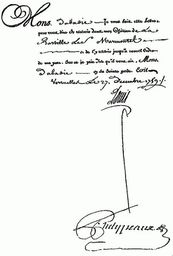
Under the heading, "Reality Makes the Best Fantasy," TristanJTarwater at Troll in the Corner reflects on
identification and official documentation and wonders how such things may work in a roleplaying game setting.
Though I'm running a historical setting, many of the questions are pretty challenging for me to answer; I have a general notion of how many of these things are handled from my background reading, but I'm admittedly a bit short on details.
- What kinds of official documents and identifications are required in the area? Are there ones for nationality? For work/certain professions/guilds? Ownership? What power and function do these documents hold?
In early 17th century France, with literacy restricted to a small portion of the population, personal documentation carried by the individual is minimal. The parish church or Huguenot temple is the repository of birth and death records for most people, and guilds, confraternities, colleges, companies, and other organisations keep their own records on membership status; under their royal charters the latter are also responsible for setting their own membership standards. Royal records are maintained for purposes of controlling payrolls, frex soldiers in companies, and royal offices and commissions are recorded and documents issued to the office-holder. Courts and magistrates produce vast quantities of documentation on their official duties. Merchants and bankers keep extensive records as well, including drafts replacing specie for trade. Genealogies and armorials are important records for tracking the status and relationships of the nobility. Records of land ownership may be kept by families, churches, and royal officials, and this is one of the reasons this is so litigious.
Passports are not required for most domestic travel, while for foreign travel they serve more like letters of introduction than identification; in a pinch, seals and signatures can be checked for veracity. They may limit where a person can travel.
- Who makes these documents? Who has access to these documents? Where are they available to obtain?
Church records are maintained by the parish priest; one of the goals of the Tridentine reforms in France is to insure literacy among the clergy. Royal records are maintained by officers and courts, and local burghers -
échevins,
consuls,
capitouls - maintain municipal records prepared by their clerks and officers. Guilds and similar organisations keep their own records in their halls or the parish church, maintained by their secretaries. Bankers and merchants keep their own records.
- What makes these documents ‘official’? Is there a special seal on them? A signature? Are they printed on special material or in special ink? Who has these special seals and signatures and who is trusted to be able to tell genuine articles from originals?
Seals are used to identify documents and their creators; forging seals is a serious offense, comparable to forging coins. Important documents may have a row of seals attached by ribbons.
- Is there a cost incurred for obtaining special documents? Or are they free for anyone eligible?
I've not come across this in my reading, and it hasn't come up in game as of yet; the adventurers have been issued passports but have not tried to obtain documents of other sorts - a bribe might be required if it seems appropriate, based on circumstances.
- Is there a certain age one must be to obtain various types of identification or that require official documentation (working papers, ID, land ownership, etc)? How does one go about proving one’s age?
Birth records maintained by the parish provide proof of age, verified by a letter from the parish priest.
- How are officials trained to recognize documents? What are surefire signs of forgeries?
Seals and signatures are the only telltale signs for most documents, and forgeries are certainly possible - there is no foolproof method of detecting such.
- Are there checkpoints where documents/IDs are checked? Who is guarding these locations? What are they looking for/trying to keep out?
The
maréchaussée are responsible for patrolling the roads and securing the borders, and they are concerned about controlling vagrancy, suppressing banditry, and protecting the integrity of the borders. Within in the cities, this falls to royal governors and the local burghers - imagine your local councilman also being a police officer, and you get an idea of what being a
consul was like in this period.
- What kinds are things are included on personal ID documents? Pictures? Physical characteristics?
Aside from seals and one's signature, personal identification is exceedingly rare.