Thursday, February 28, 2013

Choose Your Own Adventure

A couple of weeks ago I took the Cabin Girl and the Cabin Boy to California Adventure at the Disneyland Resort after school. One of the great things about having annual passes is that it makes short trips of a few hours viable - there's no sense of urgency, of 'We gotta get Space Mountain and Indiana Jones in TODAY!' to the exclusion of everything else the parks have to offer. We can spend an afternoon poking around, say, Tomorrowland, and not worry about missing the rest of Disneyland, since we'll likely be back in a week or two.

Perhaps the best thing about buying the passes is that we can spend lots of time on the playgrounds.

One of the earliest attractions in Disneyland, opened in 1956, Tom Sawyer Island is reached by a short raft trip across the 'Rivers of America.' Originally themed around the adventures of Tom Sawyer, Becky Thatcher, and Huck Finn, it was re-imagineered after the success of the Pirates of the Caribbean movies as Pirates' Lair on Tom Sawyer Island. In either incarnation, the island is a giant playground, one built with the imagination - and budget - of the Walt Disney Corporation. A central ridge is honeycombed with narrow, twisting caves, just wide enough for two kids to pass and just narrow enough for crouching parents to need to find an alcove to let one another scoot by. One cave, Dead Man's Grotto, features the beating heart of Davy Jones in its iron chest, an Audio-Animatronic pirate shackled to a wall with a tale of woe to tell, and a surprise visit by Pintel and Ragetti should a guest try to disturb the pirates' treasure. Other caves feature chests of treasure or locked doors with narrow grates to peek through, and at one end of the ridge the partial remains of a wrecked galleon is haunted by ghostly chains. Atop the ridge, reached through the caves in the interior, is a lookout with telescopes.

Around the island there is a suspension bridge leading to Tom and Becky's treehouse, which the kids can climb and explore, and a pontoon bridge made of barrels for crossing a small cove. Turning a capstan winch pulls a chest of treasure, with a pirate skeleton dangling beneath, from the water, and working a pair of pumps empties out a sunken boat and reveals more treasure, and another pair of skeletons, within. At the far end of the island is Fort Wilderness - the fort was once an actual attraction in which guests could climb the stairs and look out on the island from its log towers, but now it's just a façade - and a huge pile of pirate treasure to climb on.
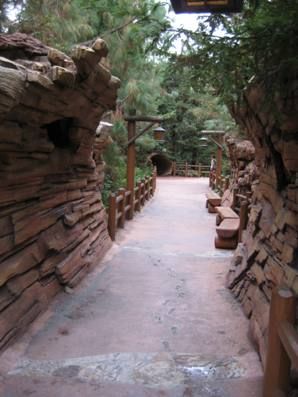
California Adventure, the theme park built atop the old parking lot of Disneyland, features a playground of its own, Redwood Creek Challenge Trail, in the Grizzly Peak 'land.' RCCT, located directly across from the Grizzly River Run flume ride, takes its inspiration not from fiction but from the real Sierra Nevada. Its winding pathways are filled with animal tracks, and lead guests through the stump of a giant sequoia and forested groves. Fallen trunks of the big trees take the place of caves in RCCT, and the suspension and pontoon bridges are replaced by thick rope cargo nets stretched between a smokejumpers' training tower and a combination ranger station and forest fire lookout, complete with a working Osborne Fire Finder.

There's a rock wall with a pair of traverses - climbing the rocks of Tom Sawyer Island is actually prohibited, as I was informed by a polite white-hatted Disneyland security guard years ago - and a twisting slide set in a jumble of boulders - a 'rock slide,' of course. Two more slides are set inside giant logs. There's a tiny stream which can be crossed by hopping on rocks made of playground rubber-mulch or a short bridge which is subject to sudden inundation. Carved statues of figures from California aborigine stories line a segment of trail, and a small cave allows a guest to learn which animal spirit they most resemble. The one attraction sure to have a line on every visit is the combination tire swing and zip line in the smokejumpers' tower.
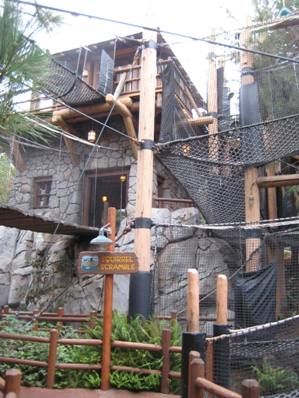
On this particular visit, the Cabin Girl and the Cabin Boy spent more than an hour roaming Redwood Creek, figuring out which tracks were left by which animal, climbing up and down the rope ramps and bridges, riding the zip lines, scaling the rock walls, racing each other down the log slides, sighting along the fire finder. With an occasional prompt from me, they would try to figure out from its tracks if an animal was running or walking, and in which direction it was travelling, or identify which animal spirits at the cave were also found among the carvings along the trail, and what legends were associated with each.

Tom Sawyer Island and Redwood Creek Challenge Trail are two of my favorite attractions at the Disneyland Resort - in fact, if I had to make a list, they would certainly be in the top four, and depending on my mood when I made the list, they might even be in the top two spots. The Disney theme parks are perhaps best known for their rides, for the way they create an amazing sensory environment and tell a story, whether it's the recounting of a famous tale or something wholly original. But what I love about the island and the trail is that while the same attention to detail is provided in creating the environment, the story - the adventure - is left to the guests to create.

I'll bet you already know where I'm going with this.

Gamers use the term sandbox to describe 'open worlds' in which characters are free to explore. One of the problems with 'sandbox' as a term of art, in my experience, is that it can leave the impression of a featureless plain - lone and level sands stretching far away. This impression is sometimes invoked by gamers who dislike such game-worlds and the associated playstyle, for one reason or another.

But most 'sandbox' game-worlds are more like playgrounds than true sandboxes, and in my experience, the best examples of these game-worlds rise to the level of playgrounds-by-Disney. These playgrounds are not random collections of furnishings. Rather, they are filled with places and people and institutions of interest, which are meant to attract the players and their characters to interact with them without determining when or how those interactions may unfold. They have themes or motifs which add depth - there are patterns to recognize and apply.

On various forums over the years, one of the recurring critiques of sandbox game-worlds offered is that some players, when confronted with too much freedom of choice, have a deer-in-the-headlights moment; in fact, I've come across it enough times that about a month ago, I started a thread at Big Purple asking gamers to help me understand what induces 'sandbox paralysis.' The answers from those posters who actually experience this were enlightening - those who took the thread as a chance to bash sanbox play, far less so.

For awhile now I held the ideas that putting genre-tropes front and center and offering a familiar setting may help with making sandbox - playground - play more readily accessible to gamers who might otherwise be turned off by the prospect. Tom Sawyer Island and Redwood Creek do both in their 'call to adventure.' Reading the responses to the 'sandbox paralysis' thread, I think that addresses some gamers' issues with the playstyle, but by no means all; some players are truly only happy if they feel they can reliably expect certain experiences from playing the game, experiences which require the referee's active participation in developing, experiences which a sandbox game-world is, in their estimation, unlikely to provide.

And that's okay, of course. Playgrounds aren't for everyone. I feel the same way about more linear, more story-oriented gaming; while I understand its appeal, it's not for me. Horses for courses.

But I do think it would helpful for gamers discussing sandbox game-worlds and playstyle to remember that they are much more than boxes of sand for digging holes and making castles. They are playgrounds as well, and in the really clever ones, the jungle gyms and slides and ladders are disguised as a pirate's lair or a Sierra Nevada forest.

Wednesday, February 27, 2013

Wednesday Wyeth


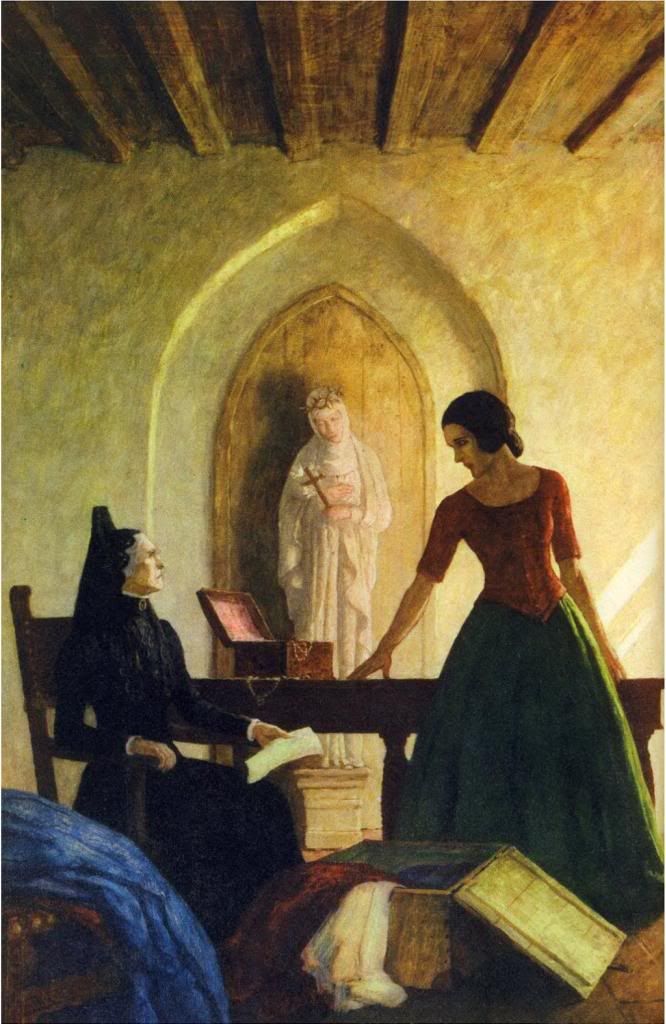
As with the Zorro stories, I have a real weakness for Ramona, because it's a tale of home - same with Island of the Blue Dolphins, which my daughter will be reading in school next year, just as I did. I'm looking forward to taking my kids to the Ramona Pageant when they get a little older.

Tuesday, February 26, 2013

DVR Alert

On Wednesday, 27 February, TCM plays the The Thief of Bagdad, starring Sabu as Abu, the eponymous thief. One of my favorite Arabian Nights movies.

Check your local listings for times.

Letters to Isabel, Redux

The title of the post says it all: courtly intrigue.

I'm often left at more than a little bit of a loss when referees complain that all their players want to do is hack-and-slash. I mean, I get it, but it also leaves me a little sad, because this right here is a very big part of what makes roleplaying games fun for me. Manipulating friends and outwitting and outmanoeuvering enemies is something I fall into naturally at the game table, which is why it was no surprise to be at all to find out my Bartle test profile was Socializer.

It's also why one of my favorite skills in a roleplaying game is Bribery.

I know this is one of the reasons the cape-and-sword genre appeals to me so much for gaming. My predilection to turn everything I run into a spy caper and my passion for the endgame are both perfectly at home in swashbucklers.

Monday, February 25, 2013

Graphic Novels Challenge: Belladone


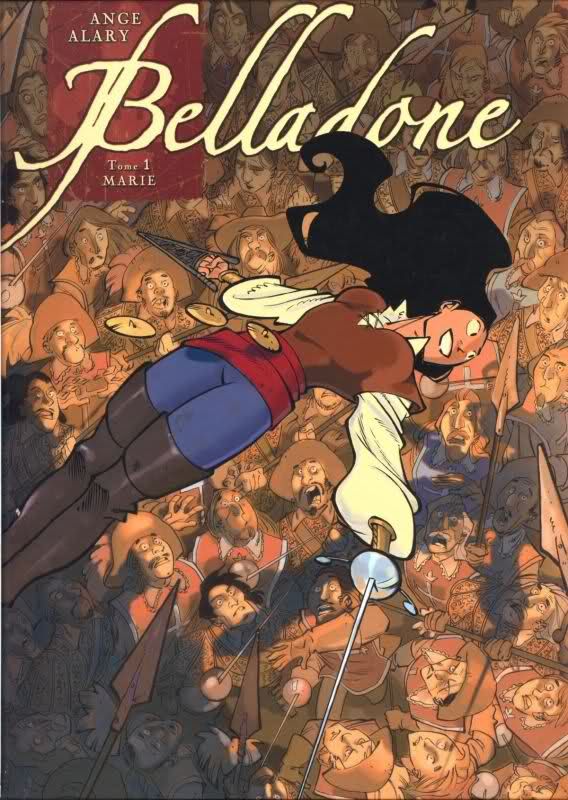
An assassin takes a shot at Louis XIV, but the ball is deflected by the iron fan of a nearby nun, who with a winsome smile leaps over the shoulders of a King's Musketeers to gain the balcony from which the assassin flees.

So opens Belladone, the creation of former Disney animator and comic artist Pierre Alary. Set in 1680 France, the story features a secret cabal of protectors of the Sun King, an Italian assassin, the Cour des Miracles, black maket 'Merchants of Death' dealing in poisons and other nastiness, and flirting between Marie, the disguised nun who is a member of the cabal, and Maxime, the captain of the King's Musketeers, who's been promised Marie's bed if he can defeat her in combat.

Ah, l'amour.

The story is simple, following the attempts of the Italian - no name is given, nor needed - on the life of Louis XIV, ostensibly for an affront to the Pope, and the efforts of Marie and Maxime - and Maxime's mother, who runs the secret cabal of guards of which Marie is a member - to protect the king. The action is beautifully illustrated, the story fast-paced and exciting, the characters engaging.

One of the amazing and wonderful aspects of the comic medium is that the stories transcend language. Belladone is written in French, but when I showed a few pages to my daughter and asked her to describe what was happening, the Cabin Girl could follow the action without recourse to the words. When she's a few years older, I look forward to sitting down with her and sharing the whole book together. Marie is a great example of a woman swashbuckler, as capable as the men without sacrificing her womanhood, and without being rendered as fanservice.

There are two more volumes of the Belladone saga, but because they are hardcover imports, they tend to be rather pricey, so I haven't - yet - picked up the sequels.

Sunday, February 24, 2013

The Pen and the Sword: The Sea-Hawk

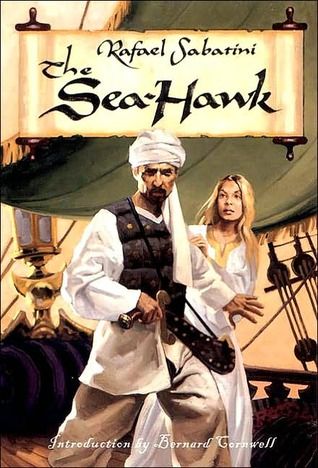
They were returning home from a trip to Genoa when one evening as they were standing off Minorca in the Balearic Isles they were surprised by a fleet of four Muslim galleys which came skimming round a promontory to surround and engage them.

Aboard the Spanish vessel there broke a terrible cry of "Asad-ed-Din" — the name of the most redoubtable Muslim corsair since the Italian renegade Ochiali — the Ali Pasha who had been killed at Lepanto. Trumpets blared and drums beat on the poop, and the Spaniards in morion and corselet, armed with calivers and pikes, stood to defend their lives and liberty. The gunners sprang to the culverins. But fire had to be kindled and linstocks ignited, and in the confusion much time was lost — so much that not a single cannon shot was fired before the grappling irons of the first galley clanked upon and gripped the Spaniard's bulwarks. The shock of the impact was terrific. The armoured prow of the Muslim galley — Asad-ed-Din's own — smote the Spaniard a slanting blow amidships that smashed fifteen of the oars as if they had been so many withered twigs.

There was a shriek from the slaves, followed by such piteous groans as the damned in hell may emit. Fully two score of them had been struck by the shafts of their oars as these were hurled back against them. Some had been killed outright, others lay limp and crushed, some with broken backs, others with shattered limbs and ribs.

Sir Oliver would assuredly have been of these but for the warning, advice, and example of Yusuf, who was well versed in galley-fighting and who foresaw clearly what must happen. He thrust the oar upward and forward as far as it would go, compelling the others at his bench to accompany his movement. Then he slipped down upon his knees, released his hold of the timber, and crouched down until his shoulders were on a level with the bench. He had shouted to Sir Oliver to follow his example, and Sir Oliver without even knowing what the manoeuvre should portend, but gathering its importance from the other's urgency of tone, promptly obeyed. The oar was struck an instant later and ere it snapped off it was flung back, braining one of the slaves at the bench and mortally injuring the others, but passing clean over the heads of Sir Oliver and Yusuf. A moment later the bodies of the oarsmen of the bench immediately in front were flung back atop of them with yells and curses.

When Sir Oliver staggered to his feet he found the battle joined. The Spaniards had fired a volley from their calivers and a dense cloud of smoke hung above the bulwarks; through this surged now the corsairs, led by a tall, lean, elderly man with a flowing white beard and a swarthy eagle face. A crescent of emeralds flashed from his snowy turban; above it rose the peak of a steel cap, and his body was cased in chain mail. He swung a great scimitar, before which Spaniards went down like wheat to the reaper's sickle. He fought like ten men, and to support him poured a never-ending stream of Muslimeen to the cry of "Din! Din! Allah, Y'Allah!" Back and yet back went the Spaniards before that irresistible onslaught.

Sir Oliver found Yusuf struggling in vain to rid himself of his chain, and went to his assistance. He stooped, seized it in both hands, set his feet against the bench, exerted all his strength, and tore the staple from the wood. Yusuf was free, save, of course, that a length of heavy chain was dangling from his steel anklet. In his turn he did the like service by Sir Oliver, though not quite as speedily, for strong man though he was, either his strength was not equal to the Cornishman's or else the latter's staple had been driven into sounder timber. In the end, however, it yielded, and Sir Oliver too was free. Then he set the foot that was hampered by the chain upon the bench, and with the staple that still hung from the end of it he prised open the link that attached it to his anklet.

That done he took his revenge. Crying "Din!" as loudly as any of the Muslimeen boarders, he flung himself upon the rear of the Spaniards brandishing his chain. In his hands it became a terrific weapon. He used it as a scourge, lashing it to right and left of him, splitting here a head and crushing there a face, until he had hacked a way clean through the Spanish press, which bewildered by this sudden rear attack made but little attempt to retaliate upon the escaped galley-slave. After him, whirling the remaining ten feet of the broken oar, came Yusuf.

Sir Oliver confessed afterwards to knowing very little of what happened in those moments. He came to a full possession of his senses to find the fight at an end, a cloud of turbaned corsairs standing guard over a huddle of Spaniards, others breaking open the cabin and dragging thence the chests that it contained, others again armed with chisels and mallets passing along the benches liberating the surviving slaves, of whom the great majority were children of Islam.

- The Sea-Hawk, Raphael Sabatini

Wednesday, February 20, 2013

Wednesday Wyeth


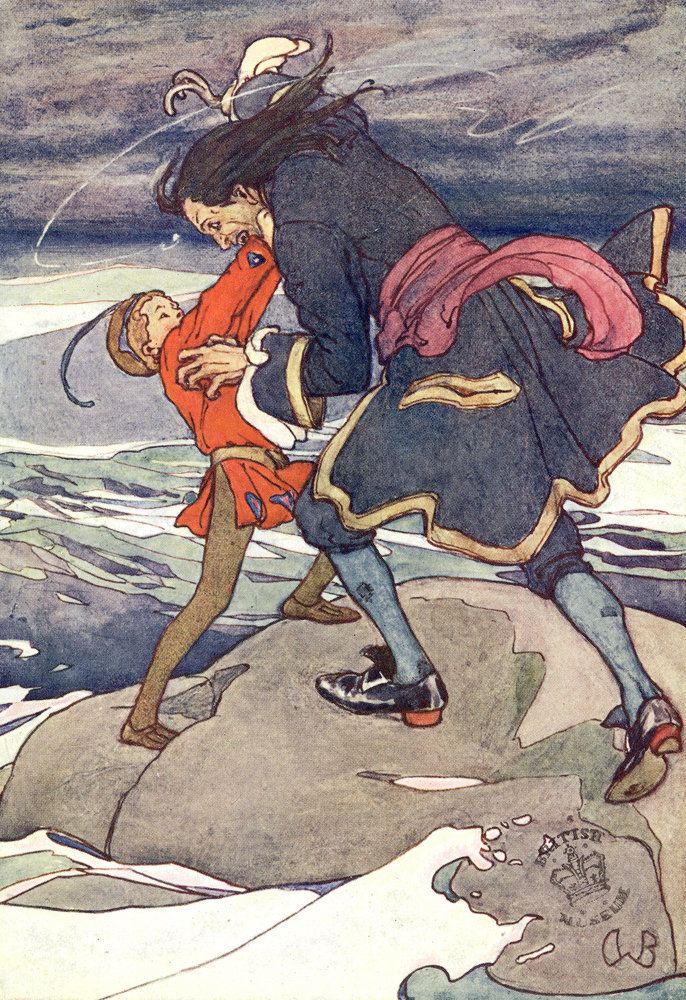
Pinch hitting for N.C. Wyeth this week is English illustrator Alice B. Woodward's Peter Pan and Captain Hook.

Note Hook's hook, or more properly, hooks.